Blog

  • Why Korean ESL Students Ask “Why?”

    Many new Korean ESL instructors are sure to notice that their students have a peculiar way of asking the question “why?’ They will notice, for example, that from the mouths of a Korean ESL student, the question “why” has the kind of emphasized lilt which illustrates, without a doubt, that the student clearly understands how a question mark influences the inflection of a word. Instructors may also notice that their students will add an extra syllable to the word, thus “why” ends up sounding something like “why-ee?”

    I’m no linguist, but I believe that at least part of the reason students exaggerate the long “e” in “why” has a little something to do with the fact that the English word for why sounds somewhat similar to the Hangul word of the same meaning, which sounds something like “whea.”

    Now consider for a moment that Korean ESL students are expected to speak English exclusively during class time and, further, that the penalty for speaking Hangul during class includes anything from a lower participation grade (and Korean students DO take their participation grade seriously) to a two-minute speech on a subject of the teacher’s choosing – in English. It logically follows then that students want to make sure there is no confusion over which language they are speaking, thus the emphasis on the difference in vowel sounds.

    This does not necessarily explain, however, why they drag out the long “e” when their teachers announce it is time to take the weekly review test or in-class quiz. In those instances they are clearly just trying to annoy their teachers.

    New instructors are also sure to  notice that Korean students use the question “why” as a kind of catch all for all “wh” questions. For example, say Yoojin’s friend comes by her classroom during break to talk to her and calls her name from the doorway to get her attention. While  most American kids would answer “what?” a Korean kid will respond “why-ee?” Students respond similarly when called on by a teacher to answer a question or read aloud.

    Important for new instructors to remember is that since “why” is not always used literally, it is wise to take a moment to consider the context in which the student is using it. Honestly, the sooner this technique can be mastered the sooner instructors can minimize the amount of class time taken up by asking students, in a puzzled tone, “what do you mean, why?”

    Again, I am no professional and can only base my theories on classroom observations, which probably hold about as much water as a mother’s intuition over, say, the educated diagnosis of a trained pediatrician. Still, I believe that English teachers themselves encourage the improper usage of the word “why.”

    Instructors are encouraged to use the Socratic Method to guide students through essays; that is, they ask leading questions that encourage students to find the answers for themselves and respond verbally, which arguably encourages participation. While I always figured that the Socratic Method was meant to encourage students to think more deeply about philosophical questions and not merely for skimming passages, it does have some practical application. Unfortunately, and this is especially true when working with reticent youth, it becomes very necessary to ask absurdly pointed questions to get the students to respond appropriately. As a result, the Socratic Method comes off sounding a little something like this:

    “OK Jimmy, according to paragraph two, line three,  aerobic exercise is beneficial becauuuussse….why?

    Obviously, the proper way to ask questions like this is to front-load it with whatever “wh” question is appropriate. But, since most instructors have little to no experience with or training in pedagogy, much less child development, and are merely trying to do their job, which is to get Jimmy to say the right thing,  the application of the Socratic Method becomes a kind of  fill-in-the-blank word game.

    Finally, ESL instructors contribute to the “why” phenomenon when trying to induce topical conversation in the classroom. For example, while trying to break up the monotony of the repetitive main-idea-and-supporting-detail-outlines teachers must illustrate on the board throughout class, they may stop periodically to ask simple content questions, usually something along the lines of:

    “So, do you think deforestation is good or bad?”

    Regardless of a student’s response, however blatant that response may be, instructors, in an attempt to encourage discussion (for which there is not time) will reply with the now infamous question “why?” i.e. why do you think deforestation is bad? This is generally followed by a thirty second discussion of little to no consequence before the teacher must move on to stay on schedule, no one being the wiser.

    New instructors will also discover, and this is the best part, that teaching is as much about being influenced by students as it is about influencing them. I mean, I could obnoxiously insist that my fellow instructors amend their teaching ways and preach the proper pathways to good grammar (as if I knew), probably causing new instructors all kinds of unnecessary paranoia in the process. Instead, I rather encourage teachers to view the “why” phenomenon the same way I have come to view all Konglish; as a kind of in-between language that captures something that neither language can capture without the other. So, if you are, or will soon become, a new ESL instructor in Korea, I say let yourself be influenced by your students and, most of all, let yourself be influenced by Konglish. Learn to respond to a moment of confusion or the call of a friend the same way students do and the same way I and my fellow instructors have learned to do as well. Learn to just ask “why-ee?”

  • “The Lisa Song:” A Gift from my Chung Dahm Students (South Korea)

    One of my favorite students ran into my classroom this afternoon before

    Front Cover

    classes started and gave me a piece of chocolate cake from Paris Baguette and a big handmade construction paper card. I’m not sure for what occasion – late birthday or early going away gift? Perhaps just an assignment from one of her summer intensive classes? Anyway, I couldn’t wait to share it and have copied the contents of the  card here (verbatim):

    Lisa

    Wacky night Lisaish night

    When all the kids tango to the moon

    Presidents appear and waltz with you

    A bear appear and tap dance with Lisa

    Every thing is so wacky, you can dance

    to the son.

    Crazy night Lisaish night

    when all the birds fly out to space

    A pig sings “sing” and dance with you.

    A spider back flips and turn cart wheels

    Every thing is so Lizaish, You can eat

    pigs head.

    It was a super special thing to get since I have been feeling a little blue these last couple of days. It’s nice to think “kids tango to the moon” on my night, though I don’t know about eating pigs head.

    `

  • Last Weeks of My Last Term at ChungDahm

    Summer in Korea
    Summer in Korea

    It hardly seems possible that it’s already the first week in August, though the weather outside certainly confirms the fact. I’ve never lived anywhere so humid and hot in my life. Even in the Midwest, the humidity never really goes above, say 70 percent, and even then, not for very long. Here, the humidity ranges between 75 and 100 percent every day while the temperatures are routinely in the 90s (Fahrenheit). It’ always about to rain, raining or just finished raining too, so things are always dripping wet. Rather than comparing the atmosphere to a sauna, a more apt analogy is a tropical rain forest. Often the moisture is so dense you can actually see it in the air, almost cut through it with your hand. It reminds me of the many misty photos of Asia I’ve seen in my life, though I can tell you walking through these landscapes is not nearly as romantic as they are to look at.

    Things are changing rapidly at my branch. Both of our branch’s Faculty Managers have moved up to HQ and about half of the faculty are leaving. This is mostly due to the fact that, like Gary and I, most instructors’ one-year contracts are coming to an end. This was the last week for at least four “veteran” instructors and there are four new instructors haunting the halls, sitting in on classes and trying to learn the ropes. They don’t know just how lucky they are to get a week to observe and adjust, for certainly not all new instructors get that privilege. They have been asking questions about why so many people are leaving. We give them the standard explanation that contracts are expiring and people usually choose to leave at term’s end. It’s too difficult to explain fully why most instructors don’t renew. There are just too many nuances that a new instructor could not possible understand, and no one wants to terrify a new person. It’s better they see for themselves what it’s like to work for ChungDahm. Besides, it’s a different experience for everyone.

    Most of my students are all doing pretty well, though they are a little more excitable than usual because they are on school break (yes, they still come to academy during school break).  I have built great rapport with many of my students and feel like I have become rather masterful at managing a classroom of elementary or middle school students. I have even made progress with one of my most difficult students, who I have had in my Wednesday 4:00 pm class for three terms in a row now.  On most days, he follows my instruction and does as I say with little resistance. Just the other day, for example, instead of choosing to act out in anger by kicking his desk, as is his habit, he simply stated that he felt angry. I was a little stunned that he chose to articulate his feelings rather than acting on them without thought. I also feel like my rapport with him had a little something to do with his choice. All in all, I view this change as progress.

    Another one of my students recently won a prize for best webzine. Since I am his teacher, and he made the webzine for my class, I get a little recognition too. A staff member came around to my class and snapped a picture of me with the student, though I have no idea how the photo will be used. (Probably some promotional marketing pamphlet somewhere).

    Right now I am in the middle of a bit of a time crunch. It’s enough to keep me on my toes and make me a little resentful that I don’t have more time to write this week, especially since taking on an extra class, but I also know it won’t last long and I have lots of great poems in the works.

    Only three more weeks of gainful employment before Gary and I head south to Busan for a well deserved, and real, vacation by the sea, followed by an adventurous visit to Tokyo, Japan.  We’ll be back in the states by September 20th.

  • Leaving South Korea:Last Weeks At Chung Dahm

    Seven is the number of the month in which I was born, and the number of the month in which we find ourselves in now, this 2010th year AD. But the significance of this number today has to do with the number of weeks left in my contract with Chung Dahm; the number of weeks in which I still have gainful employment.

    It means only seven more weeks of Closed Circuit Television and working 4:00 to 10:00 PM with only one or two five-minute breaks and never sitting more than a couple of minutes at at time. Only seven more weeks of lesson planning and grading online essays with their strange and arbitrary set of parameters, e.g. you must make exactly seven comments, each comment must contain 250-350 characters,  include the student’s name, an example and make reference to the in-class lesson.

    It also means only seven more weeks to spend time with some pretty amazing students who bring me a great deal of joy and laughter and who have exponentially increased my enjoyment of Korea and the quality of my life’s experiences. Only seven more weeks to interact with these kids and appreciate their unique perspective of the English language and American culture. Only seven more weeks to spend time with awesome co-workers turned friends and fellow writers whose insight and experience will no doubt continue to inspire me long into the future, wherever we may find ourselves.

    As in past experiences, as I prepare to move from one geographical area and way of life to another, my experience of and interactions with the objects and inhabitants of this world are more vivid than in months previous. The lines that frame objects and people are sharper, their colors, if not always brighter or identifiable, more noticeable. Even the moisture that sticks to my skin as I move through the humid Korean air is weightier.

    I began my countdown the first week I started working for CDI, when I was culture shocked and slightly traumatized by a week-long training session that was quite different from my expectations, despite my efforts to suspend those expectations. I kept counting down through the first awkward, stressful weeks of my first term teaching children who I could barely understand and who arguably didn’t understand me – wondering all the while how anything could be taught or learned in an environment in which the language barrier was so pronounced. And when homesickness pierced my liver and shot through my heart after every American holiday, I counted even more carefully the weeks left in my contract.

    Now the acute awareness over every awkward mistake of my early weeks in Korea has begun to give way to acute awareness of momentary perfections, often manifesting in the beautiful faces of my students. My relief over surviving another day now daily metamorphoses into confidence that comes from  perseverance.  I am not longer timid to tell a student he or she is not doing well nor do I refrain from taking their cell phones. I no longer fret over Korean people staring at me on the subway, or the lack of friendly acknowledgments from fellow foreigners on the street. Today, I move through the streets with confidence and teach like an expert. Today, I know these days, at least for me, are coming to an end.

  • Gary and Lisa’s Travel and Photo Journal for Jeju Island, March 2010

    Jeju Island is located south of the Korean peninsula about an hour’s flight away from Seoul’s Gimpo Airport. Gary and I spent four days visiting the island during our vacation from Chungdahm the last week of March, 2010, and even though it was too cool for the beach, we found plenty of fun things to do around the resort area, all of it within walking distance of our hotel.

    We stayed at the Jeju Hana Hotel (hana is Hangul for one) located in the Seogwipo-si resort area among a cluster of hotels, golf clubs, and tourist attractions. Our hotel was reasonably priced and had a bath tub, a luxury since most officetels do not have tubs, only showers.

    Though the Hana Hotel has a nice restaurant, we were visiting during the off season and the restaurant closed in the evenings. This fact prompted us to explore the area for other dining options. We included in our search all nearby hotels and found Hyatt’s accommodations to be among our best. Of course, being open might have had something to do with that.

    The Jeju Hyat is located down the road from the Hana Hotel and has a stunning view overlooking the ocean. Around its grounds are a number of scenic pathways built for strolling and enjoying the local plant life. Visitors can take advantage of these pathways as alternate routes to different parts of the resort compound.

    The lobby of Jeju Hyatt also features and indoor koi and goldfish pond with a half-dozen small ducks waddling about. I’m not sure what kept those ducks from flying beyond the perimeter of the indoor pond (their wings did not appear to have been clipped), but they never did. Perhaps they intuited they would get cooked if they didn’t mind their territory.

    Many of the other nearby restaurants were also closed for the season, but that didn’t stop us from walking around and snapping a few pictures. Many restaurants on the island offer horse meat and, of course, all types of seafood. Here are a few exterior shots of one traditional-style restaurant near our hotel.

    Up the road in the opposite direction of the Hyatt are a number of tourist attractions. We visited the “Sound Island Museum,” which includes in its collection a number of  phonographs (circa Edison vintage), musical instruments from different regions of the world and a couple of rooms filled porcelain nick-knacks and dolls arranged in a kind of diorama. We never figured out exactly why these scenes were on display or their relation to sound and music but speculated that perhaps they are some kind of personal collection belonging to the museum the owners who have no better place to store or exhibit these things. Korean people are, after all, very efficient with space.

    Photo courtesy of the Official Site of Korea Tourism

    Later, we ambled over to Jeju-do Chocolate Factory, famous for being the only chocolate factory in Asia in the 10 top chocolate factories of the world list. It feature an impressive art gallery consisting of a number of miniatures and “paintings” rendered in chocolate.  It also features a ‘Bean to Bar’ showroom, which shows the entire process of chocolate beans’ transformation into chocolate. Finally, there is a showroom and gift shop where visitors can purchase Jeju Island chocolate. Since the area is also famous for it’s huge, delicious oranges (which adorn trees all across the island this time of year) visitors can also purchase orange flavored chocolate.

    Jeju Botanical Gardens: Greenhouse
    Jeju Botanical Gardens: Greenhouse

    Not far from the Sound Museum and Chocolate Museum is the Jeju Teddy Bear Museum. Korean people have the corner market on cute, and so it’s not terribly surprising that there exists a museum celebrating cuteness as encapsulated by the iconic teddy bear.

    The Seogwipo-si area boasts a spectacular botanical garden and is perhaps the best attraction in the area. The indoor compound contains a number of greenhouse gardens that including a simulated desert, water gardens, and a tropical plant and exotic fruit bearing tree greenhouse.

    Cacti and Succulents

    Kimchi Pots
    Kimchi Pots
    Banana Tree
    Banana Tree
    Inside the top
    Inside the top
    View from the Top
    View from the Top
    European Gardens
    European Gardens
    Italian Gardens
    Italian Gardens
    Japanese Gardens
    Japanese Gardens
    Korean Traditional Garden
    Korean Traditional Garden

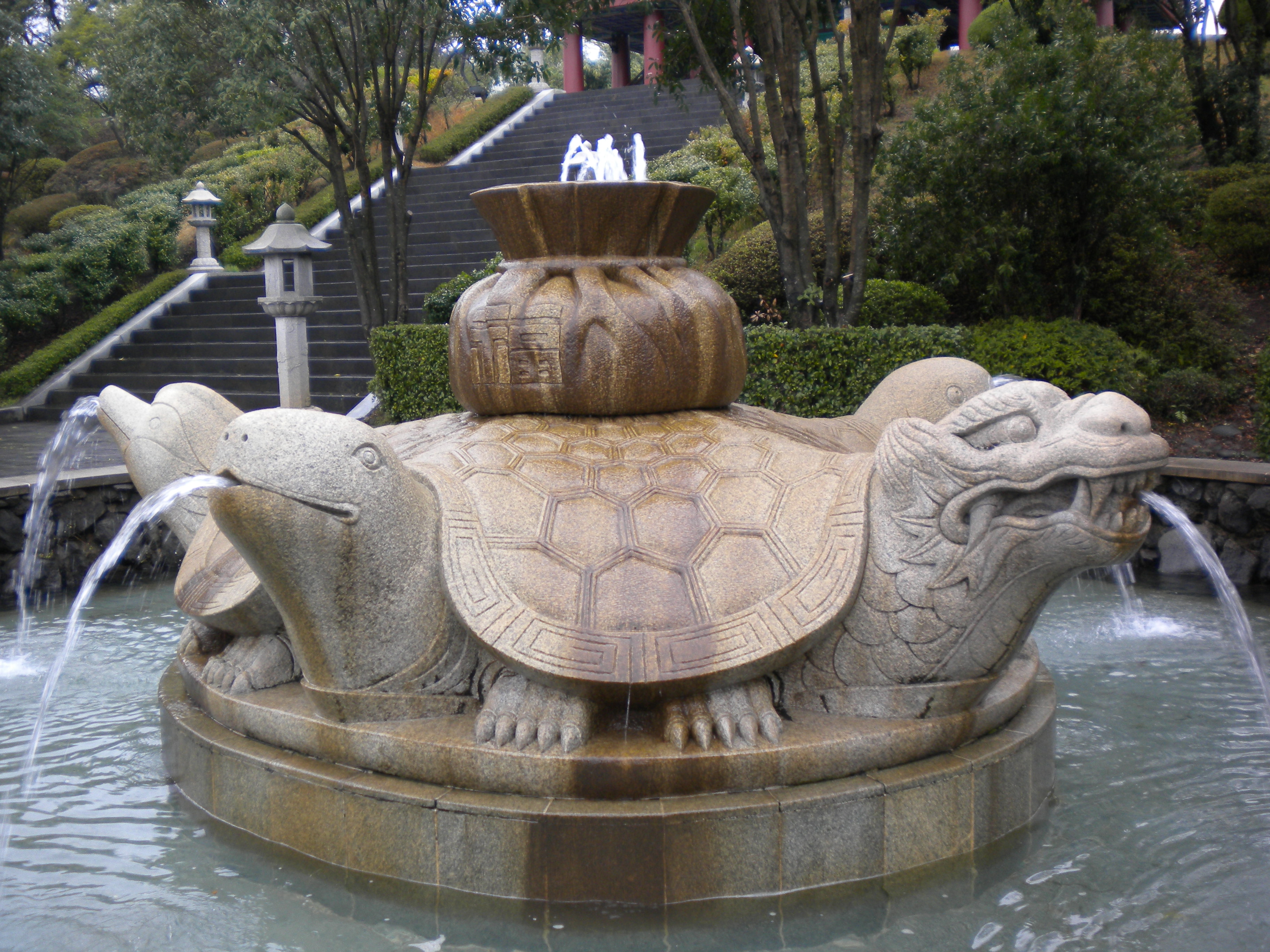
    Not far from the Jeju Botanical gardens is a beautiful traditional style bridge with a view of a nearby waterfall.  There is also a lovely  Pagoda and fountain nearby, as pictured here.

    Good Luck Fountain
    Good Luck Fountain
    Pagoda Palace
    Pagoda Palace
    View of Falls from Pagoda
    View of Falls from Pagoda
    The Bridge
    The Bridge
    The Falls
    The Falls
    View of Falls Through Decorative Cutout in Bridge
    View of Falls Through Decorative Cutout in Bridge

    Perhaps the best part of our vacation was hanging out with Korean tourists. We are used to living and working among Korean people and Korean children and in general doing all the normal daily stuff right along side them.  Our days are made up of the uninspiring stuff that make up daily living, like taking out the trash, getting groceries, taking public transportation and paying bills at the ATM. But we got another glimpse of Korean people while on vacation – Korean people as tourists- and they are a blast. Especially the older folks, who are definitely out to have a good time (the odor of soju on their breath confirms that fact). We were approached several times by folks wanting us to take pictures of their groups. They always offered to take our picture as a return favor. Sometimes people would come up and start a conversation, never mind that we can’t speak the language. They kept talking and explaining things to us even when we gestured  our incomprehension. Really, there may be nothing more endearing in this world to me now than a tour group of vacationing older Korean women dressed in matching pink out to have a good.

    I spied one fellow in particular who was dressed elaborately, especially by Korean standards, hanging around the area offering to take pictures for tourists. Koreans are  quiet homogeneous and rather prefer things that way. I mean, they dress alike on purpose and stick together. However, this man was clearly an individual, and I tried several times to take his picture on the sly. None of them came out very well though. I’d given up when he came over and offered to take a photo of Gary and I – it’s the one at the heading of this blog post (it was his suggestion that we put our hands up in the air). After taking our picture, he voluntarily posed for a picture with Gary so even though my previous efforts at capturing his digital likeness was a failure, in the end I was granted the perfect opportunity. Here’s the pic:It’s Gary’s favorite pic of the batch.

  • The Earthquake Affair: Another Abecedarian Story by Chung Dahm Students (South Korea)

    Here is a story my Comp. 100 class and I composed using the exquisite corpse writing prompt our last night of class. Starting with the letter “A,” each new sentence must begin with the next letter in the alphabet. There must also be an attempt at cohesion in the story. All together, we composed four stories. This was voted as best. (Remember, these are middle school aged ESL students.) I’ve copied it verbatim here:

    Again and again the children asked their mother to push them on the swings. But their mother, her belly holding yet another child, shook her head, her face white. Children started to find out where their father had gone. Dad was in restaurant with his secret girlfriend. Every other day, he met this secret girlfriend for lunch at this favorite restaurant.

    Father!” the children cried in unison when they saw him – one with a shocked face. Girlfriend also stared at the children and asked father “Is they are your kids? Why are they calling you father?”

    Ha ha ha,” they are not my kids, they are kids who live in my town.”

    I am your son! I am your first son,” the boy cried, his tears streaking his cheeks and rushed home.

    John, the first son, went home and surprised by strange man sit closely with mom.

    Kelly, I really think you should tell your husband we’re dating. I mean, look at OUR baby!”

    Listen to me, we can’t let anyone know about our love-child NOW!” Mom whispered and John the son hide behind the sofa, was so shocked that he cried

    NO, it can’t be – Mom and dad BOTH can’t both be having an affair! “Oh my god, what did you mean that both me an your father having affair?” Mom shouted.

    “Please tell me it isn’t so!” she wailed. “Quickly, hide Luke!” she said to her boyfriend when she saw her husband coming.

    Really, I can’t believe this situation! I heard all things! How can you have affair” said father.

    Suddenly the ground began to shake and rumble.

    To be continued…

    ——-

    We ran out of time before we ran out of alphabet. But we didn’t run out of fun!

  • Writing a Poem a Day

    Every April I celebrate National Poetry Month by reading lots of poetry, convincing other people to read lots of poetry and trying to get everyone to write a little poetry. I also follow the “Poem a Day” challenge, and this year, for the first time,  completed the challenge by writing thirty-five poems in thirty days.

    One trick to writing a poem a day, or writing anything on a daily basis for that matter, is to allow yourself to do it poorly. Because, integral to the creative process is failure and foolishness, hopefully of the playful kinds, and just generally coming to terms with the awkwardness of making something from nothing. It’s all “elbows and knees,” or in the case of writing, passive voice and too many adjectives. Anything worth doing is worth doing poorly, I also say, otherwise, expectations of perfection will interfere with the act of creation, a process that in and of itself is already perfect.

    With that said, let me admit that the poems I’ve drafted this month are all pretty crappy. They are unfinished, awkward, contain trite beginnings and contrived endings, tired images and many clichés.  But maybe, just maybe, there is a line or a poem’s worth of lines that will evolve into something publishable.

    For me, generating poetry to use for raw material is all about the “quantity = quality” equation, one that is still sneered at by many. Maybe for writers like Tolstoy, writing the perfect sentence or paragraph before moving on to the next is the best process, but I for one need the actual act of writing to get where I am writing too, and there is a lot of support for this belief. “Writing begets writing” my Graduate Fiction Writing instructor, Susan Rodgers, used to say. It takes a million words before you can publish, or earn, your fist novel, according to Randy Ingermanson. Obviously, for Chris Baty of the NaNoWriMo phenom, it’s about writing 50,000 words in thirty days for one month out of the year. Finally, according to a wiser author than I (whose name escapes me at the moment), you have to write through a lot of crap to get to the good stuff.

    But letting yourself write poorly is also about facing the blank page every day and consistently conquering it, “consistently” being the operative word there. That is, writing needs the same consideration as such daily self-care pursuits as eating, showering, and exercising (or meditating). In my life, writing must receive the same priority as a second job, especially necessary though doubly difficult since I am already employed full-time. As a second job, writing is difficult because its rewards are often delayed and are rarely monetary, its process often tedious, and its available time often gobbled up by greedy employers, needy people or insistent errands. But still I write, and still I fail to write, and still I fail when I write.  But the bottom line is, I write.

    But let me return to the topic of writing a poem a day in April and say that the best part of this year’s challenge is that after essentially forcing myself to write a poem every day is that it became easier to start. Similar to keeping a well primed, everything I saw or experienced had potential for a poem. And best of all was experiencing something akin to a runner’s high; moment when I felt like I could go on writing forever.


  • Children’s Day in South Korea (Auli Nal)

    Today is Children’s Day in S. Korea, a national holiday, and judging by the two-million people in Pyeongchon Central park today, a big holiday for families. (The number quoted in the previous sentence is an exaggeration – there is no way that many people would fit in PC Central Park. It’s simply meant to connote my surprise over the quantity of people in the park today. Hundreds of people would be a more accurate estimation.) A great number of these people were children.

    There where children in strollers, children on bicycles, children on roller blades, and children on skateboards. I guess you could say there were many children on wheels.

    Children not on wheels were involved with familial activities such as flying kites, catching balls or playing chase; this despite the limited number of square footage (meter-age) available per individual. Still more families could be seen sitting on blankets on the grass eating picnic lunches or just relaxing with their shoes off. One family appeared to have ordered their picnic food from a restaurant as I saw a man on a scooter delivering them their food. I can just imagine the directions they must have given over the cell phone when ordering: “Ah, yes, we will be the Korean family of  four on the green blanket in front of the blue tent right next to the croquet court.” Made me wish I could speak better Korean.

    I can’t imagine Americans celebrating children quite to this degree. In terms of scale and participation, today’s holiday  is more akin to the American Labor Day. Schools are closed for the week, parents take off from work and most acadamies and hagwons are closed, except of course, ChungDahm.

    Though many students did not attend class this evening, the ever vigilant instructors of ChungDahm English and Critical Thinking were on the front lines ready to deliver a little edu-tainment to any child who appeared. I took the stance that providing education for chlidren on Children’s Day is the ultimate in celebrating children. The students didn’t really buy it though.

    Fortunately, Kim ChungDahm, the fictional entity that makes all upopular rules and decisions at ChungDahm, allowed teachers to pass out candy suckers – a rare treat since we are normally strictly forbidden from giving students food. The irony of this gesture was not lost on the students. Nonthelsess, we were a little less hated as a result.

  • Photo Journal: Building 63, Seoul S. Korea

    Yook-Sam Buidling 63
    Yook-Sam Buidling 63

    In March, 2010, my friend Cereba and I spent a day at Building 63, also known as the Yook Sam building. It would be our last “girls day out” before her return home to the states. While it was windy, cool, and as you can tell from the photo, cloudy, we found plenty of fun things to do inside.

    Building 63 is a landmark skyscraper in the Seoul area built in 1988 for the Olympics and has, as you may have guessed, 63 stories. These 63 stories distinguished Yook-Sam as the tallest building in Seoul until 2003, when the Hyperion Tower was built. Then, in 2009, the Northeast Asian Trade Tower was “topped-off” and is currently considered the tallest building in Seoul.

    Building 63 features “The World’s Tallest Art Gallery” on its 60th floor, an aquarium, wax museum, Imax theater, and myriad shopping opportunities. On a clear day, you can see this golden tower from as far away as Incheon (though, there aren’t many clear days in Seoul).  According to wikipedia, “The 63 Building is an iconic landmark of the Miracle on the Han River, symbolizing the nation’s rapid economic achievement in the late 20th century. 63 refers to the building’s 63 official stories, of which 60 are above ground level and 3 are basement floors.

    After grabbing a bite to eat at one of the restaurants in the building’s food court, Cereba and I bought a “three-attraction pass” and headed for the aquarium. Being that is was a Saturday, the place was packed with families and children. In Korea, if you linger in any spot for more than a minute, a crowd will gather – so we tried to keep moving. I joked with Cereba that we should stand near something we did not really want to see, then as soon as a crowd gathered, dash over to whatever exhibit we were really interested in – at least until another crowd gathered.

    Aquariums are fascinating and seem fairly harmless to their inhabitants. I mean, fish don’t seem to care where they swim, and, I’ve hear, forget where they’ve been only seconds after being there. I was a little surprised, though, to find that the Building 63 aquarium features penguins, sea otters, and miscellaneous reptiles in addition to all forms of fish. The fellow pictured here is one of the featured exhibits. You can get a sense of how he feels about the whole situation.

    The penguins were cute, and seemed content to preen and groom themselves, and were particularly cute and had a pretty interesting set-up, including a number of glassed-in areas between which were suspended transparent tunnels in which they could scurry from one area to another – very entertaining for spectators. There was also a small cut-out in the barrier of the central exhibit where one could feed the otters small minnow-like fish from a nearby freshwater tank. The otters’ antics sometimes humorous, sometimes desperate.

    My favorite exhibits were the jellyfish and octopi, whose liquid movements are mesmerizing.

    After getting our fill of observing watery creatures, Cereba and I headed for the Sky Gallery on the 60th floor. We had to stand in line and take turns to ride the elevator in small groups. The elevator features an outward facing glass wall allowing passengers to enjoy the view while making their way upward.

    While there is a gallery on the 60th floor, it is the view from the 60th floor that is the most impressive thing about visiting. You can see all of Seoul from there and in every direction. While it wasn’t the clearest of days, the distant horizon was still discernible. As is always the case whenever I get a panoramic glance of Seoul, I was impressed and humbled by the size and density of the city.

    Pictured here are various apartment buildings, officetels, skyscrapers, office buildings, and different shots of the Hahn River. Very domino-esque.

    Cereba and I decided to take a rest at the coffee shop on the 60th floor and to enjoy the view in a leisurely fashion. I had a hot tea with milk and a bit of sugar while Cereba has a smoothie and a container of dippin’ dots. All around us there milled tourists, most of them Korean, but a few European and westerners too. And like at the aquarium, there were a lot of families. One little Korean girl, dressed cute as a play- doll (as all Korean children are) ordered some dippin’ dots too, but just after reaching her chair, she’d dropped the container. Little balls of dry-frozen vanilla and chocolate ice cream scattered all over the black marble floor and began melting almost immediately. The little girl’s eyes grew wide with astonishment, for it was quite a site to see, all those little balls rolling around on the shiny floor.  But she knew she had made a mistake too, so seemed unsure of how to react.  Fortunately,  the coffee counter clerk saw what had happened and came quickly with a pile of paper napkins to clean up the mess, and all was well.

    Cereba and I finished our beverages and decided to move on to the next attraction. We made sure to give our table to a group of three senior-aged eastern Europeans who were casting about for a place to sit. They were very gracious in accepting and we felt pretty good about offering.

    Last on our itinerary was the Wax Museum. Truly, wax museums are kind of cheesy, but they are a fun kind of cheesy and a good way to spend the afternoon with a good friend, and everything you do with a good friend is fun and interesting.

    Meeting Obama in Korea
    Meeting Obama in Korea

    When standing up close to a wax figure, it’s pretty obviously fake, but they are great for snapshots like this one. Except for the awkward hand gesture, this is a pretty convincing image of Obama – right?

    Anyway, we saw all kinds of campy portrayals of famous, semi-famous and downright obscure historical figures. One thing Cereba and I noticed about most of the figures, particularly those of western icons, is that their heads are a bit too large for their frames, and we wondered if this was intentional, or simply how Koreans see westerners.

    The highlight of our visit to the wax museum, however, was the “scary, haunted house” exhibit. We were eager enough to accept the invitation to see “scary exhibit” from the young Korean man promoting the attraction and thought it would be a real hoot.

    We entered the darkened area and immediately I commented on the fact that this is the kind of situation that begins many horror films – here we are, a couple of confident spectators underestimating the danger of the situation we have just entered.

    After a couple of mildly gruesome displays of wax figures being tortured and coming round a few dark corners, we came upon an exhibit that was an obvious set up. Upon the floor and lying across the path was a wax “corpse.” Near its feet a dummy sat in an electric chair. I came to a complete stop and pointed out the obvious set-up to Cereba. If we tried to jump over the corpse, I felt, the corpse would jump up and grab us. If, on the other hand, we walked around the corpse’s feet and near the dummy in the electric chair, the dummy, who I began to doubt was really a dummy at all and figured to be a real person, would be the one to grab us.  I didn’t like my choices, and in a flash had made the decision to run ahead without looking back – consequently leaving Cereba behind.

    What Cereba experienced, but I did not look back to see, was the dummy jolting briefly out of its electric chair to the accompaniment of a series of loud pops and bangs. I guess now we truly know the answer to the hypothetical question of what Lisa would do in the event of a zombie invasion (she would run like hell and not look back). Poor Cereba had been abandoned and had no idea where I had gone – and I had GONE.

    We both had a good laugh over the incident at the time, but got to laughing  even harder when we realized later that we were probably being watched from CCTV. The operators must have had a good laugh at us while choosing the exact right moment to trigger the dummy in the electric chair.  I wish we had a copy of that tape!

    So that was my last “girls day out” with my friend Cereba. Now she is back home in the states and I miss her very much and feel lonely without her. But, we will meet again when I get back home, and for that day I cannot wait!!

  • Letter from Anyang, South Korea: Missing America

    Lately I’ve been missing small-town life. Oh, not the small-mindedness and lack of vision that is often characteristic of living in small communities, but the simpler pleasures. Things like tulip festivals and poetry readings attended by the same five or six people at the neighborhood coffee shop. Maybe it’s a reaction to the rash of recent Face Book postings and photos of families engaged in family-type activities that are particularly suited for spring; or maybe it’s from living in a city that is more densely populated than anywhere I have lived before. In any event, with only four-and-a-half months to go on my teaching contract I am looking ever forward to setting my feet on familiar ground and living among familiar people.

  • How Chung Dahm Students Get their English Names

    Before my first day teaching at Chungdahm, I fully expected I would struggle with my students’ names, but as it turns out, most students use English names when attending English Academies. This was a relief  since Korean names can be really difficult to pronounce properly. In fact, all of my first term students used English monikers so I did not have to embarrass myself mispronouncing their names.

    Still, I noticed that a lot of students had rather unusual English names. Elvis, for example. I figured the kid just saw the name in some name book and liked it enough to use it as his own. I also figured he probably didn’t know a thing about the famous Elvis Presley of America, who is always the first person that comes to my mind when I hear the name Elvis. It seemed very likely to me that the other kids in the class would make fun of him if they new he shared a name with an American rock icon from the 50s. So,  I didn’t bother bringing it up.  I figured it didn’t really matter anyway, and certainly I didn’t want cause him any embarrassment. Besides, I further figured, what were the chances the matter would ever even come up in class?

    Well I’ll be damned if the last unit of the terms wasn’t “The Roots of Rock and Roll” and who did we talk about but none other than the King himself. My god, the poor kid, who was often the subject of teasing anyway, was harassed practically to death. Turns out the odds I had bet against where greater than I suspected, I guess.

    Other names that I have heard and wondered about include: Jelly, Chocolate, Cream, Drac,  Rooney, Jack Sparrow, June and some kid that names himself after a different letter of the alphabet each term.

    Most kids choose their own names, but often enough they are given their names by English teachers who don’t want to try and pronounce their Korean names, so arbitrarily name them. Sometimes it’s kind of obvious that the kids were in a class together when they were named because you’ll see a group of kids with names like Peter, Thomas, and Paul. Or Christina 1 and Christina 2.  Other times, as in the examples above, naming just seems random and thoughtless. I don’t know which was the case with Elvis.

    Since my first term, I have had several students who use their Korean names and I do my best to pronounce them correctly, with some success. The most difficult time I had with names was when I had Jung Huan and Yang Hawan in the same class. The pronunciation of their respective names have subtle, but important differences, which I was only able to appreciate after much tutoring from the students. Jung Huan sounds almost like John Juan, and Yang Hawan sounds similar to Young Ha – wan. I could just about pronounce them correctly by the end of the term.

    I have a few more new Korean names to learn this term, and I will probably butcher the heck out of them before I get remotely close. Fortunately, most students are patient, at least in my sight. The most surprising name so far this term, surprising in that is was unexpected rather than odd, is a girl named Eugene. I guess this is a rather common English name for Korean girls to take.

    So, If anyone out there ever finds themselves in a position of giving a student an English name, I implore you to do so with consideration.

    I mean, it seemed very likely that the other kids in the class would make fun of his name if they new he shared a name with an American rock icon from the 50s.
  • Teaching Masters Classes at Chung Dahm

    Well, the first week of my third term is complete and I have met all my new students.  I am not teaching any Memory classes this term, rather all the classes I have been assigned are mid- to upper-level reading classes (Par and Eagle) and, this is most exciting, three different Master Level classes: Masters Comp. 100 & 105  and Lit. Project 100 (Wartime Literature).  This first week has been a real challenge since I am prepping for so many different levels (Par is the only class I have previous experience with) and I am scheduled to teach 27 hours a week (as opposed to the usual 24) this term. I feel confident one moment and completely incompetent the next. Ah, but such is usually the case when facing difficult but worthwhile challenges. I only wish I’d hadn’t had a head-cold all week; it’s the third one in six months! Everyone says it’s the poor air quality. Still other people tell me it’s due to the change in seasons.  I believe another contributing factor is the exposure to so many different people, mostly kids, in a week’s time. Suffice it to say, I am pretty tired and am looking forward to a Sunday afternoon nap.

    Comp. 100 is fundamentals and very similar to Expository Writing. Even though my students are Middle-school aged, they will be responding to college level texts. Sometimes I’m not entirely sure they are mature enough, intellectually or emotionally, to respond to some issues, but then they always surprise me. The students will be writing a variety of short essays and learning about different genres of writing.

    Comp. 105 is all about argumentation and is taken only after a student has had experience with Comp. 100. Ethos, Logos and Pathos, here we come!

    Lit. 100 involves Wartime Literature and includes the following on its book list: When My Name Was Keoko by Linda Sue Park,  Hiroshima by John Hersey, The Red Badge of Courage by Stephen Crane, The Things They Carried by Tim O’Brien and The Book Thief by Marksu Zusak. I can’t wait to sink my teeth into some of these books, some for the second or third time.

    Did I mention our terms are thirteen weeks long? With all these books to cover, I think this third term (second to last one here) is sure to go quickly.

    When I’m not prepping or teaching, I am writing. My current writing schedule (which was on a semi-hiatus this week) involves writing, free-writing and generating new work in the mornings from approximately 10:00 AM to noon Monday through Friday, with one “floater” day to be used for miscellaneous unexpected events that necessarily come up. I used to spend one hour on Monday and one hour on Friday nights, previously my evenings off, to work on revisions. However, since I no longer have Monday evening’s off, I plan to work on revisions for two hours on Friday nights this term, as I have all day Fridays off.

    Sometimes I do a little writing on the weekends – usually blogging – if so moved or inspired, and have begun a writers group here in Pyeongchon, by request. We’ve only met once, but plans are underway for another meeting later in March. Since April is National Poetry Month, I am hoping to recruit a couple of fellow writers to participate in the Poem-a-Day challenge with me.

    I’ve been reading voraciously since arriving in Korea, but this has lately been slowed as I try to work my way through Doris Lessing’s The Golden Notebook, a read I admittedly am  undertaking more because it is an “important” work than for pure pleasure – though I find parts of it interesting enough. The political backdrop is actually more interesting to me than the interrelationships among the characters, surprisingly enough. It does inspire me, however, to make notes and observations of the various individuals I’ve met here which I believe will make great character profiles for some novel that could be written at some future date. The novel in my head is of a group ex-pats living and working in Korea and the tales of their travels, relationships and escapades.  Sort a modern Hemingway/Fitzgerald-esque novel with bared secrets and slightly dysfunctional ways of looking at the world. Of course, the novel in my head is interesting and great. Getting it onto paper is another thing all together, isn’t it? Character profiles will be enough for now, though.

  • Letter from Anyang, South Korea: February 8th, 2010

    Walk to Work 4It’s gray outside and the sky looks as if it holds rain. The temperatures hover around the 40 degree F. mark, which feels positively balmy after weeks of below freezing temperatures.  I can hear chainsaws in the distance and know this to mean there are crews working in Pyeongchon Central Park, trimming trees around the perimeter and clearing dead or fallen limbs. There are always people working in the park to keep it tidy and beautiful with newly planted bedding plants, bushes, and flower, making it a pleasant place to linger any time of the day or night. I look forward to marking progress and change I walk through on my way to Hagwonga and Chung Dahm, where I teach, later today.

    There have been two interruptions this morning: First, Fed-ex came to the door with a package addressed to me from Kansas City – a box of mail and Valentines gifts from my mother. Second, the pesticide lady, who comes around about once a month or so and sprays something odorless around the nooks and crannies of our officetel.

    Yesterday I held a small-scale writers workshop for a few of the newly arrived instructors interested in same. We found a spot at the local Paris Baguette, a Korean bakery chain, near Holly’s coffee shop her in Pyeongchon and spent about two hours working from writing prompts for poetry, fiction and memoir. Everyone seemed to enjoy the experience, generated workable drafts, and are eager for our next meeting in two week. After our workshop, our party of six walked a couple of streets over to Chicken and Beer, or Chimaek, (a pairing of chicken and beer served as dinner or anju) for dinner. I’ve never had such wonderful fried chicken, so crisp and flavorful, and the owner provided us with lots of extras, also known her as “service.” It was delicious and a fitting conclusion to wonderful afternoon away from teaching.

  • Anyang Library: Pyeongchon Branch (South Korea)

    Recently I decided to explore the Peyongchon library. It’s only a block away, so an easy walk. It has five stories, including the basement level, where there is  a cafeteria with standard snack bar type food, an outdoor “lounge” on the second floor, which will be a great place to hang out and read when the weather gets a little warmer, and five reading rooms for adults (not including the reading room for children and parents on the ground level). There is also a “wireless internet corner,” a periodicals sections and what looked like a computer classroom (it was empty so I assumed it wasn’t for public use).

    As it was Saturday afternoon, the library was very busy and all of the reading rooms were pretty full. Really, they are more like study rooms equipped with cubby-like desks. I took my time browsing around and found a room that was less full than the others. I went in and found a desk to sit at and began reading. About ten minutes later a young Korean girl came down my aisle – I assumed she was going to sit at the empty cubby-desk next to mine. She approached me with a piece of paper. She had her thumb on it and wanted to show me something…I looked closer…everything was in Korean, but I recognized the number ten just above the spot where tip of her thumb was pressed. I looked at her in question and she pointed to the top of my cubby, which had the number ten on it. “ooohhhhhhhh” I said, and got my things together. I told her “sorry,” laughed a little, and made my way out of the room. I was a little embarrassed, could feel my cheeks blushing, but I was not daunted.

    I wasn’t sure what to do next, so I left the library and headed to the Acro-Towers Starbucks, where at least I know the rules: buy a chai, wait for a seat, race to acquire it. Under no circumstances be polite and allow others who were there first get the next available seat. It just doesn’t work that way here.

    On my way to Starbucks I reflected on my library visit. I thought, “I have no idea of how one goes about reserving a cubby in a study room at the library.” I had noticed an information desk at the front entrance, but the man sitting there looked more like a security officer than someone who would arrange for reservations, and since I really don’t know any Korean, I don’t know how I would even begin to ask him where I could get more information. How does one gesture the words “reservations,” and “cubby?” I didn’t even have the phone with me, which has a dictionary in it. And of course, the signs are primarily in Korean.  I did recall, however, one reading room that had large tables in it rather than cubbies and wondered if that isn’t a general reading room for which one does not need “reservations” to sit and read in. In any event, now that I have collected myself and thought it over, I will have to go back and investigate further.

    Funny, every time I mention the library to other foreigners, they all seem surprised and state they did not even know there was a library in the ‘hood, even from those who have lived here for a couple of years. Unfortunate for me because that means they don’t know how it works either and can’t explain it to me. Well, I guess I will have to figure it out myself and be the one to inform them.

  • Third Term Masters Class, Chung Dahm (South Korea)

    It’s hard to believe that I have teaching for Chung Dahm for six months now. I am much busier than expected and have barely enough time keep up with my blog. Everyone I talked to before coming to Korea who said they had taught here said they had a lot of extra time on their hands. All I can say is that they must not have worked for Chung Dahm. Either that, or they were here before the Hogwong industry really took off and became so competitive and high pressure.

    With that said, I have to say that my second term here has been considerably less stressful than the first. For one thing, I am more settled  and established now than before, am no longer a newbie, and  feel like I am hitting my stride in terms of teaching. Track “B” is also a considerably more manageable curriculum than Track “A.” It didn’t hurt that I had a great schedule – half-days on Mondays and Fridays. I will miss that.

    In other news, next week is the beginning of a new term (no break between terms here), my third, and I will have a new schedule. Though I’ve not received confirmation yet, its about 99% certain that I will be teaching a Saturday class which meets from 2:30 to 5:30 PM. The , it is a Master’s Reading class, so I will get to teach literature to high-level reading students, and I look forward to the opportunity. So far, there are only five students enrolled, so I really think it’s going to be worth the trade off. It also means I will get a day off during the week, and it’s so much easier to get to places like Itaewon on the weekdays. Saturdays on the subway is always mayhem. The image of sardines always comes to mind when I consider riding the subway during the weekends, because that’s usually what I feel like when standing in a cram-packed metal subway car.

    The Master’s Reading class is in addition to the Master’s Writing class I was asked to teach earlier, so I will need to go through some additional training. Master’s Classes instructor training is scheduled for this Wednesday in Gangnam, which means getting up early to travel on the a fore mentioned sardine container. After training, I will  need to rush back to my branch by 3:00 PM, then teach until 10:00 PM. In other words, it will be a long day.  Since Gary has to attend the first training session with me (he will be teaching a Master’s Writing class next term), and doesn’t teach until 7:00 PM Wednesday, he said he’d wait for me to finish the second training session so we can take the subway back together, as sardines (yea!).

    In any event, as I will be teaching what I have know how best to teach, writing and literature, I am very excited about teaching Master’s Level classes this term.

    I am thinking of everyone back home and unfortunately blogging is the best way for me to keep in touch at the moment, and even that (I know) is spotty. Please keep checking in whenever you have a minute and always feel free to leave a comment.