A Rondeau is a poem consisting of fifteen lines arranged in a quintet (five-line stanza), a quatrain (four-line stanza) and a sestet (six-line stanza). The first few words of the first line act as a refrain in lines 9 and 15. These refrain lines do not rhyme, but repeating the fragments seems to imply the rest of the line, including the rhyme. The rhyme, therefore, acts invisibly. The roundeau’s usual rhyme scheme is aabba, aab Refrain. An eight-syllable line is traditional:
Here’s an example:
DEATH OF A VERMONT FARM WOMAN
(Barbara Howes, 1914-)
It is time now to go away? July is nearly over; hayt winter lingered; it was May Fattens the barn, the herds are strong Our old fields prosper; these long Green evening will keep death at bay.
Last winter lingered; it was May Before a flowering lilac spray Barred cold for ever. I was wrong. Is it time now?
Six decades vanished in a day! I bore four sons: one lives; they Were all good men; three dying young Was hard on us. I have looked long For these hills to show me where peace lay . . . Is it time now?
Today’s Poetry Pick comes from Catherine Anderson’s second book of poetry titled “The Work of Hands,” published in 2000 by Perugia Press, whose mission it is “to produce beautiful books that interest long-time readers of poetry and welcome those new to poetry.”
THE NAME OF A TREE
Right here on Ash Street, Ana says, she used to stagger up the stairs like a drunk. There was no light, so she patted the wall, following hardened gum and kick marks. Those were crazy days she tells me – two kids, no money, no job – when English made the sound of click, swish, money gliding from a cash drawer, and the only words she knew were numbers – seventy-five cents ringing down the throat of a soda machine, her soapy fingers counting quarters to feed the dryer.
Some days I am Ana’s teacher, some days she is mine. This morning we look through her kitchen window, The one she can’t get clean, cobwebs massed between sash and pane. The sky is blue-gold, almost the color of home. Ana, I say, each winter I get more lonely. Both of us would like the sun to linger as that round fruit in June, but Ana says it’s better to forget what you used to know: the taste of fish cooked in banana leaves, the rose color of sea waves at dusk, the names for clouds and wild storms, and a tree that grows, she says, as full as a flame in the heart of all countries south of here.
Catherine’s book is informed by her work with immigrants and refugees and explores the pathos involved in such work. Her poem “Womanhood,” which was chosen by Billy Collins’ “Poetry 180” project, can be read at poets.org
This week’s exercise requires the writer venture away from home and the writing desk to find an interesting public venue in which to work.
Find a comfortable spot in a busy location where you can to sit and listen to conversations of others around you. Naturally, restaurants and coffee shops can provide such a setting, but try to broaden your search to less obvious locals. For example, a classroom fits the bill well, especially if you happen to be student or a teacher. So does a work environment, the park, a long line or the waiting room at the tax preparer ‘s office. Be sure to bring your notebook with you.
As snippets of conversation float your way, take selective dictation in long-hand in your notebook. While there is no rule against using a lap-top computer for this exercise, the key here is to be selective in your dictation and try not to write down every detail – long-hand will lessen that temptation.
Alternately, and particularly if you are a techy, you could use a voice recorder of some sort, transcribing selectively when you later listen. This approach allows you to listen closely in the moment and focus on the texture of the conversation rather than the details of the words. Your note-taking can focus on intonation and other non-linguistic details that might help animate your later (selective) transcription.
Instead of returning to your transcribed notes right away, let time lapse and events intervene with your memory. When finally you return to your notes, it will be with fresh eyes (and ears). Hopefully you will have forgotten some of what you heard and your subconscious will have already begun to make up alternate explanations for the notes you have taken. Let your imagination fill in the parts you don’t remember accurately, or, better yet, let your imagination rearrange everything contained in your notes.
Create a poem from this experience and share it in the comments area below.
Spring’s tumult stirs the air and moves the poet’s heart. It was T.S. Eliot who lamented:
April is the cruelest month, breeding Lilacs out of the dead land, mixing Memory and desire, stirring Dull roots with spring rain.
Centuries before Eliot’s angst Chaucer wrote this of spring:
Whan that Aprill, with his shoures soote The drought of March hath perced to the roote and bathed every veyne in swich licour; of which vertu engendred is the flour
For this week’s prompt, write the beginning, or prologue, of an imaginary epic poem that evokes the feeling and imagery of Spring. Be wildly imaginative.
HOW MY FATHER LEARNED ENGLISH
382nd Hospital, Japan 1952
The wounded who could not speak English
congregated around the bedridden every morning.
Manuel, the nurse from some other ward,
taught my father and others English
word by word. Sometimes, phrases, the sloppy
repeated English made sense — Because es porque. Yo soy es I am. I am. Otra vez, diganme.– Bee cause. Pain. I am in pain.
English moved my father’s tongue unlike Spanish.
It stuck in his mouth, stumbled past his teeth.
He dreamed he forgot Spanish and his tongue
withered away. My father never told anyone
about this or the scratching fear of his legs,
under bandages and scars, never walking again.
He didn’t have words in English yet.
From its initial lines to its closing stanza, Morales’ book of poems are nothing short of compelling. Sometimes surreal, other times magical, these poems evoke moods akin to the visual art of Frida Kahlo. It is a staple for any lover of the arts.
Juan J. Morales is currently the Director of Creative Writing and Assistant Professor at Colorado State University-Pueblo. He is curator of the Southern Colorado Reading Series as wells as the student literary magazine, Tempered Steel.
“Friday and the Year That Followed” (ISBN 9780977197354) is available for purchase at Amazon
The subject of my first poet interview is Alarie Tennille, a Kansas City poet whom I met at a fund-raising event for The Writers Place late in 2010. Our initial conversation was everything you might expect in such a social situation, but beyond our words was an instant affection and respect for each other as poets. I frequently run into Alarie at area poetry readings and other events and always make it a point to seek her out and have a conversation with her. It is my pleasure to feature her in this, my inaugural interview. Please sit back and enjoy this lively conversation.
—–
Alarie Tennille was born and raised in Portsmouth, Virginia with a genius older brother destined for N.A.S.A, a ghost, and a yard full of cats. A Phi Beta Kappa, she graduated from the University of Virginia in the first class that admitted women. She has spent most of her career as a professional writer and editor. Alarie met her husband, graphic artist Chris Purcell, in college. They moved to Kansas City in the early 1980s.
A Pushcart nominee, Alarie serves on the Board of Directors of The Writers Place. Her poems have appeared in numerous journals, including Poetry East, Margie, ByLine Magazine, English Journal, Coal City Review, Kansas City Voices, I-70 Review, TheMid-America Poetry Review, Little Balkans Review, Rusty Truck, and The Kansas City Star.
Featured poem:
How to Get an Unusual Name
Pick ancestors from a foreign-speaking land. Begin with a name that is little heard even there.
Now stir up some rebellion. Politics and religion work best. But first make sure you’ve chosen visionary or stubborn stock. Neighbors must wish them dead, must drag ancient uncles from their beds to execution by gallows or guillotine. This culls the family tree, makes those who stay change their names.
Send the few remaining branches to different countries, where spelling will be changed and more cousins lost. Your name will trip the new native tongue, and you’ll spend a lifetime correcting it.
Now for the first name. Choose parents who crave the exotic. Hippies and Southerners work well. They’ll take care of the rest.
—-
What drew you to writing, or more specifically, writing poetry?
My earliest writing was an extension of make believe. I was in the second or third grade when I wrote “The Mouse Family Christmas.” I read it to my mother as she washed dishes, and she thought I was reading from a book. That was a very proud moment! In the fifth grade, I made friends in a new school when I wrote a wildly exaggerated, five-page essay on “Why I Shouldn’t Talk in Class.” I later wrote for school papers, but didn’t care for journalism the way I enjoy writing fiction. I was first drawn to writing because I enjoy creativity and because it’s a thrill to be able to entertain and move readers.
When I decided at 17 that I wanted to be a writer and an English major, poetry was the last thing on my mind. I wrote short stories and plays in college along with the long stream of required critical papers. I read mostly novels and drama. I think my lack of interest in poetry then had a lot to do with not reading the right poets. I was in the first co-ed class at the University of Virginia. Almost all the literature in the curriculum was written by dead white men. But I think it was the archaic language and formal verse, rather than who wrote it, that made me feel poetry wasn’t for me. Later, poets like Jane Kenyon, Ted Kooser, and Nikki Giovanni helped me see that I could write about the small, everyday moments in my own life rather than war, politics, and epic heroes.
I’ve been fortunate enough to support myself with my English degree, working as an editor or writer since college. Frankly, it’s tiring and hard on the eyes to do that much paperwork every day, so for years I didn’t have enough passion or interest to write for myself when I got home from work. A friend kept urging me to write my family stories, a project I was planning for retirement. Then one day those stories started arriving in poems. I was hooked, and I started devoting myself to writing poetry in my spare time.
How long have you been writing poetry?
I’ve been writing a poem here or there since elementary school. But I only got serious about writing poetry about seven years ago. I’m a poet!
That’s still a surprise to me. Getting involved with The Writers Place, where I’m on the Board of Directors, helped me make connections and learn more about the craft. So I suppose I’m either an overnight success or a late bloomer, depending on whether one sees the glass as half full or half empty.
Tell me a little bit about your writing process. Feel free to discuss your writing space, the time of day you write or any rituals or visuals you might utilize to help you with your process.
Poetry doesn’t pay my bills. I spend my work week writing and editing, so I try not to pressure myself with a tight writing schedule at home. If I’m tired and force myself to write, it shows. I spend much more time reading poetry, which is a vital part of the process. When a few weeks go by without a poem, I begin to fret, but looking at artwork can usually jumpstart my writing. I’m a night owl, so I most often write when I get my second wind—after 10:00 or 11:00 p.m. Or I may just turn ideas over in my head all through the day–or several days–before sitting down to work on them. I have a cheerful, red study, full of books and my computer. But I prefer writing first drafts in my family room, sitting on a sofa with an afghan, tablet, and maybe a cat on my lap. Then I type the poems into my computer upstairs and begin the work of polishing. The most structured part of my writing process is my writing group. We try to meet about every six weeks. Because there are only three of us, we can critique quite a few poems in an hour. ANT (Alarie, Nancy, Tina) meetings give me the deadlines I need to make sure I keep writing. And I believe every writer benefits from constructive criticism.
Tell me about your first major publication.
Maybe it’s because I’m still new to poetry, but every publication is a thrill…and I’ve had about 50. My first poems appeared in The Kansas City Star, when John Mark Eberhart ran a poetry column in the Sunday paper. Not only did that give me real confidence to submit to literary journals, but I was read and complimented by people I know who wouldn’t have seen the poems in journals. I then branched into the local literary magazines, and we’re fortunate the Kansas City area is rich with them: Kansas City Voices, I-70 Review, Mid-America Poetry Review, Coal City Review, Little Balkans Review. I like submitting to local journals because of the opportunities to give readings and mingle with the other authors. It was a thrill when I had a poem published in Poetry East, because I was able to see my poem at Barnes & Noble. My poems have also appeared in Margie, English Journal, and ByLine Magazine. But, while It’s exciting to be in a volume beside poets I’ve admired for years, sending to little known journals can also have advantages. Finding a fledgling review, Touch:The Journal of Healing, on duotrope.com, gave me the opportunity to publish my first chapbook through their publishing branch, The Lives You Touch Publications. Spiraling into Control came out in July 2010 and is available on Amazon.
What are your creative goals, plans, or dreams for the immediate future?
I try to keep poems in circulation to publishers. If I’m waiting to hear from at least three editors, I find I’m less discouraged when a rejection notice rolls in. Often an okay will follow right behind it. Another chapbook would be nice, but publishing a full-length poetry book is my dream.
Try this writing exercise for overcoming blocks, shifting perspectives or stretching the imagination. The technical aspects of this exercise keeps the left brain busy so the right brain can freely imagine.
The found poem, variation 1: Take a stroll through the grocery store with paper and a writing utensil. Write down interesting words as you encounter them. Create a form by making arbitrary line and stanza breaks. Be as random as you like. In lieu of the grocery store, try a retail store or the public library.
The found poem, variation 2: Find book which contains hundreds of pages. Turn to different page numbers as they coincide with a significant number. For example, think of an important date and use those numbers as your guide. If the important date is June 12, 1930, for example, you might turn to page 6, page 12, page 19 and page 30 of the text. Feel free to rearrange the numbers in any manner. Each time you turn to a new page, close your eyes and drop your finger somewhere on the text. Use the words or sentence closest to your finger as a line in your poem. Don’t over think this – just jot down the first words your eyes land on. Do this several times with a series of significant numbers until your poem reaches its ideal length.
Lift an image from this stanza of the poem To a Young Poet by Mahmoud Darwish, as translated from the Arabic by Fady Joudah, and use it as the basis for a poem of your own.
Alternately, chose a line from the given stanza with which to begin a poem, craft the poem, then omit the borrowed line in your revision.
Be strong as a bull when you’re angry weak as an almond blossom when you love, and nothing, nothing when you serenade yourself in a closed room.
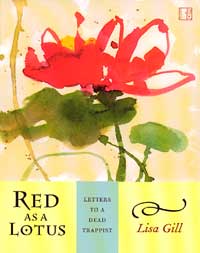
Red as a Lotus by Lisa Gill, La Alameda Press, Cover by J.B. Bryan
The third poem in my Poetry Picks Series, which celebrates poetry and honors poets, is from Lisa Gill’s first book of poetry titled “Red as a Lotus,” a collection of approximately 110 fourteen-lined epistolary poems addressed to Thomas Merton.
Many poems in this collection read as contemplative meditations while others provide voice to spiritual and existential questions whose answers are often ephemeral. Described by La Alameda press as a collection “with an eye which stays true to the bone,” and by others alternately as a mystery and a revelation, Lisa Gill’s first book of poetry is a worthy read and one every serious poet should have on his or her bookshelf.
viii
I watched the lunar eclipse. Ever so gradually the shadow
of the earth crept across the surface of the moon until nothing
but an infinitely fine sliver remained. And standing under
a street lamp, I realized I’m part of what blocks the light,
just another person on this planet spinning about, following
one dizzying pattern after another, rarely bothering to calculate
the ramifications of my orbit. Perhaps despite every attempt
to move in good faith, I’ll always end up coming between the sun
and the place it should shine. When the moon started waxing,
people spilled back into buildings. I held out, thinking how
fifteen minutes ago, the bars emptied onto the street an
for a while, we all stood still and looked up, past any neon,
to the moon — as if were new, as if it were last call. Heading
back into the bar I prayed my shadow sheds such light.
Check back here for a future interview with Lisa Gill and learn about the many projects she has been, and continues to be, involved in since the publication of her first book.
There aren’t many people who would argue that walking isn’t good for you, and that certainly holds true for the poet. What better way to clear the cobwebs from the mind and lubricate joints that are aching from too long sitting at the writing desk than to take a stroll around the block or through the park. Make a conscious effort this week to take a walk, paying close attention to the world around you when you do. Leave pen and paper behind and really, truly use your five senses to take in the environment you encounter. Trust your senses to store your experience to write about when you return home, for nothing triggers memories better than strong sensory associations. No need to limit yourself to walking in your neighborhood, though that can be an adventure if done with an attitude of a foreigner. Consider taking a slightly bigger adventure and try walking a trail in the woods you’ve been thinking about since Autumn and didn’t get around to exploring before winter set in. If you are a fair weather walker, then check the forecast and make a concrete plan to engage with the outdoors on the nicest day this week. Better yet, use April showers as an excuse to don raincoat and goulashes for a child-like stomp in the rain to get in touch with your inner youngster (just let your inner parent keep the inner child from catching cold in the process.) Or perhaps the best way to approach this week’s writing “exercise” is to simply drop what your doing and take that walk right now!
The first monthly issue of Blue Ships Creative Arts Magazine is now available. Take a moment to peruse its digital pages for quality creative works from artists all over the country. In addition to literary works, this premier issue features stunning photography, evocative artwork and graphic full-color tales. Blue Ships takes submissions year round, so submit something today!
“The fool thinks himself to be wise, but the wise man knows himself to be a fool.”
~William Shakespeare
For this the first day of April, otherwise known as April Fool’s Day, write a foolish poem. Feel free to interpret this prompt broadly. For example, perhaps for you a foolish poems suggests writing about a past foolish endeavor, a foolish game or plan, or perhaps it simply suggests utilizing foolish language and silly words. Alternately, maybe it suggests writing about fools, and there are many of those from which to choose. There is the quintessential court jester, the fool in love, the foolish student, any number of fools (or foils) in Shakespeare’s works, even the foolish raven (fox, cat, frog…) of Aesop’s fables. If none of these strike your fancy, consider writing a poem about the origins of April Fools, which is vague enough to encourage fanciful (foolish) interpretation.
I am beginning to appreciate just how many Americans travel to South Korea each year for employment. Take Chung Dahm for example. They hire approximately 300 teachers every quarter. Multiply that by hundreds of academies and hogwons across the country and the number of ESL teachers coming into the country each year climbs into the thousands. Add to that the thousands of enlisted soldiers coming to live on various military branches and the hundreds of businessmen and women working for big corporations who regularly spend weeks, months, or even years living in Seoul and you come up with a population comprised of about 2% foreigners – a significant number when considering the population in South Korea is somewhere in the 50 million range. It’s none too surprising, then, that the big question among people headed to the ROK is: What do I pack?
So, for today’s post, I put together a list of items to consider packing for a long stay in Korea with a little discussion of each. I hope future expats find here a useful anecdote or two.
WHAT TO PACK:
Deodorant: Unless you have easy access to a commissary, deodorant is difficult to find and expensive when it is. If you get stuck in a lurch, you can purchase deodorant for a high-markup price at several of the foreign markets in Itaewon, but it’s much easier just to go to the Dollar General Store before leaving the states and stocking up on a year’s supply to throw in your luggage. It’s well worth the extra weight and luggage space. Also, it will save you from having to beg friends and family to send more when July rolls around and you’re sick of your own stench. Seriously, Koreans do not use deodorant and you will not find it on the shelves at E-mart or any other retailer.
Toothpaste: While there is plenty of toothpaste to be had in S. Korea, it is quite dissimilar to American brands, so if you have a favorite brand, I recommend packing a year’s supply of that, too. Next to deodorant, it is the American product highest in demand among American expats.
Clothes and Shoes: This may seem obvious, but unless you are petite and thin (or of Asian descent), it will be difficult to find clothes that fit properly. There are several fundamental differences in body shapes between Korean and American people and most clothes available for sale in Korea are not going to accommodate the size, shape, or length of the average Western body frame, even in extra-large sizes. If you can’t fit a full year’s supply of clothing into your suitcases, I recommend packing clothes for the season you will arrive and for the season that follows. Next, arrange to have a friend send you a box of clothes in six month’s time. It may be expensive, but not any more so than buying specialty clothes in Korea. Besides, that’s an infinitely better option than wearing clothes that feel awkward or which are inappropriate for the season. If you find yourself in a lurch on this one, try scouring foreign clothing stores in Itaewon, though even here the selection will be limited to an odd array of knock-off t-shirts and baggy jeans.
If you are up for an adventure, find a tailor or seamstress in the Dongdaemun Fabric Market who is willing to work with you. If you are a little savvy, open-minded, and willing to try speaking Korean, you could get a really wonderful deal on custom-made clothing – Western style OR Korean, for they regularly make traditional Hanbok for weddings and family photos.
Cosmetics for Your Skin Tone: Clinique, Este’ Lauder and Channel are just some of the major high-end brands that ARE available in the malls in and around Seoul, but keep in mind that foundation, make-up, and powder shades are suitable for the Asian complexion.
DON’T BOTHER PACKING:
Korean Language Books and Guides: Not only are there myriad language books and guides in used book stores around Itaewon and the foreign book sections of large bookstores like Bandi & Luni’s, you will also likely inherit books from fellow expats, teachers, or co-workers who no longer need them.
Shampoo, conditioner, body lotion and other every-day toiletries: There is an abundance of these types of products in stores all over South Korea. Besides E-mart, these products are available Watson’s, Homeplus, Costco, and most pharmacies. Also, there are millions of Body Shop, Olive, The Face Shop, and similar outlets in every neighborhood.
Accessories like sunglasses, socks, ties, hats, scarves, Jewelry: Name brand knock-offs of these products can be purchased from the thousands of street vendors that line the streets of nearly any district in S. Korea, not to mention in the subway stations and sidewalks of most neighborhoods. If you don’t want to buy the cheap stuff from a street vendor, there are something like two million stores and malls in S. Korea, many of them high-end, where you can buy high-quality items. You won’t be sorry.
Office, Art, and School supplies: S. Korea is a virtual heaven for the office and art supply aficionado, most of it exceeding anything you can find in America in terms of quality and variety. My very favorite place to shop in the entire country is Dream Depot. In fact, I’ve filled boxes and bags of stuff from Dream Depot to send back home.
Recommended:
Favorite accessories, books you feel you can’t live without, and your favorite teddy-bear: Even though there are many quality products in S. Korea, sometimes you just want your own stuff, so pack it. Living abroad for a year is a big challenge and it’s a good plan to have a few comfort items and mementos of home to get you through those less-than-stellar expat moments.
Post Script: One evening, a group of my fellow teachers and I were swapping stories about our first impressions of S. Korea – specifically, what we had and had not packed. One of the newer teacher said that for some reason she worried she wouldn’t be able to find cotton balls in Korea, so she’d packed way more than she could ever use in a year. Since cotton balls are not hard to find, she was giving a few of her packages away.
The perspectives we had acquired through experience allowed us to laugh at ourselves and the silly misconceptions we had before coming to South Korea. Still, preparing for a year of teaching abroad can be somewhat of a mystery fraught with anxiety for some. With any luck, this post will make the job a little easier a fellow angst-prone (but none-the-less adventurous), traveler.
This second poem in Zingara’s Poetry Picks made it into the “notebook of favorites” for the same reason many poems do – I like it. I like it because I relate to it and identify with the speaker, whom I find believable and authoritative. And while these reasons may not be critically sound, they are nonetheless the primary reasons I chose to write it down in my book of favorite poems and include it here. A brief commentary of some of the poem’s strengths follows.
Yesterday, in snow’s rare visit to this city,
my son and I raised his first snowman.
As we rolled the white boulders of its body
my pregnant belly nudged up against them like kin.
By evening, its body leaned to the left so impossibly
I kept checking the window for its collapse.
In the morning, even more so, the body straining
groundward as if to grasp the carrot nose
that had fallen and lay now half-covered in slush.
My son, who hasn’t yet been around the block
with gravity, suspects nothing. I remember
last summer when he skinned his shin on the sidewalk.
I watched his eyes register the body’s betrayal.
Yet he seems not to notice the snowman’s state,
the degree of recline, how little it would take
to return it to an idea of itself.
All over the neighborhood,
snowmen assume such inspired angles,
splayed skywards as if in appeal to their place of origin,
kneeling for their own beheadings,
canted in prayer, tipsy
with the song of their own slow-going.
The relief obvious in their frozen hulking masses
to rejoin the fluid grace of ground waters.
The truth is: before I became a mother,
I knew the body’s longing to be lost.
An untrustworthy lover bound
to forsake us, I’d rather do the leaving
than be left.
But now, as we walk home in the dusk,
my two-year old riding my hip,
patting my cheeks with his mittened hands,
I never want to leave this earth.
Inside the baby tumbles and reels,
already knowing where the body will take us,
that we have no choice but to follow its lead.
In addition the speaker’s repeatability, there are in fact a number of poetic techniques that contribute to the poem’s effectiveness. The first stanza, for example, provides the reader with a appropriately subtle set-up for the poem. Instead of writing “I built a snowman with my two-year-old son,” the poet opens the topic with an observation of the rarity of snow, suggesting preciousness, and does not reveal the age of the child until later in the poem, when the reader has become truly curious about it.
The word “raised” in the second line is a powerful choice and connotes a process more complex than the simple act of packing and rolling snow to create a shape suggestive of a human being, and further broadens the significance of the event to include the complex experience of raising a family.
Imagery plays a huge role in poetry and is wielded with expertise here in such observations as “the white boulder of its body / my pregnant belly nudged up against them like kin” and “as if to grasp the carrot nose / that had fallen” add animation and whimsy despite the underlying seriousness (mortality) of the poem’s tone.
The meandering thoughts of skinned knees and the longings of youth present in the poem do not distract from the narrative because they reaffirm the overall theme that our to bodies seem always to betray us, or at least resist our desire, forcing us into an internal life and landscape where our bodies matter less. Adding these meanderings in just this way illustrates a lovely mastery of language.
Finally, the extended metaphor pairing the human body and its biological changes with that of the slowly melting snowman is particularly poignant.
Two months have passed since my return from South Korea and I suppose my transition is well underway. I’ve been busy with volunteer work at The Writers Place and as a manuscript reader and occasional proof-reader at New Letters Literary Magazine at the University of Missouri at Kansas City. I attend every reading I can, every community writing class and workshop that holds interest for me, and a remarkable number of live performances. I’ve already seen two operas, a ballet, two modern dance productions, a performance by Quixotic, a piano recital and a play at the Unicorn theater. I even wrote a 50,000 word novel. To top it off, I will start teaching at the Blue River Campus, Metropolitan Community College in January.
But as my feet become firmly planted in Missouri, my loyalties are still disconnected. Being busy is merely a coping mechanism, and while it may belie my inner restlessness, it only hides my lingering sense of dislocation. I had grown accustomed to always having people with which to do interesting things or discuss intense work and life experiences. People who knew the implications and share the humor inherent in such expressions as “really?’, “teacher, why?” or “not delicious!”
I knew while living it that my life in Korea would pass very quickly, so I made it a point to pay careful attention to every possible detail while there. Now my memories are filled with details that cannot be captured with words or digital images but can be re-experienced through daydreaming and reminiscing with friends. They are not easily shared with strangers.
Time will inevitably lessen my loneliness and disconnection and soften the acute edges of my remembered truths, though I do not wholly welcome it; for with time comes distance between myself and a difficult adventure I want always to remember in vivid detail.













 The Zingara Project