Blog

  • Summer Writing and Revision is Easy

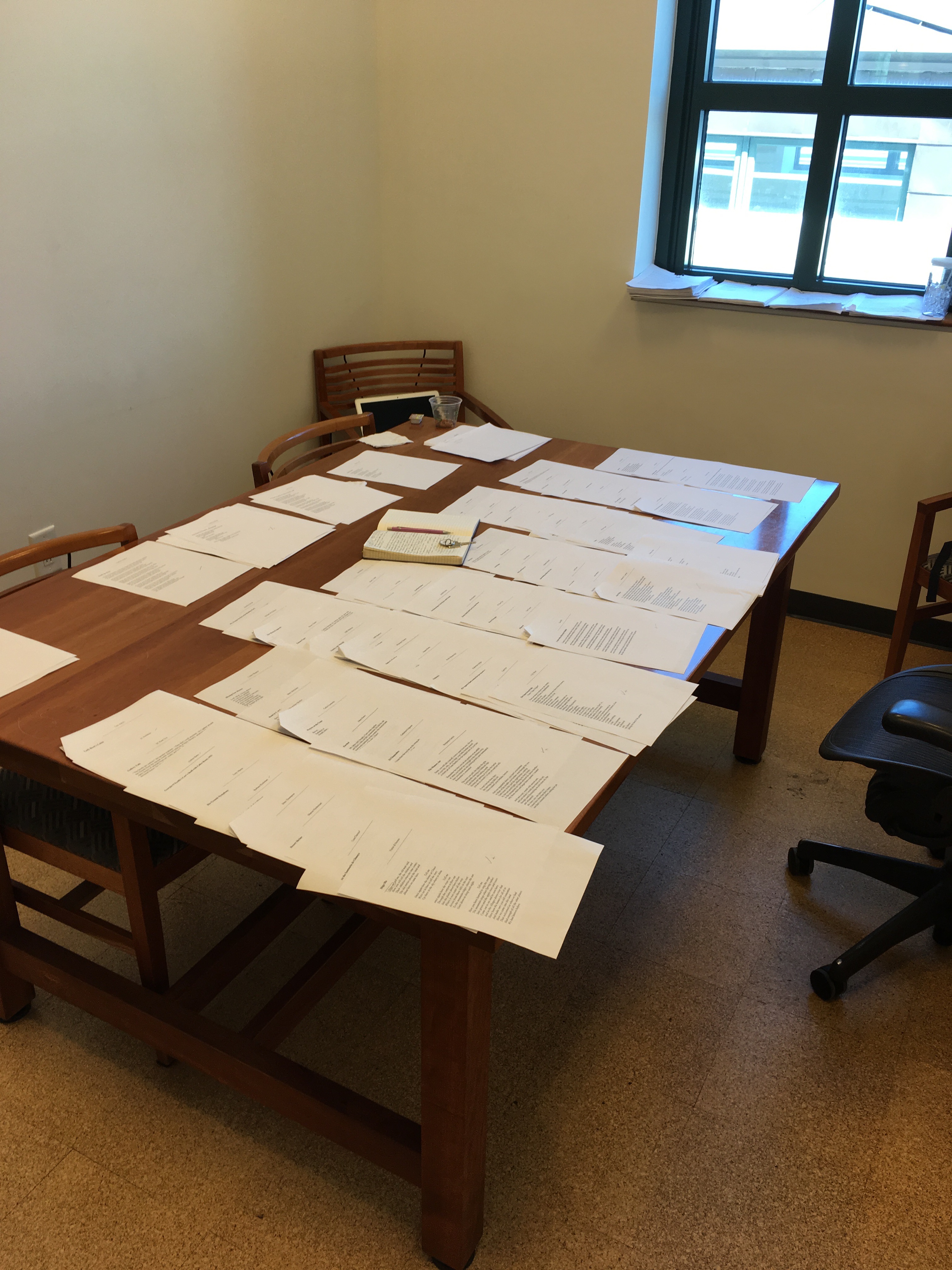
    This summer, I have been availing myself of the use of the College of Charleston’s Addlestone Library’s study rooms to focus on several writing projects.

    This is the first summer that the library has offered reserved study rooms to faculty, and it all came about in response to popular demand and the advocacy of the Faculty Writer’s Retreat facilitator, Lynn Cherry.

    The retreat itself, held during most school breaks, is quite a boon and one that I participate in every chance I get, which has been four times thus far. Unlike a writing conference, which usually involves craft lectures, panels, readings, seminars, and, perhaps, workshops, the College of Charleston’s Faculty Writers Retreat simply provides a distraction-free study room, daily lunches, afternoon snacks, and a sense of accountability. Faculty can apply for a 2, 3, or 5-day stint and available spots fill quickly. Participants agree that they will not use the time to prep for classes, grade or browse social media. Most everyone finds they get a lot done during their selected time period, and even when there are struggles or blocks, most faculty are glad to have had the time to deal with those, too, as it actually helps them  move forward.

    Though I come away from the Faculty Writer’s Retreat with a different kind of same kind of high that a conference might generate, I always come away feeling productive, and centered and with plenty of evidence of my hard work. The difference is subtle but important.

    This year, after a number of participants expressed just how useful it was having access to a study room, myself included, the retreat facilitator inquired into the matter on our behalf. Thanks to her initiative the good folks at Addlestone agreed to set aside three rooms for faculty to reserve for up to three days at a time during any given week this summer, up until the week that classes begin.

    And I have been in one of them every week that I’ve been in town.

    The first several weeks of the summer I worked almost entirely on the New Mexico Poem anthology, since that was my focus during the retreat in May, and more or less wallowed in rereading every contribution and reconsidering the organization and title of the sections. What I found interesting about the process was how I paired some of the same poems together in the revision as I had paired in the first collection, which I discovered after reviewing both manuscripts. In other instances, and maybe because of the new section titles and focus, poems wound up in very different locations.

    I’m sure I’ve spent over 100 hours reconsidering the collection in detail, not including the breaks I took to remain as fresh and as objective as possible. It’s no lie that being hungry, angry, lonely, or tired will drastically affect one’s judgment, so I made sure not to deliberate while experiencing any of those states.

    I sent the manuscript off to my co-editor in mid-June, right before taking off for Kansas City to visit family.  As is usually the case, I found it very difficult to shift my mental state from contemplating poetry to focusing on family for those few days but finally let go and shifted my focus to the present moment and to enjoying my time away from Charleston. Now that I have returned home, the opposite is more true and I struggle to ease myself back into a life groove.

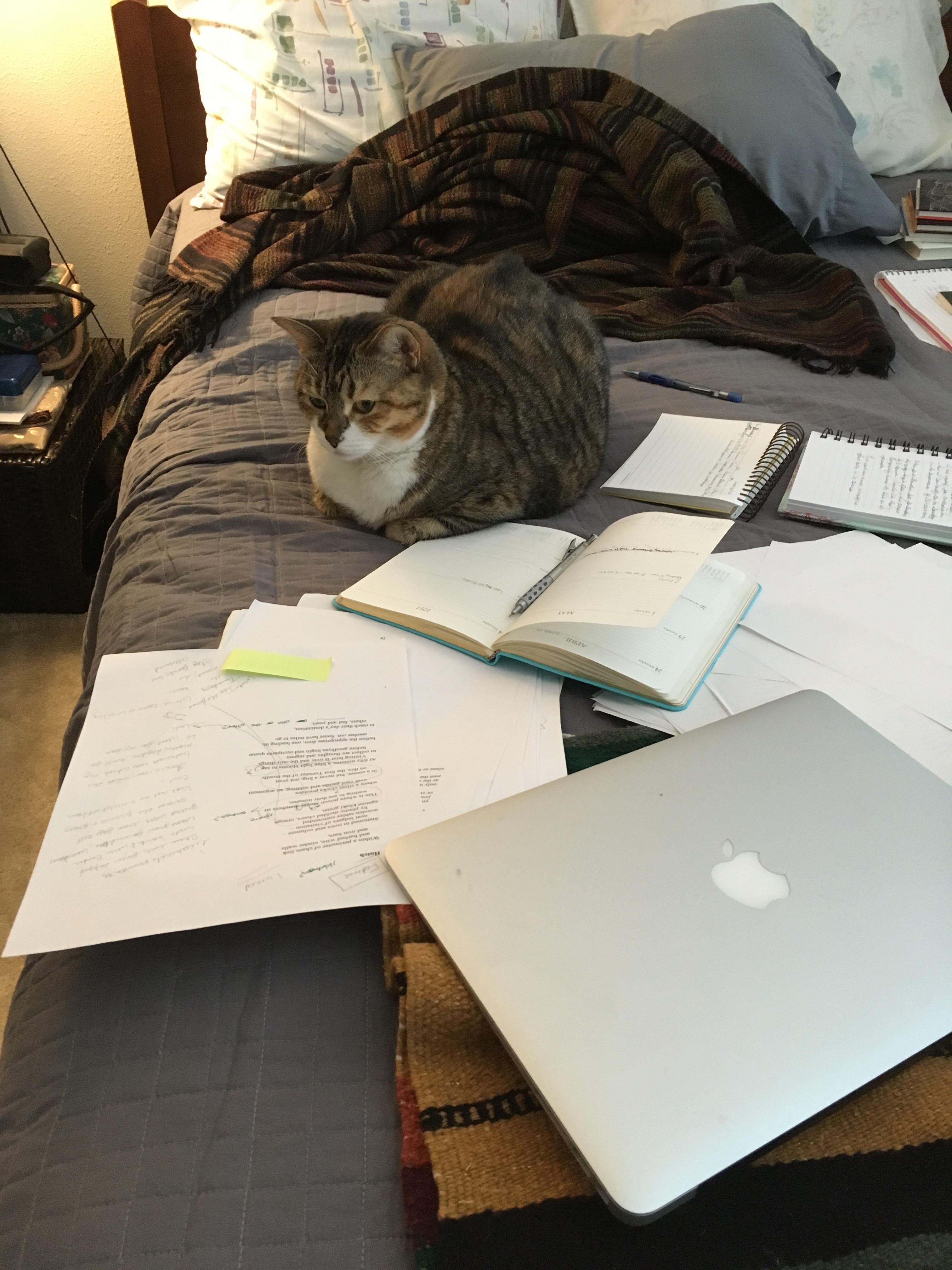
    To help with my re-entry, and in the spirit of easy does it, I “suited up and showed up” to my reserved study room on Wednesday, after three weeks away, determined to work on something. I set no specific goal or objective – just brought with me a hard copy of my own manuscript and my computer. After getting settled in, I was able to revise a few poems, rearrange my MS into sections, and, eventually, assemble and submit a six-page manuscript for a literary magazine In which I would very much like to have my poems appear. I think the day was more productive than it would have been had I fallen into either of the two habits that are most common to me: 1) overwhelm myself with a list of a dozen possible projects on which I might focus, or 2) frustrate myself with an improbable goal. It is much better, I am learning, to have an open mind as I approach one small project at a time.
    I did wind up canceling my Thursday study room reservation, however,  to meet with an exterminator regarding the Yellow Jackets that have taken residence in my yard, most likely as a result of our neglecting yard work those seven months we were living in an apartment while repairs were being made to the house after Hurricane Matthew. (Yes, I can find a way to drop that bit of info into most conversations.) Yellow Jackets, I decided, are just a little more pressing than having a study room for the afternoon.

    The week ahead is a busy one. I am to attend a Writing Across the Curriculum conference and have about a half-dozen appointments to see to. I was tempted to cancel my study room reservations for the week, seeing how I will only get a few hours here and there to utilize the space, but decided against it, for when things are especially busy it is especially important to hold space open for my writing. I may not get as much time as I would prefer, but any time I do capture will go under the column for successes this week.


  • Years Later You Walk In by Maryfrances Wagner

    Tangled under a blanket
    we could melt curbed snow,
    smoke up windows,

    desire unable to hold.
    Boiling water, morning
    after, sudden laughter.

    You walk into my dream:
    older man, panzer tan,
    builder hands.

    How could I have imagined
    you would turn: spoiled meat,
    October leaf, yellow teeth.


    Maryfrances Wagner’s books include Salvatore’s Daughter, Light Subtracts Itself, Red Silk (Thorpe Menn Book Award for Literary Excellence), Dioramas (Mammoth) and Pouf (FLP). Poems have appeared in New Letters, Midwest Quarterly, Laurel Review, Voices in Italian Americana, Unsettling America:  An Anthology of Contemporary Multicultural Poetry (Penguin Books), Literature Across Cultures (Pearson/Longman), Bearing WitnessThe Dream Book, An Anthology of Writings by Italian American Women (American Book Award from the Before Columbus Foundation), et.al.  She co-edits I-70 Review.

    To find out more, enjoy this previous interview with Maryfrances:

    Zingara Interview Maryfrances Wagner

    Enjoy more poems at Zingara Poetry Picks

  • Renting a Room on Magazine Street by Jim Zola

    The obvious is difficult to prove
    in a room with ceilings high enough
    for giants to unstoop, where glass doors
    introduce a garden plot of chickweed
    and empty pots. Upstairs a piano
    plays all day, plinking made-up melodies
    like a drunk weaving patterns
    in a Sunday parking lot. Sometimes
    the songs are funereal, marching

    the dead on bright white keys. I never
    see the player, never slip past
    in narrow veins of hallways. He works
    nights, sleeps days on the hardwood floor
    above my head. It’s the nights that take
    their toll, the tireless jangle
    of window fans, babies crying
    as if they know their mothers moan
    in the deep sleep some lover’s arms.


    Jim Zola has worked in a warehouse, as a security guard, in a bookstore, as a teacher for Deaf children, as a toy designer for Fisher Price, and currently as a children’s librarian. Published in many journals through the years, his publications include a chapbook — The One Hundred Bones of Weather (Blue Pitcher Press) — and a full length poetry collection — What Glorious Possibilities (Aldrich Press). He currently lives in Greensboro, NC

    Enjoy more poems at Zingara Poetry Picks

  • Affirmative Through Toledo by Paul Grams

    Say me that only word
    the one counts one and two
    in the sweet book of love
    that Ima write wit you

    saying how this really could
    be time to say it best
    now that the moon be nerve
    air chill and lay it rest

    Whisper me like tires
    reading the pale gray road
    sufficient love for this next
    kiss
    word up kids ax you bogue
    lets light one closer fire
    between the stars      say yes
    this

    Paul Grams earned degrees in Linguistics and English Literature; he taught in the Detroit Public Schools, mostly grades 6-9, for 30 years; he ran scholastic chess programs there. He’s retired to Baltimore with grandchildren. Two books of his poems have been published.

  • Consolations after a Birth by Beth Sherman

    My books are sniping at one another
    Hurling accusations concerning inaccurate information
    On blood sugar and forceps.
    Later on in the week I will make a bonfire
    In the kitchen and scald their flapping tongues.
    A mobile over the crib jiggles uncertainly.
    The yellow bunny sneers at the spotted cow.
    It knows nothing of midwives. Quaint word
    From a simpler time when mothers died
    With rags stuffed in their mouths to muffle the screaming.
    I’ve discovered that I don’t need God.
    A gazelle sleeps beside me.
    I can feel its fur choking my breath,
    I can taste the grass on its hind legs,
    Alone in this angry house.

    Beth Sherman received an MFA in creative writing from Queens College, where she teaches in the English department. Her fiction has been published in The Portland Review, Sandy River Review, Blue Lyra Review and Gloom Cupboard and is forthcoming in Delmarva Review and Rappahannock Review. Her poetry has been published in Hawaii Pacific Review, Hartskill Review, Lime Hawk, Synecdoche, Gyroscope and The Evansville Review, which nominated her poem, “Minor Planets” for a Pushcart Prize this year.

  • Six Years Old on her Grandparents’ Porch by Penelope Scambly Schott

    Her life seemed like two nights and one day
    where the first night had been birth
    and the last night would be her death
    and that single long day stretched so far ahead
    filled up with future and furniture
    she could almost rock in the white wicker chair
    and forgive the world for making her a child
    who sometimes still needed to hide
    behind the rocker where the porch screen
    pressed tiny diamonds onto her young cheek
    while the man on the tall Sunday Philco
    preached grandly Do unto others
    but this girl didn’t want to be done unto
    no she did not want to be so undone


    Penelope Scambly Schott’s most recent book is How I Became An Historian. She lives in Portland and Dufur, Oregon where she teaches an annual poetry workshop.

  • Floating World by Marian Olson

    Floating World

    Raven lands on the tallest pine,
    a sentry at his post,
    so orderly and calm
    at the end of the day,
    enough to make you believe
    chaos is illusion.

    The great tsunami has returnedfloating-world
    to its source, and the ocean
    glows with a gentle pulse
    in the sweet light of dusk.
    Yet who can forget this morning
    when the earth’s plates shifted
    and believe once again
    in the Garden of things?

    the moon rises
          the moon sets
                this floating world

    Marian Olson, the author of seven books of poetry) lives in Santa Fe, New Mexico. Desert Hours (2008) won top recognition in both the Haiku Society America and the New Mexico Books Awards. Consider This (2012) won first place in the e-book competition of Snapshot Press in the U.K.


  • Like the Dancing Horse by Jenny McBride

    If they were fully aware
              the invested misery,
              the scathing abuse
              and the bludgeoning of perfection
    Would they renounce their gilded ease,
              their snappy playthings,
              hypnotic tomorrows?
    If we could show
              the privileged marauders
              who have never seen their own footprint
              the toll and mortgage of
              their artificial lifestyle,
              all the stock they’ve bought in climate change,
    Would they shriek and flee
              or gaze unapologetically
              like an audience that watches
              a live bear
              slowly lowered into the boiling water?


    Jenny McBride’s writing has appeared in The California Quarterly, Tidal Echoes, Green Social Thought, Star 82 Review and other journals.  She makes her home in the rainforest of southeast Alaska.

  • Stop The Clock by Bruce McRae

    I remember,
    you were pointing a stick
    at the moon.
    It was the day before
    the wolf bit you.
    Near to that incident
    with the toothpick.
    You were with a girl
    who rubbed brass for a living.
    I remember,
    you had a signed edition
    of a box of bags
    and were dating an ex-nun.
    Around the time
    of the break out.
    Sure, and as I recall,
    you were studying wych elm,
    or was it moonwort?
    Either way,
    that was the same summer
    they moved the graveyard
    into the secret forest.
    Remember?
    You had that awful sunburn
    and a lung had collapsed;
    the very same day
    as the mudslide . . .
    Makes you wonder, doesn’t it?
    Makes you think
    real hard.

    Bruce McRae, a Canadian musician, is a Pushcart nominee with over a thousand poems published internationally in magazines such as Poetry, Rattle and the North American Review. His latest book out now, ‘An Unbecoming Fit Of Frenzy’ is available on Amazon and through Cawing Crow Press, while in September of this year, another book of poems, ‘Like As If’, will be published by Pskis Porch. His poems on video can be viewed on YouTube’s ‘BruceMcRaePoetry’


  • Sternum Words by Melissa Hobbs

    Sternum Words
    for Tom C.

    I sit at your feet listening.
    A torch of earth-core liquefies
    and low pitches spray
    from your mouth.
    You, the tight-throated volcano
    pump mineral ash to sprinkle
    my glacial snow pages.

    I stretch to catch
    what doesn’t freeze
    or burn my hands.
    My baby volcano smolders.

    With sternum words
    you set me on fire.
    I nod, not knowing how
    to use your power to powder
    my charcoal for words.

    I have your fire stones
    cooking in my basket
    of ground grain.
    Do I stir you
    with mother’s walnut spoon
    or silver tongs?


    Melissa Hobbs’ passion revitalizes hearts in her writing. Retiring from regular work freed writing to fly from high-rises. She retrieves new writing after coaching high school freshmen, and working with Bhutanese refugee children. Her feet often return to Ohio’s rural paths, where she earned a degree at Kent State University.

  • Guardian by Penelope Scambly Schott

    A veiled woman stands tall
    among stars. Every night
    she rotates the shining sky.
    Some of her stars are old,
    others are not yet visible.
    She’s been busy tending to stars
    since before the beginning of counting.

    On earth she has four children
    and each child is beloved:
    water for spilling through channels,
    air for hugging shapes,
    loose dirt for its grit,
    and fire for lighting the sky.
    Her name is Do not despair.

    In her netted veil she watches
    as a mama skunk drinks
    from a stream that ripples over rocks,
    the kits safe in their burrow
    under the luster of stars.
    The skunk’s white stripe
    might be the Milky Way.


    Penelope Scambly Schott’s most recent book is HOW I BECAME AN HISTORIAN.  She lives in Portland and Dufur, Oregon where she teaches an annual poetry workshop.

  • Jetman by Jonathan Travelstead

    I rebuffer the YouTube video of Swiss ex-fighter pilot Yves Rossi
    & watch this man-cum-black wing let go the rails & bail out of the helicopter
    like a Navy SEAL, whirligig in a tailspun freefall until his aelerons
    & helmet’s rudder lock in, tilting into clean air.

    I think of birds’ aerobatics. How the swift hatchling- plummeting
    from the nest for the first time, remembers flight just in time. I see his manouevers
    named in the comments. Falling leaf. Chandelle. Afterburners quilled
    with kerosene for feathers, I watch him jockey in high definition

    a wide, blue field & wish it were me barrel rolling the Alps with a ballerina’s
    easy pirouette over shards of coal-dusted ice. I can’t see it enough,
    the dream every generations’ boy dreams- whether Iron Man, or an eagle,
    all of us wishing to attempt the split s. On replay I consider

    his skull’s declension from the slab of black wing,
    & the moment’s precipice where he submits to some higher plane of physics
    that to the rest of us is only dark art. Shoulders camber forward then
    he dives, puncturing cirrus, then cumulous cloud, contrails twisting

    at a moment past the last believable one when he cranes his head & body
    in a half pitch skyward once more, a cough of flame as he cuts power,
    pulls the ripcord on a ballooned parachute which lowers him
    to the ground in a landing he- incredibly, survives.


    Jonathan Travelstead served in the Air Force National Guard for six years as a firefighter and currently works as a full-time firefighter for the city of Murphysboro, and also as co-editor for Cobalt Review. Having finished his MFA at Southern Illinois University of Carbondale, he now works on an old dirt-bike he hopes will one day get him to the salt flats of Bolivia. He has published work in The Iowa Review, on Poetrydaily.com, and has work forthcoming in The Crab Orchard Review, among others. His first collection “How We Bury Our Dead” by Cobalt Press was released in March, 2015, and his “Conflict Tours” is forthcoming in Spring of 2017.

  • In Memoriam by Sharon Scholl

    I feel the sigh of thinking
    about you, breath
    carving out a riverbed of memory.

    Cool in the shadow
    of my passing through,
    scenes flicker – you standing

    in a door three summers
    tall. I’m trying to find
    your form, assemble love
    from the labyrinth of places
    that contained us, the web
    of words that passed for truth.

    Your pulse is made of ashes.
    Your being is a whirlpool
    in the ripples of my brain.


    Sharon Scholl is professor emerita from Jacksonville University (Fl)  where she taught humanities and non-western studies.  Her chapbook, Summer’s Child, is new from Finishing Line Press.  Individual poems are current in Adanna, Caesura and, Rat’s Ass Review.

  • Paint On Pasteboard by Peter Goodwin

    I was about to chuck it, in a push to clear space
    but the image, painted on pasteboard, looked vaguely
    familiar, a winding river, wandering through lush woods,
    triggering a memory of a long ago summer,
    of picnics on a bluff, smiling women flirting,
    the slow gentle current taking us, like driftwood,
    floating along its curving meandering path, while
    he set up his easel to capture the Ukrainian light.

    So much seemed possible, bathed in summer days
    when Perestroika loosened the cold grip of communism,
    who could have imagined that the regime would collapse,
    Ukraine become independent and fritter its freedom,
    imperial Russia return and that pristine river valley,
    so close to Donetsk would become a battlefield,
    the river washing away blood and pleasure, beauty lost
    and almost forgotten, but for paint on pasteboard.


  • Releasing the Dark Landscape by Martin Willitts Jr

    The last sunlight falls behind the vanishing trees,
    where it hesitates before leaving completely.
    Some decisions are measured by regret.
    Some of us, when we find ourselves old, notice this.

    Out on the prairie, someone tries to hold the land
    together with barbed wire stapled to aging wood posts.
    however I am the kind of person who brings cutters
    and snip each sharp wire, and let the fields open.

    I am the kind who encourages yellow-throated meadowlarks.
    When cut, the dark will be released; the air will be set free.
    Doors on distanced houses ripple like muscles after working.
    Some wonder why I do this, question idleness as the cause,

    suggest I had nothing better to do. I am the kind laws
    are made to discourage people like me from acting impulsively.
    I cannot obey, and sharpen the blades like a raptor’s talons.
    I am the kind that knows outcrops sweeten with silence.

    I go to the wire to test it. It glints in moonlight and speaks.
    It knows the quiet patterns of flight, the tactical for listening.
    I should have brought the cutter, it slender purpose of justice,
    the rusting wind caught on it should be freed. I touch barehanded.

    It slices like eyes. It whispers, be careful. The fields, spare me.
    Yearning and ceasing are shadows lengthening, in stillness,
    in the final ambient light, then, the meadowlark stopped —
    only the robin’s sleepy-time sound is in this field, and it is held here.

    I experience the necessary absence. I also lose blood to its danger.
    They say actions speak for you and what you stand for.
    I have been listening to the suffering. Something had to be done.
    When I cut, the earth flies away, like wings or leaves or regret.
    ___

    Martin Willitts Jr. has 11 full-length collections including “How to Be Silent” (FutureCycle Press, 2016). His forthcoming include “Dylan Thomas and the Writing Shed” (FutureCycle Press); “Three Ages of Women” (Deerbrook Press); and the winner of the Editor’s Choice Award, “The Wire Fence Holding Back the World” (Turtle Island Press).