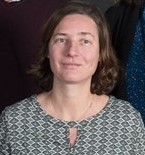
Zingara Poetry Review is pleased to present this interview with Margarita Serafimova.
Margarita Serafimova is a Pushcart Prize nominee and a finalist in nine other U.S. and international poetry contests. Her work appears widely, including Nashville Review, LIT, Agenda Poetry, Poetry South, London Grip, Waxwing, A-Minor, Trafika Europe, Noble/ Gas, Obra/ Artifact, Great Weather for Media, Nixes Mate, and Moria.
She has had four poetry collections published in Bulgarian and is the recipient of the 1st place prize for the Tony Quagliano International Poetry Award. Established in the memory of poet and editor Tony Quagliano, the biennial prize is awarded for an outstanding body of work by a poet who “consistently strives for cutting edge and avant-garde innovation.”
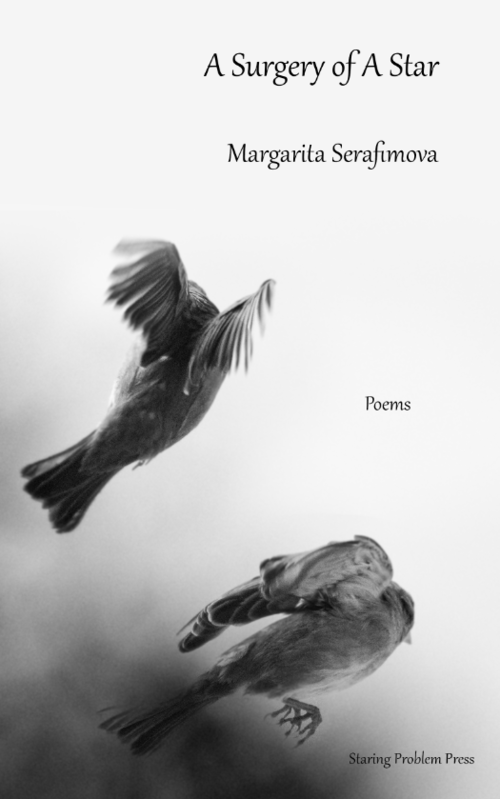
First, a poem from her most recent chapbook, A Surgery of A Star:
Weeping: Clarinets
The circle allowed us for an instant – an instant
in eternity –
to step out of it,
and then, it closed.
*
 Your work has garnered the 2019-2020 Tony Quagliano award. Tell us more about this distinction.
This international biennial prize awarded by the Hawai’I Council for the Humanities honors author Tony Quagliano by ‘recognizing an accomplished poet with an outstanding body of work’. Under the award eligibility rules, “the poet must consistently strive for ‘cutting edge‘ and ‘avant-garde‘ innovation, which means experimental, innovative, ‘pushing the envelope‘ literature.” To quote the award-givers, “winning poets exemplify what Tony loved—poetic innovation that embraces experimental craft and a joy in unexpected language”.
The criteria for the award entail having, as a poet, “a body of work over a period of years” that corresponds to the requirement of innovation. The recognition comes with a $1000 prize.
I’m honored!
Your latest collection, A Surgery of a Star (Staring Problem Press), contains poems that are described as “cutting edge” inventive poetry. Tell us a little about how form and content work together in such brief poems as ‘L’éternel Retour’ to capture this sense of “piercing intimacy” that reviewers mention.
‘L’éternel retour’ (Eternal Return), first published in LIT Magazine by The New School, is one of the poems, on the basis of which I was awarded the 2019-2020 Tony Quagliano International Poetry Prize. It is also a centerpiece of my chapbook, A Surgery of A Star (2020).
This poem is a good example of how work usually happens in my creative process: the poem simply occurred to me, in its entirety, while I was going on about my day, not sitting down writing; I recorded it in my phone, and never revisited a word. Later, I self-translated it from the Bulgarian original into English. So, my poetry-making is organic; content and form are inherently merged from the genesis, they never exist separately, I don’t work on making them come together.
I never have any poetic goal, in terms of either form or content, in mind prior to writing a poem. Poems happen to me of themselves, dropping in my palm like ripe fruit. I usually express my feelings in free-verse micro-poems, three-four lines, sometimes, just two; so, the form is relatively stable and easy. Sometimes – again, without any design – it happens that I write longer poems, but almost never longer than a page. As for the content, it is invariably impulsive and has its origins in my lived experience. I don’t write poems deliberately and I don’t write directly from my ideas – aesthetic, philosophical, social, political – so much as from my emotions and sensations. My foremost concern is authenticity: to capture an expression of what I experienced emotionally that rings true; the poem has to resonate, to feel right, above all. If it does, that’s it. I am satisfied, I do nothing more. I don’t deliberately seek for what would be the accurate or the best expression, but I have been cultivating all my life a free mind that speaks its own mind, so to speak, and when it does, poems organically occur out of the intensity of my emotional life.
Intimacy with another person, or another living being, or another manifestation of life on Earth, or being itself as a deep sensе of self, is very important to me existentially, as is visual beauty. They naturally manifest themselves in many poems that occur to me on the subject of ‘You’ or the couple as a modus of being, in which some image of the sublime is mirrored. Or, a more plural ‘we’ bond – identification with some small intimate community. My inner attention is trained on those phenomena, those moments, and that intense mental attention often produces Eros-driven works; Eros in the sense of the binding life-principle opposed to Thanatos, or annihilation. The exquisitely piercing or blessing-like balmy nature of such moments, which my mind is focused on re-producing as a verbal sight, is an existential reality for me, in my actual every-day life; it is not an abstraction or a concept. That energy of the immediate living, combined with my attraction to images and my taste for condensed language, produces highly concise visual pieces; a kind of passion. I delight in revelation – when I discover, by means of looking at things, a sense of some truth underneath their surface, inside of them, I am thrilled. If I feel energetic, which I often do, forming words is then my impulsive response – verbal expression that photographs the distilled essence of the real-life happening I witnessed. As the bosom of things is usually inseparable from their outward appearance, their imagistic presence, their truth is manifested to my eyes, which are always looking, and not to my rational brain.
How do you develop a keen eye for the imagery that appears in your work?
All my life, I have derived a keen pleasure from contemplating beautiful natural occurrences and living beings – trees, sunlight, birds in flight, surf breaking, the moon and clouds, clear air, statues, wind moving, the sound of it in high branches, the aura, the force of it, light in water, elegant fish, a desired face. I am dedicated to looking at them to the point of saturation; I’m devoted to them. It is only natural that a part of me exists as a medium for words reflecting them. As mentioned, poems usually occur to me from actual instances of physically looking at the many faces of the Earth – the serene heavens, the magnetic soil, the soaring blue depths. Or, when I am relaxing indoors, in some pretty room, cinematographic images appear in my mind’s eye, merging fantasy, actual experience, and artifacts from the collective unconscious; then, words naturally crop up from those vivid images. Normally, my mind produces a verbal rendition of an image after the latter appears clearly in my imagination as it were against a deep dark background. As a poet, I operate from my vision. It gifts me exquisite feelings, which trigger utterances, as a sort of existential witness-bearing to the intricate beauty of existence. My role is to make sure I am at all times genuine so that I won’t fail my moments.
What kind of considerations go into building and ordering a collection of poems?
In my experience – which includes four full-length collections in Bulgarian published in 2016-2020, a chapbook in English in 2020, another one forthcoming in January 2021, and a full-length collection in English to appear in 2022 – I haven’t used rational or professional ideas as tools to structure my books. I am not an educated or professional poet; I’m a natural, self-made one. I’ve been rather impulsive, even arbitrary in my selections and ordering. I will group together works that were written in a particular period, which has marked them with a common timbre or a family of evolving moods. Often, I will arrange them in chronological order, following their natural rhythms and progression. In this way, real life serves as the director of the narrative. I will use a title that is an important signifier of the mood or underlying energy – it will be a blind-eyed choice, not a thought-through one, no considerations outside of my own gut feeling would apply (the reader is never there). I might pull in works from other periods as well, if they have some tie to this underlying binding drive or symbol. In other cases, I will group together poems belonging to a certain relationship; a gallery devoted to a single lover. Or, the collection will be dedicated to some cross-cutting presence, some comprehensive, systemic passion in my life. For instance, my debut full-length book (in Bulgarian) is entitled ‘Animals and Other Gods’ – it gathered all of my works of adoration of animals and birds, and other forces of nature, expressing my exultation from focusing on their subjecthood and their power, their glory, written over a long period of time, many years, different styles and moods. My second full-length collection, ‘Demons and World’, similarly encompassed poems written over diverse periods in my life, all somehow linked to an elusive feeling of yearning for, and choosing, the world over darkness. ‘A Surgery of A Star’ is very much about erotic desire as a capacity to transcend.
How does writing poetry fit into your professional career as a lawyer?
I don’t spend much time writing my brief poetry, it occurs to me while I am doing other things, including legal work. I then just need to take a moment to commit the lines to writing so I won’t forget them. Self-translating and submitting take more time, which I manage, being a freelancer, an independent expert; I manage my own time. However, even during a brief recent period when I was employed as an international lawyer in a fast-paced environment managed by others – during the pandemic – I was able to protect my inner energy and my spiritual space remained intact, nothing was able to stop my poems from coming. Regardless of how busy and strained at work I was, I would be walking in the park with my dogs, or returning home from the supermarket, or even sorting out evidence in a case file, and poems would simply enter and lighten the scene. It helps that I always bond with the people I have to interact with during the day, with the space I inhabit – rooms, garden, stairs, windows, with the neighbourhood, the environment that contains my life. I am quite selective and once I am able to focus on a thing or a person because I chose them, I can then love them – on a spectrum of ways – and investing myself so, I can decorate as it were the space for my poetry, make it habitable for it. Then, I share it with the people around me, whether it’s expected or not. I could not care less about conforming.
How has it been writing during the pandemic?
For the first six months, I was in a new city, starting a new job, with strong personalities as my colleagues, with whom I shared many important things in common and equally, various cultural and other differences, which all bred tensions and strife. But we overcame, and populated our interactions variously with kindnesses, excitement, closeness, joyful surprises – in addition to the pressure of not being according to each other’s expectations. Throughout this process, I held on to my sanity by being a worshipper of the sublime oaks in my area. I was their scribe, the recorder of their crowns. They elevated me and sustained me. A full-length manuscript emerged from us. I called it ‘The Oak Odyssey’ because I was always going home, from the moment I set sail. So, this is how I traversed the rise of the pandemic. Now, I am in the Greek islands, where I feel eternally at home, the sea reminding me every waking hour of what is permanent and what is impermanent. Everything is.
Our Voices
Stark naked ballerinas with rapiers,
skin heated by some sun,
and these naked rapiers.
A scent, a long shine.
*