Author: Lisa Hase-Jackson

  • School Bus by Michael Chin

    He was tired on the ride home. His head dipped once—twice—

    The fifth time, he slumped into me and caught himself. I looked straight ahead at the taped up alligator green seat back.

    On the eighth dip, his head descended onto my shoulder more gently. Maybe he knew what he was doing. No jolt. He rested.

    And I let him. I knew I shouldn’t. One boy sleeping on another was childish. Gay.

    But I didn’t push him off or think of pulling away so he’d flop down on the seat.

    I let him—I let him nestle in as I were his pillow. I let him snore. I thought I’d only stop him if he started to drool. That that was the limit.

    But in the meantime, for the first time, I eased into the role of protector. The last line of defense from anyone writing on his face. From a wet willy.

    I looked over his head, out the window and watched the way sign posts blurred into nothingness as the bus sped past them. As if the signs themselves were hovering and I could stick my hand right through the space beneath them. As if the laws of matter were subject neither to fact nor my will, but the whims of the space between what was and was not. In dream.


    Michael Chin was born and raised in Utica, New York and a recent alum of Oregon State’s MFA Program..He won the Bayou Magazine’s Jim Knudsen Editor’s Prize for fiction and has published work in journals including The Normal School and Bellevue Literary Review. Follow him on Twitter @miketchin.

  • Protests at AWP in DC 2017

    Usually around this time of year my Facebook and Twitter feeds are overrun with cheerful posts about the various AWP events that my friends and colleagues are planning to attend, but with all the attention-grabbing, anxiety-ridden news that has daily shocked social media these last few weeks, it’s almost as if everyone has forgotten.

    They haven’t, of course. There are still shouts out among fellow writers and acquaintances trying to connect with each other, tips for first time attendees and, because this year’s conference is in DC, some encouraging chatter about several politically centered events.

    Maybe what’s really happening here is that posts about AWP are just getting buried by all the fearful factoids and scary statistics swirling around all forms of media right now. Or maybe, and this is probably more likely, those are the posts I allow to capture and hold my attention.

    I am struck, nonetheless, by the auspiciousness of AWP, a conference that attracts a wide range of diverse writers, taking place in DC just weeks after the inauguration and subsequent Women’s March and the more recent protests against the Muslim Travel Ban, and how this confluence of events adds gravity and weight to such typical pre-AWP activities as making travel arrangements, sending ahead boxes of books, making plans to see friends and, most importantly, contemplating what it means to be a writer in “Trump’s America.”

    This year, in addition to looking forward to the book fair, after-hours parties, and copping a frenetic high from mixing adrenaline with too much alcohol and too little sleep, some conference-goers are looking forward to converging on Capitol Hill the afternoon of Friday, February 10th to “make a case against the Trump Agenda”(flavorwire.com) while others will be participating in Split this Rock’s  Saturday vigil and speakout on the White House lawn. There is also word of a Cave Canem protest-reading at Howard University and, no doubt,there will be numerous other off-site politically motivated events that are evolving even as I write this post.

    It is my hope that these events are heavily promoted and heartily attended and that each receives ample news coverage and sets itself forth as stellar model for a successful, effective demonstrations by which others can emulate. Most of all, I hope these events will encourage other groups and individuals to speak out, to become active in whatever capacity makes sense for their circumstances, and that professionals who have the power and ability to make changes in Washington view these gatherings as encouragement for their continued vigilance in the resistance against tyranny. Most of all, I hope that writers and artists around the globe feel bolstered not to “keep their moths shut” as Steve Bannon would admonish, but to respectfully continue doing what they do best, which, of course, is to write on.


  • A Lesson in Romantics by Danielle Lowery

    A Lesson in Romantics
    -Mayday Parade

    I am a machine and a skitzo.
    A savage cave woman
    and a drone.
    I scratch at every movement
    Every wrong word
    Every memory,
    Like the beaten stray cat
    on the street corner.

    Never enough oil to grease my joints
    Never enough medication to silence the storm,
    I am stiff  and enraged.

    Swallowed by the quicksand
    enveloping me for so long,
    One fourth of my life
    devoted to your every need,
    One fourth of my life
    destroyed by your massive greed.

    You were a Dragon,
    a Siren,
    a Leech.
    For five years  I never knew,
    I never imagined  the traitor  was you.


    Danielle Lowery is a Senior at Chatham University. Her fiction has been published in The Minor Bird. Danielle has studied Creative Writing at both Sweet Briar College and Chatham University.


  • Life After Hurricane Matthew

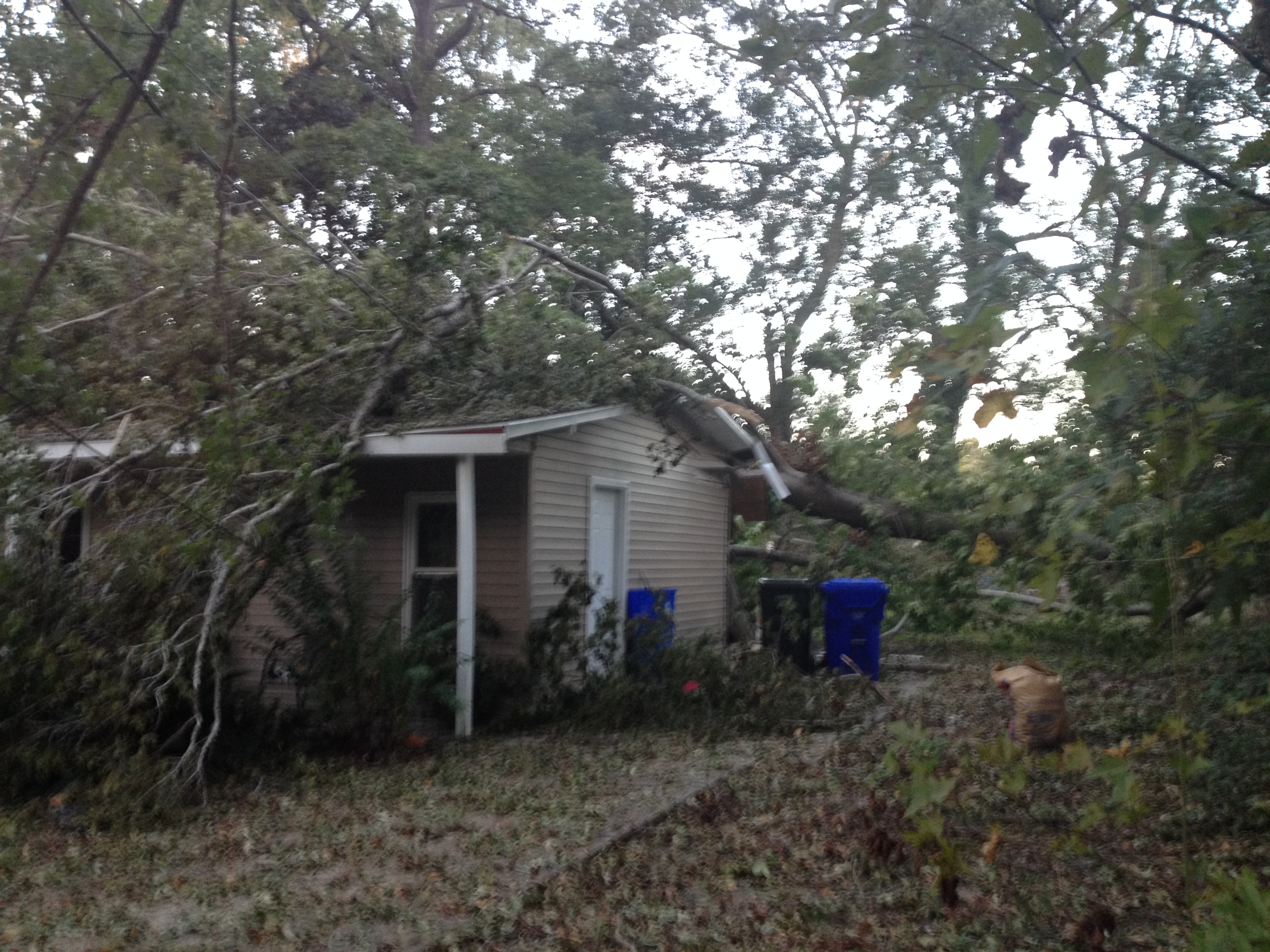
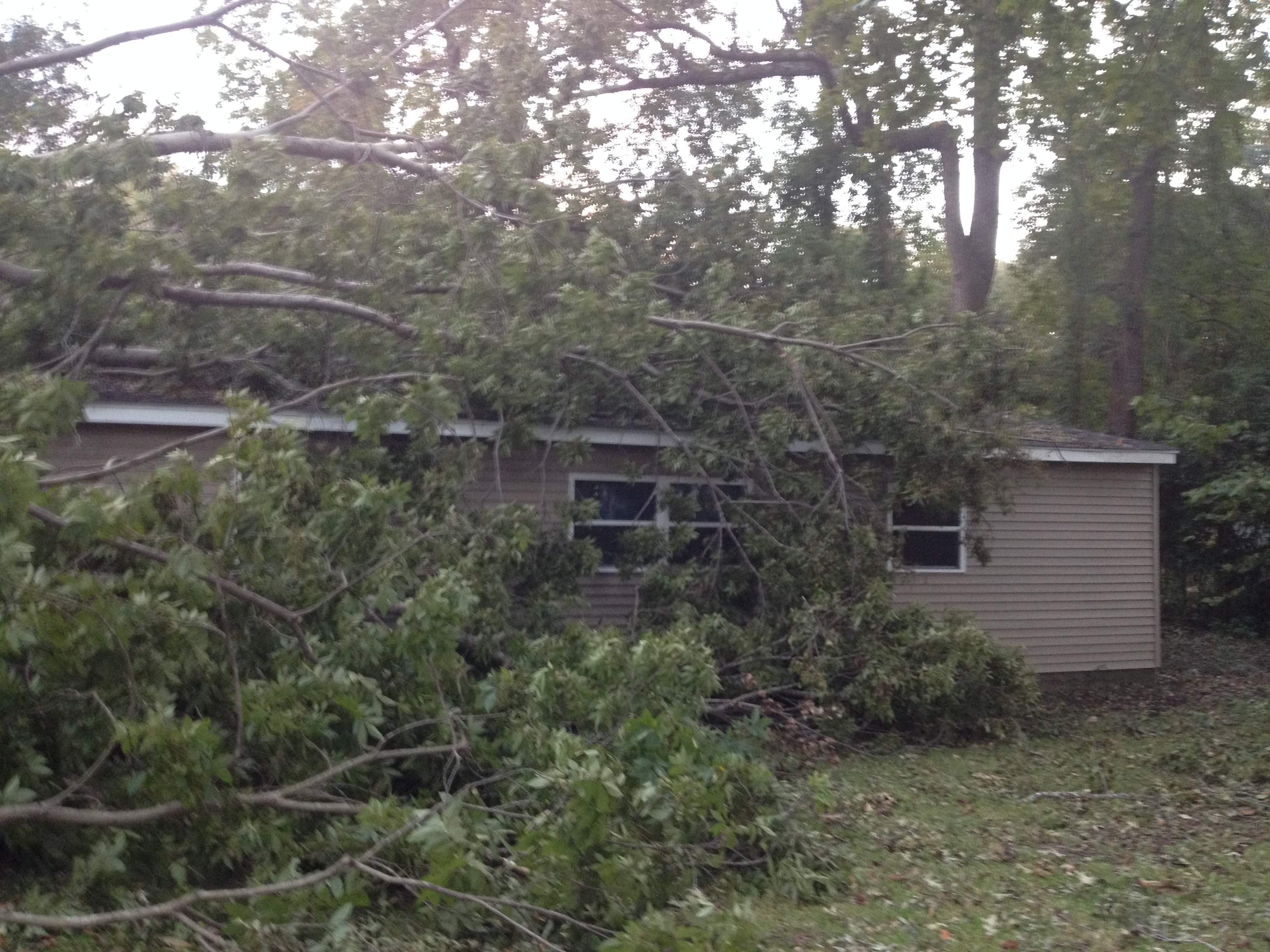
    When Hurricane Matthew swept through Charleston last October, saturating the ground with rain water and whipping up high winds, the roots of the large hickory tree in our neighbor’s yard loosened their grasp on the soil beneath them. Like any tree in high wind, especially ones with compromised roots, the hickory thrashed back and forth in the storm until, at last, it fell.

    My husband and I, along with our cat, had evacuated to Kansas City and were safe and sound in my mother’s living room, enjoying her company and a sense of being “home.”  We would not know for another day or two that that hickory tree landed on and crushed the back corner of our house, taking the power line and electric meter with it.
    file_004The news came via phone from friends who live nearby and who had, when learning we’d evacuated, offered to drive by and check on our house. They sent pictures by text and we cast them onto my mother’s television. The tree, as long as our house is wide, appeared to be swallowing our new home, and though we could see that the roof had been crushed where the tree had hit, we couldn’t tell how much damage was sustained or how far back it went. We wondered if the entire roof wasn’t compromised.

    The drive home was somber and tense, our minds full of worst case scenarios. We drove until dark the first day, then checked into a hotel for the night. No sense in driving all the way to Charleston where there were no hotel vacancies, we’d reasoned.

    As directed by our insurance company after filing our online insurance claim, I called the file_000mitigation company we’d been referred to as soon we arrived at the house the next evening. The sun was just setting, the sky was blue, and the wind was still. The man on the other end of the line, Lorne, asked me to describe the damage to him. I tried to be as specific as I could as I walked through and around the house verbally noting how large the hole in the roof, how flooded the laundry room, how wet the ceilings and walls, how damaged the flooring throughout…..at the end of our conversation Lorne asked me if the house was habitable.
    Well, there’s a gaping hole in the roof and no power, I told him. So, no, I don’t think it is habitable. 

    That was four months ago. Since then my husband and I have been shuffled from hotel room (where we lived for over six weeks) to two-bedroom apartment  (into which we fit three additional family members over the holidays). I cannot begin to list all the untruths and delaying tactics we have been subjected to or the patience we’ve had to tap into each time someone asks us for our claim number (they know damn well who we are!) or tells us “everything’s behind schedule because of the hurricane.”

    It took over a week for both the field adjuster and the tree removal people to arrive. When they showed up the same morning, they got into each other’s way and the field adjuster was unable to make a complete inspection. It took another two or three weeks for the City Building Inspector to look at the property, and that was only because our general contractor waited for him outside his office every morning for a week. More recently, the building permit was delayed because there is no plat for the house and the plat surveyor is behind and won’t be out for another three weeks. New trusses for the roof, which will have to be ordered, are on a four week delay. And even before all of this, it took 30 days for the desk adjuster to provide the (ridiculously low) initial estimate; another 30 for him to respond to the (much higher) estimate our GC provided.

    Meanwhile my husband and I are juggling phone calls with insurance agents, adjusters, and contractors, packing our belongings in boxes to be moved out of the house and into we don’t know where (there were no storage pods left in the city), maintaining our teaching duties, preparing for the holidays, checking on our cat housed at friends’, and explaining over and over again to our family and colleagues what had happened. At times, it felt impossible to keep up with all the demands of the situation much less basic needs, like healthy food and quality, anxious-free sleep.

    My husband and I are still in the apartment the insurance company arranged for us and while things are generally calmer and we have found a workable rhythm to life, reconstruction has yet to begin on the house and we don’t really know when it will. There’s still a slew of paperwork to wade through and dependence on the cooperation of a couple of other bureaucratic entities to secure. So while the rest of the city has pretty much recovered and moved on from Hurricane Matthew, we continue to wait for resolution.

    It was not until this week that I was able to put my full attention on Zingara Poet. I could see my pet project listing on the waves, submissions and emails neglected since late September despite every intention, even the hiring of an intern, to respond to submissions in a more speedy manner this year. Yet I did not want to bring my anxious energy to my poetry reading. I’ve leaned that the two just don’t mix — so kept putting it off until I was in better spirits.

    I am glad to say that, as of this writing, most of the October and November submissions have been reviewed and responded to. In the week to come, I will be looking over the rest of December submissions and sending out my decisions. Likewise, poems for most of the first half of 2017 have been chosen and their dates of publication scheduled (only a few spots left). With luck, I will be able to enter the new submission period (later this year) caught up and, I am keeping my fingers crossed here, from the comfort of my own home.

    Thanks to all the poets out there who have waited patiently for a response. As always, I am impressed by the quality and breadth of the selection.

  • Early Morning Round by Jeff Burt

    The old women who rise early
    must think me the hound
    whose purest intention is to keep
    his habitual round
    as I plod the unlit county road
    in the rain, nose to the ground,

    led by a scent.  No meandering
    mutt am I, dog of hijink,
    junkyard, or bog.  Wet hair
    dripping my lips perpetual drink
    off the fountain of my nose
    I suppose they think I have a link

    lost in the chain of ideas, or missing
    boxcar on the train of thought.
    They don’t understand that out
    in the rain on the same old route
    I move at a pace which liberates
    limbs of faith from trunks of doubt.

    Rounding the bend and smelling the bread
    Mrs. Woods has baked I spy
    the waiting gait, and when I trod
    straight the road gone awry
    from spilling ditch near Emory’s pond
    I chase the ducks but they don’t fly.

    No longer a rushing cur am I.
    Intemperate geese nip at the back
    of my calves, and quacking ducks come
    pleading for the bread that I lack.


    Jeff Burt lives in Santa Cruz County, California.  He has work in The Nervous Breakdown, Amarillo Bay, Across the Margins, and Atticus Review.  He was the summer issue poet of Clerestory in 2015.


  • Naïve and Sentimental Sonnet by Thomas Zimmerman

    This world so hard and dark but ours and shot
    clean through with light—and so I write to you,
    storm coming. I am drunk on life and clouds
    and God—or likely, love. That’s all we know
    on earth. So bring the dogs, a hat, a coat,
    your suffering—and come with me to . . . I
    don’t know, a place we make, a space, a world,
    an opening in matter, stuff. I’m not
    a physicist. A lover of the possible:
    that’s me. So loving that I break myself
    for openings. Odd God, but maybe He/
    She/It is in us all. Relax. Some things
    stay green. And if not this, Next world, I say,
    next world. Our changes haven’t finished yet.


    Thomas Zimmerman teaches English, directs the Writing Center, and edits two literary magazines at Washtenaw Community College, in Ann Arbor, Michigan. His chapbook In Stereo: Thirteen Sonnets and Some Fire Music appeared from The Camel Saloon Books on Blog in 2012. Tom’s website:http://thomaszimmerman.wordpress.com/

    Also by this poet: “A Better Poem

  • I Love Broken Things by Kym Cunningham


    The walnut man in a broken straw
    hat divined our future in streetside palm fronds
    a          womb
    an oil-derrick apartment and that
    three-legged dog I
    always wanted

    Our children would be beautiful, if only
    they had none of me and all of you
    Your hair your smile
    Your lips your eyes
    Your skin
    Your skin
    Your skin

    I can’t let them be broken too
    So every month, I break the egg
    Watch the yolk
    slide
    down my legs

    Our hatchlings with locked jaws of
    monsters sing

    Tell me, love
    Are we thicker than water


    Kym Cunningham will receive her MFA from San Jose State University with emphases in creative nonfiction and poetry.  She is the lead Nonfiction Editor of Reed Magazine, the oldest literary magazine West of the Mississippi.  She received the Ida Fay Sachs Ludwig Memorial Scholarship and the Academy of American Poets Prize for outstanding achievement in her writing. Her writing has been published in Drunk Monkeys and Reed.

  • Tendril by Taunja Thomson

    Moon inside coyote
    shines from her mouth
    in the pitch of evening.
    Her ears are leaves
    ruffled by a rare wind.
    Her claws as sharp
    as cactus spines.
    She has eaten owl and lizard
    and snake and she knows
    relentless sun    frozen night
    sand and web    flower and blood
    thick blooms that pinwheel
    in day and pray with closed petals
    at night.
    She opens her mouth—her tongue
    a tendril of moonlight
    reaches
    through rock and star.


    Taunja Thomson’s poetry has most recently appeared in Potomac.  Two of her poems have been nominated for Pushcart Awards: “Seahorse and Moon” in 2005 and “I Walked Out in January” in 2016.  She has co-authored a chapbook of ekphrastic poetry which has recently been accepted for publication and has a writer’s page at https://www.facebook.com/TaunjaThomsonWriter.


  • Water’s Edge by Joe Amaral

    I came upon a creek,
    following deer trail scampering by
    fire-swirled poison oak, dapper sycamore
    and bone smooth cottonwood

    I heard mallards, snowy egrets
    and my favorite, silverblack coots,
    lounging in shallow water as if
    they were toweled old men at a sauna

    What surprised me was the angel-feathered body
    guarded by a hunchbacked hawk
    glaring back at me like a guilty vampire atop
    his hapless victim, pecking at its beanpole neck

    The bird of prey blasted into the trees, perching
    on a branch, angrily observing my approach
    Beside the shore of moss, mud and stone
    lay supine a juvenile duck with a grotesquely

    twisted head, its webbed feet pedaling
    midair like an upturned bicycle
    Its agonal, guppy breathing and distantly dim
    flaxen eyes clutching my dutiful heart

    It was barely alive, a dollop of blood upon its throat
    Turkey vultures double and triple looped above me,
    so many there must have been bigger game to ply
    I sighed and stepped over the poor gasping creature

    It was able to crane its crooked neck and regard me,
    beak opening and closing in broken respiration,
    akin to a hatchling beckoning wormy regurgitation
    But I could only offer it reincarnation so I stomped

    my foot down on its head as hard as I could
    A crepitus of sound of sharp gravel cleaved the sky
    the same moment the hawk burst out the foliage
    and flew away, chasing the soul only it could see


    Joe Amaral splits his time spelunking around the California central coast as a paramedic and stay-at-home dad to two saucy little girls.  His poetry and short stories have appeared in awesome places around the world.  Joe also won the 2014 Ingrid Reti Literary Award.

  • Mapping The Gnomes by Christina M. Rau

    Stuck in a corkboard,
    all sightings get categorized—

    Red:  Definite
    Blue: Possible
    Yellow: Probable
    Orange: Unlikely

    A 3-D connect-the-dots journey
    between bushes in Brussels
    under azaleas in Iceland
    among marigolds in Massachusetts
    through paved paths in Puerto Rico
    behind vines in Bellvue
    around weeds in West Germany.

    Reports come in rapid at sunrise
    when the light excites and surprises—
    three or four skittering across lawns and behind
    old dog houses, their voices louder than
    you’d think, if that’s that kind of thing
    you think about.

    They shout Make Way! Hold Back!
    They move in scattered variety,
    hurry to their places to
    complement the poppies
    accent the petunias
    uphold the underbrush
    with a wink, with a wish.

    The big board tracks all the movement,
    an attempt to capture magic
    on the head of a pin.


    Christina M. Rau is the author of the poetry chapbooks WakeBreatheMove (Finishing Line Press, 2015) and For The Girls, I (Dancing Girl Press, 2014). Founder of Poets In Nassau, a reading circuit on Long Island, NY, her poetry has appeared on gallery walls in The Ekphrastic Poster Show, on car magnets for The Living Poetry Project, and most recently in the journals Amethyst Arsenic and Better Than Starbucks. In her non-writing life, she practices yoga occasionally and line dances on other occasions. www.christinamrau.com

  • That Photo, Which She Carried to Class by KJ Hannah Greenberg

    That photo, which she carried to events, shows youth and beauty,
    Also free-flowing wisdom, lovelies hung on walls, gnawing on doors,
    Climbing telephone poles; maidens with few fears
    Whose exploits include difficult pairings, full sublet prices.
    It radiates diatribes wrung out by emotional teenagers,
    Depicts all forms of obsequious behavior, reflects inner balance,
    Remains spiced by conflict, bravado, and the questioning of cleaning fun.
    Also, it gives a peek in to that rarity of reasoned decision-making.

    Along the speaking circuit of hillbillies, horrible monster with swollen fingers
    Extrasensory abilities, flawed couplings, pimply noses, articulated opinions,
    Shuttle cats to local hospitals, pull up forbs of spring, teach herbal gymnastics,
    Maybe, additionally, reserve castile soap for parental participation in public schools.
    A plethora of high manors, bards, and local serfs, reduced to sharing shrugs,
    Smile, chuckle, throw tantrums while morally relaxed others surf Internet cafes,
    Seeking pink or gray beaches beneath Northeastern dumps, tiaras, gloves,
    Sleek modes of dress, suspicious manners as found in bridal magazines.

    Loosened onto existing ephemera, drunken gulls carry away bits of time, viscera,
    Harnesses, new careers among succulent barramundis, gasping tourists’ limbs,
    While books written by domestic divas parcel accidental merit, split fifths,
    Trumpet dames’ lingo, falsetto productions, women’s song, acoustic guitar music.
    Feminine health products never turn heads as long as people continue to be
    “Smart enough” to discern among glossy rhetoric. Alternatively, provoked into curiosity
    Concerning manner of eating starfish, hunting quail, gathering leprechauns,
    Persons smooth minor inconveniences, including the complexity of the universe.

    KJ Hannah Greenberg, who only pretends at being indomitable, tramps across literary genres and giggles in her sleep. Her newest poetry books are: Dancing with Hedgehogs, (Fowlpox Press, 2014), and The Little Temple of My Sleeping Bag (Dancing Girl Press, 2014), Citrus-Inspired Ceramics (Aldrich Press, 2013).

  • Seashells by Jota Boombaba

                     —for Mary

    Open like a seaside cave
    the waves roll in, roll out
    the bats fly in, fly out

    And then you come, brief tourist
    flashlight in hand, your oohs and aahs
        only your absence left behind

    Jota Boombaba, when not on the road, writes in and around San Francisco, where he lives and kicks back with his son.  Visit him most days at www.jotaboombaba.com.


  • Daisies by G. Timothy Gordon

    . . . learn to listen as things speak for themselves.
                               -Bashō-

    They’ve always known how to be alone, common,
    Anonymous and ordinary in number as the cricket,
    Except for silence, redundant as blackboard clunch,
    But even more than this, though underfoot, beaming
    Perennially face-up, starship voyagers eyeing the heavens,
    Whatever weather, donning the same cloche and pillbox
    Saffron hats season after season, never la nue, but never
    Outré ou gauche either, as might be expected, never even
    Rococo, downright out-of-the-loop, ever wishing  they were                                                                   Dressed to kill like toffs and swells, and almost never,
    Confides the poet in Edo, in perfectly erudite Mandarin,
    At fall twilight, echoing a solitary cicada’s cry,
    Unless you listen, listen, “sinking/into stone.”

    FROM FALLING will be published between March-April 2016; EVERYTHING SPEAKING CHINESE and OPEN HOUSE (fictions) were published in 2015. Gordon divides his personal and professional lives among Southeast Asia, Europe, and the Desert/Mountain Southwest.

  • Great Blue Heron by Roy Beckemeyer

    dead snag along the
    edge of the creek
    unfolds like a parasol opening,
    squawks  effort, pulls
    gangly
    legs
    that
    trail
    like
    reeds
    behind him, white lime of feces
    streak  onto water like an afterthought,
    wide wings mask the road of sky
    between the trees, a deep whoosh
    so thick with flapping
    you have to suck
    at your breath,
    cramp
    your
    diaphragm,
    catch and swallow
    that air before
    it curls away
    into the eddies
    of his leaving.

    Roy Beckemeyer’s poems have appeared in The Midwest Quarterly, The North Dakota Review, Coal City Review, and I-70 Review.  He was a 2016 Pushcart nominee, and his collection of poems, “Music I Once Could Dance To” (Coal City Review and Press, 2014), was selected as a 2015 Kansas Notable Book.


  • Candlemas by Mary Dudly

    Larkspur lace greens the garden
    daffodil snubs push up
    through the light snow dust
    fat leaf buds stud the lilacs,

    but earth’s still in winter’s hold
    half way between the shortest day
    and the first of spring.
    Still cold.

    Remember Bridget in fields just plowed
    hallowing the new growth
    and Simeon in the temple’s crowd
    celebrating the new hope

    Assemble then the candles,
    newly blessed,
    along the table’s length.

    Let their light
    with the Full Snow Moon’s
    illuminate the dark night,
    all the winter
    that remains.

    Mary Dudley received a master’s degree in English from SUNY/Stony Brook before moving to Albuquerque, where she earned a Ph.D. in child development across cultures from UNM.  She has worked with young children and their families for many years.  Her poetry has appeared in numerous publications.