- Waiting for someone to tell you it’s ok to write.
- Put off writing until after the dishes are done, the bills are paid, the lawn is mowed, Game of Thrones is over, you’ve re-watched all nine seasons of Seinfeld.
- Use your writing space for grading papers, planning lessons, paying bills, doing taxes, repairing your motorcycle.
- Never jotting down your good ideas.
- Believing your good ideas are rubbish.
- Judging what you write.
- Judging what others write.
- Comparing your writing with that of others.
- Berating yourself for not writing more.
- Repeating the familiar instead of exploring the unknown.
- Never asking questions.
- Assuming you don’t know how to write well.
- Assuming you do know how to write well.
Blog
-
13 Ways to Sabotage Your Writing Practice
-
A Glass of Wine Near Birds by Judith Bader Jones
At twilight, Grackles and Goldfinches drink water,
but I prefer transparent Riesling, a wine to capture
in-between-light when all gets said and undone.Glass in hand I drink and watch birds clutch
the rim of the feeder. My hand grasps a glassful
of stemmed memories populated with music.After one sip of time people gather and hang around
for a last drink served up near birds perched next to
my life’s collection of ghosts. No one flies solo.—
Judith Bader Jones’ poems appear in The Language of Small Rooms and Moon Flowers on the Fence,chapbooks published by Finishing Line Press. Her book of short fiction, DeltaPearls, published by Sweetgum Press, Warrensburg, MO received the William Rockhill Nelson Award for Fiction. She has upcoming poems in I-70 Review, Heart, and CHEST, The Journal of the American College of Chest Physicians.
-
September Digest for Zingara Poetry Review, Including News and Events
 Milestones: School began two weeks ago on August 21st with a Monday morning College Convocation and an afternoon viewing of the eclipse from the backyard of a neighbor’s home. We spent most of the afternoon and early evening visiting with friends old and new and enjoying a variety of delicious foods. We also had the unique opportunity to observe the behavior of backyard chickens as well as a growing hive of bees. As you might guess, the chickens were just beginning to settling down to roost at totality and seemed a little confused that it was time to get back to hunting bugs only a few minutes later. The bees, only slightly befuddled, went into their hive one minute then popped back out the next.
None of the resident or neighborhood dogs seemed to notice anything different about the moment, except, perhaps, that their silly pet parents seemed awfully preoccupied with the sky.
Tuesday, August 22nd marked the first day of classes, and like many other first year writing instructors, I found my English 110 classrooms filled with eager deer-eyed students ready to prove they are ready handle a college workload (in most cases), a spirit that was dampened by Thursday afternoon when an active shooter and hostage situation developed in a restaurant near campus.
In fact, two of my students were confined to their dorms, located adjacent to the restaurant, and sent emails notifying me they would not be able to attend their 1:40 PM class. Because police contained the situation rather quickly, and it did not technically happen on campus (though we have an open campus), the president did not cancel classes, a choice that has resulted in a great deal of flack and general outcry from parents. At no point did the alert messages sent by campus security mention that there was an active shooter, only that there was an” incident” on King Street and to avoid the area.
Needless to say, with so many charged events, the first week of classes was both exciting and exhausting; busy and disheartening. Fortunately, and thankfully, the second week of classes was much closer to normal, though I fear my freshmen students are already a little worn out. As you can imagine, their parents have become extra vigilant and are demanding frequent updates.
During these same two weeks in my Intro to Poetry class, we discussed Gregory Orr’s “Four Temperaments and the Forms of Poetry” as well as completed several in-class writing prompts. Out-of-class poetry assignments have included writing an Abecedarian poem, a question poem, and a student choice poem, so my Labor Day weekend plans includes reading and responding to new poems by new poets.
Now, for this month’s digest.
Editorial Busy-ness:- Poetry Picks have been filled until March and there are still submissions to consider. I even selected a few extra poems to publish on Holidays – that’s how great this year’s submissions have been.
- Submissions closed on August 31 for this reading period. They will reopen in December.
- I am reviewing poems published between July 1, 2016 and September 30, 2017 with an eye for six to submit to the Best of the Net awards.
- I have selected six poems that were published, or slated to be published, on Zingara Poetry Review in 2017 for submission to the Orison Books 2018 Anthology of Spiritually Engaging Poetry. I am awaiting releases from their authors and will post a notice on the site with the poem titles once I have them.
Of Interest and Inspiration:I lifted the following Phillip Larkin quote from the August 9th Edition of Garrison Keillor’s The Writer’s Almanac and share it here because it nicely encapsulates the spirit practicing poets try most to maintain:When asked how a young poet could know if his or her work was any good, Larkin answered: “I think a young poet, or an old poet, for that matter, should try to produce something that pleases himself personally, not only when he’s written it but a couple of weeks later. Then he should see if it pleases anyone else, by sending it to the kind of magazine he likes reading. But if it doesn’t, he shouldn’t be discouraged. I mean, in the 17th century every educated man could turn a verse and play the lute. Supposing no one played tennis because they wouldn’t make Wimbledon? First and foremost, writing poems should be a pleasure. So should reading them, by God.”The Writing Life:Music for Writing from the Internet Archive (Jackpot!), a website of archived works, including thousands of 78 RPM recordings (thanks to friend Erik K. for the tip).In Review:
August Poetry Picks:
August Monday Minutes:and one prompt:
Looking Ahead:September Poetry Picks:“A Glass of Wine Near Birds” by Judith Bader Jones (9/6)“Inches” by Jamie Lynn Heller (9/13)“The Artist as Her Own Model” by Andres Rodriguez (9/20)“The Girl in the Cornfield” by Natalie Crick (9/27)
Monday Minutes (that I know of):“13 Ways to Sabotage Your Writing”AND the return of poet interviews!!
Readings and Workshops:
Save the Date: Gary Jackson, Elizabeth Powell, and I will be reading at The Writer’s Place, 3607 Pennsylvania Avenue in Kansas City, MO on Friday, October 20th beginning at 7:00 PM.I will also lead a workshop the following morning, Saturday, October 21st (details to follow).Hope to see all you Kansas City area poets! -
Susan Restringing Wind Chimes by Alan Proctor
The stitching I could never do. She threads
fishing line – stronger than last season’s
snapped string – through the chimes’ pinhole
throats: the petite, sprung belfry fixed.Or not. She’s winging it, retracts
the line, reams nits from a clogged
winter hole, plucks a gnat from her wine
glass with a tool better suitedfor spackle, strangles the racket
of clanging, takes a sip, shakes the throats
of sound itself until the bells
dangle. Harmonious.Fishing line, wine, choked cacophony,
chime-stitched wind of her surgery.—
Proctor’s poetry and prose have appeared in numerous journals including New Letters and Laurel Review. His hybrid memoir, The Sweden File: Memoir of an American Expatriate (Westphalia Press 2015), received a featured Kirkus Review and was named by the KC Star as one of the 12 best memoirs of 2015.
-
Conversations by Maril Crabtree
After “Caught in the Days Unraveling” by Chelsea Welsh
Among my undiscovered loves and passions
lie patterns unwindingtokens from another age
finding wilderness that matchesthe beauty in my head
reducing self to its essencelearning how to carve something
as intricate as Chinese calligraphyas intimate as skywriting
if I live long enough I will discover
patterns both intricate and simplea hairbrush swimming in a sea of hair
its blue fish-eye sendingone more message to decipher
from an urgent universeEnjoy Maril’s other poems, “Driving to Dripping Springs” and “New Mexico Sky,” on 200 New Mexico Poems
Maril Crabtree grew up in Memphis and New Orleans but calls the Midwest home. Her most recent book is Fireflies in the Gathering Dark. Formerly a poetry editor for Kansas City Voices and contributing editor to Heartland: Poems of Love, Resistance and Solidarity, her work has appeared in Literary Mama, Kalliope, I-70 Review, DMQ Review, Main Street Rag and others.
-
Solar Eclipse: This Post Is About You
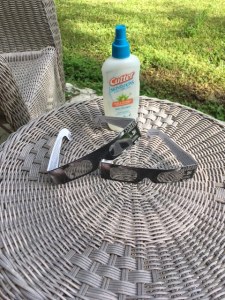 After all, I am living in the path of totality.
A location that is very attractive to people for hundreds of miles around who have been trickling into town for the last 48 hours.
Some estimates predict Charleston’s population will swell by approximately 1 million people, which is over double its normal population. I don’t know where everyone will stay, now that the hotels, Air B&Bs and campsites are filled to capacity.
And I can’t even imagine what’s going to happen with our already congested traffic Monday afternoon through Tuesday morning when people try to leave. I am imagining something akin to the evacuation traffic I witnessed during Hurricane Matthew last October, except I doubt the Governor will reverse lanes.
Though you never know.
In anticipation of this century’s total solar eclipse, folks around here have been preparing the way I used to prepare for a Kansas ice storm; that is, by running lots of errands and stocking up on food and water. Only this time, shopping lists include a pair of eclipse glasses.
Now, the day is here, and though I have plans to attend a backyard BBQ and viewing party, the sky is in fact overcast and the weather app on my phone has that little cloud/lightning bolt/rain icon thingy for the hours of 1:00-4:00 PM.
Precisely the hours the solar eclipse is to take place.
Oh, we will still notice the darkening sky, still raise a beer to toast another 100 years (talk about auld lang syne!), still appreciate the afternoon off and the strange ways the eclipse has been commodified.
But I don’t know if we’ll actually get to see it.
So, to pass the time, I’ve compiled this entertaining list of eclipse related media, the most bizarre (in my opinion) being the Chiquita Banana Eclipse Commercial below.
(And look – the sun is peeking out now, so there’s still a chance we’ll see the eclipse after all.)
Enjoy.
How the Solar Eclipse Works (great visuals): Sure, you know the basics, but why not enjoy this refresher?
Eclipse Extravaganza at Caw Caw Interpretive Center: Usually closed on Monday’s, Caw Caw is open today for the eclipse event and interpreters will be on duty to observe the behavior of wildlife (though I don’t expect alligators will jump in their cars to sit in line for a Krispy Kreme Eclipse Donut). Viewing glasses will be provided to visitors.
Astrological Significance of the Eclipse: “An interesting observation about the coming eclipse is that 5 major planets (Sun, Moon, Rahu, Mars, and Mercury) will be in close proximity within 20° and will also be under Ketu’s aspect. This planetary amalgamation is likely to make the full solar eclipse even more potent.”
Chiquita Banana Sun: Something purely silly and ridiculous that makes me hate advertising a little less.
Krispy Kreme Eclipse Donut: This will tie up traffic on Savannah Highway all day. The last time Krispy Kreme had a donut deal, we needed traffic cops!
-
A Date with Doubt by James Croal Jackson
 You look around the room
and rate singles from one to ten
in terms of melancholy
but don’t know
how to rate yourself–
Pacific waves flow through
you almost drown
in the sea of your thoughts–
the scisms between pen and mirror,
heart and mind, these are thieves
who will lie to you ‘til the Greyhound
leaves for Cincinnati at 11:30.
Until then we watch superheroes do bad
stand-up comedy in the conference room
at the new Mikey’s, eating mushroom pizza
with too-hot sauce. Bass pounds from the stage
so loudly we walk to 16-Bit next door
to drink water and pretend we are drunk,
our mouths rocketships exploring the universe
of each other– the rotation of stars
confused with physics. In the end all you want
is chocolate cake. Your blue eyes curve away
in that soaring flyball-to-left way. The way
you sway me back to simpler times
when buying CDs was a holy act
of personal preference
and I stayed sealed on a shelf in plastic,
waiting to give the world my music.—
James Croal Jackson is the author of The Frayed Edge of Memory (Writing Knights Press, 2017). His poetry has appeared or is forthcoming in FLAPPERHOUSE, Rust + Moth, The Bitter Oleander, and elsewhere. He edits The Mantle and is a former winner of the William Redding Memorial Poetry Contest. Find him in Columbus, Ohio or at jimjakk.com.
-
If Yellow Sang To Me by Linda Imbler
If yellow sang to me of bright sun’s day,

the consonance of corn on the cob served at picnics
sweet cream butter at the sideIf yellow sang to me as I watch the march
of lemony taxicabs
transporting frazzled strangers
from airports to who knows whereThe rhythm of bouncing saffron school buses conveying our future
A vase of sunflowers painted on canvas, the romantic interpretation
through beautiful hands belonging to Van Gogh,
harvest gold portrayedStunning yellow tang, the maestro, swimming amid corals in clear water
A cadence of newly sharpened pencils united with
cobalt legal padsThe aria of a canary’s song
A polyphony-
Bananas to be peeled and sliced
placed atop cerealIf yellow sang to me.
—
Linda Imbler is the author of the published poetry collection “Big Questions, Little Sleep.” Twenty-one of her poems have been published by various magazines and journals. Another poem is forthcoming in Leaves of Ink. Online, she can be found at lindaspoetryblog.blogspot.com. She lives in Wichita, Kansas.
Read last week’s poem: “Somewhere Near Odessa, 1900” by Joanne Townsend
-
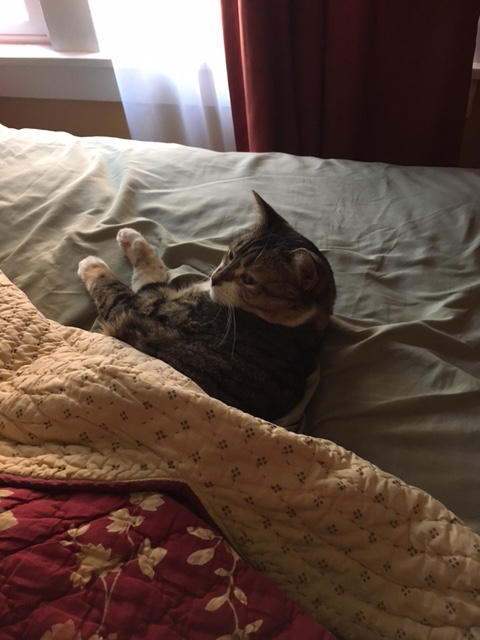
When You’re Feeling Casual on a Saturday it Must be #Caturday

Keeping it Casual, or should I say, catual? The calendar reveals a falling away of days, as does the light that changes with the earth’s slight tilt and the urgency with which cicadas call to one another.
The new semester begins soon.
Indolence is becoming sparse, time for staring out windows at a premium. Already my dreams are peppered with classroom scenarios and visions of students misunderstanding the purpose of peer review. The books in my bags and on my bedside table have transformed from fiction & poetry, a graphic novel or two, to texts and opinions on pedagogy.
These next two weeks will slip through my fingers as if I were grasping water.
I cannot keep time from fleeing, but today I will embrace the casual.
Casual as in relaxed and unconcerned, as in not regular or permanent. As in irregular.
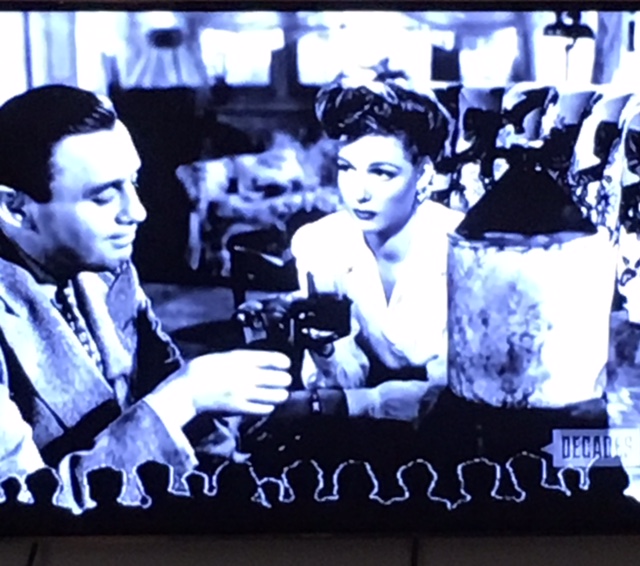
Casual as in eating out of the refrigerator, watching old movies with bad reviews, sitting on the
 broken lawn chair on the front porch even though the weather is hot and humid, wearing pjs for most of the day.
I mean ˈkaZHo͞oəl/, as in acting without sufficient care or thoroughness, puttering around the house, starting projects and not finishing them. Mooching.
And maybe later it will mean a happenstance discovery of a good deal at the local record store (it is vinyl Saturday, after all) and grabbing a iced something from a local someplace.
Just as long as it is informal,
without style,
almost accidental.
Like writing prompts? Try one of these: Fast Friday Poetry Prompts
-
Somewhere Near Odessa, 1900 by Joanne Townsend
In the low light by the river
my grandparents, so young,
stand in shabby coats and worn shoes.
The bridge casts violet shadows on their fear,
on the pine trees and frigid cold,
the black rage of Russia
an underlying hiss.
He knows he will leave,
the spoken goodbyes harder than hunger,
the thirst deep in him.
He will work and save,
send for her and the children.
He sees her tears and turns away,
his restless mind already in flight,
his feet tapping, tracks
that will fade to memory.On the way to America,
those cold damp nights on the Rotterdam,
he hears the fading colors of their voices,
diminishing wave lengths, the tossing ship
and the shock of the lonely dark.—
Joanne Townsend lived in Anchorage, Alaska from 1970 to 1995, and it was her honor to serve as Alaska State Poet Laureate officially from 1988-1992 and unofficially at the request of the Alaska State Council for two more years until the appointment of Tom Sexton. In December 2005 she moved to Las Cruces, NM which is now home. Her 24 poem collection Following the Trails appeared as an internal chapbook in Minotaur 55
(Minotaur Press 2009) She is currently working with 2 co-editors in judging poetry for Sin Fronteras: Writers without Borders 2018.
Also enjoy Joanne’s poem, “Summer Solstice”
-
Yellow Jackets and the Demons of Indecision
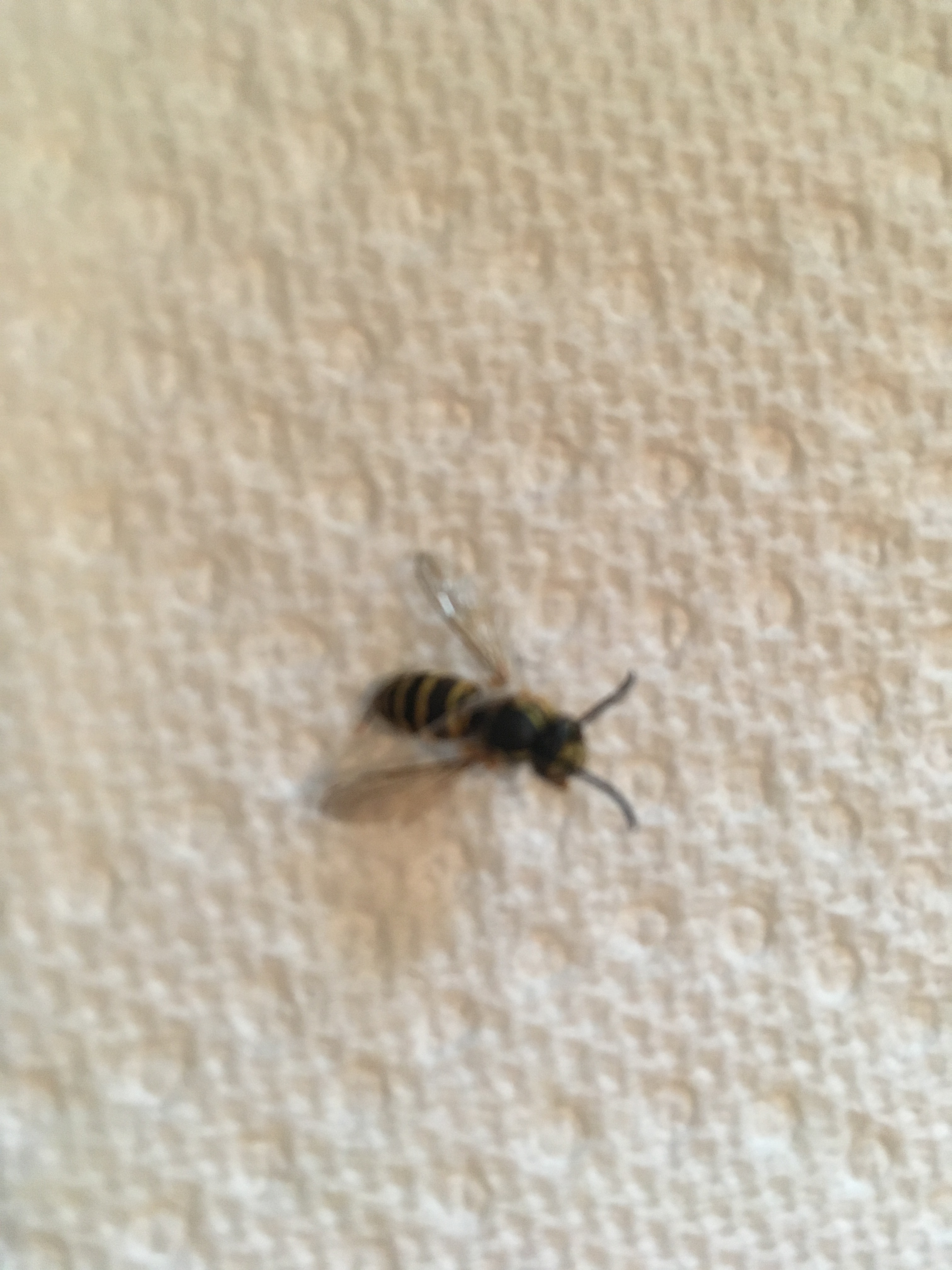
 By the time this post appears, it will have been a week since the exterminator came and took care of the yellow jacket problem in my back yard.
I didn’t know the exterminator had even arrived until my husband called me around mid-morning to say he’d received an invoice for the exterminator’s services via email. My husband was in San Diego at the time, attending the Comic Con.
I was surprised because the appointment had been scheduled for 2:00 PM., and because it was raining cats and dogs when I’d left the house at around 8:20 AM. I was attending a conference in town.
Of course, it makes much more sense to extract a wasp’s nest first thing in the morning. That’s when the nest is most occupied by wasps.
I just hadn’t thought of it.
Still, I was in doubt. I couldn’t fathom that the heavy rain and wet conditions wouldn’t interfere with the extermination. Honestly, I half-expected the phone call was to cancel.
But my husband confirmed that, yes, according to the exterminator, the wasps had in fact been “augmented” from the yard. It was a sizable nest, my husband quoted the exterminator as saying, probably 500 wasps or more. There is a chance that a few are still buzzing around looking for their home, but they won’t last long without their nest,” my husband continued.
Something about this last observation made me feel cold-hearted.
I’m not confessing a secret love for yellow jackets here, or anything like that, but I have to admit to experiencing some residual feelings of guilt over creating a situation that caused the death of hundreds of innocent creatures. Those yellow jackets were, after all, only behaving as yellow jackets do: making and protecting their home, creating more yellow jackets, and generally building an existence.
It just so happened that their existence was interfering greatly with ours.
Specifically, they made it impossible to mow the yard, first by attacking my husband when tried
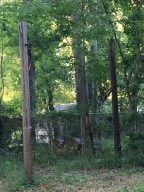 mowing the back yard before we left town, then attacking a friend, who tried to mow just the front yard while we were gone.
They simply had to go.
Still, I couldn’t help imagining those few surviving wasps, stunned and confused, hovering around the hole in the ground that was once their nest. Couldn’t help but sense their groundlessness.
Such are the thoughts of a writer.
But then I realized that, since the extermination had been taken care of, my afternoon was free.I felt cheered, then, and shifted my thoughts to how to spend the rest of my day.
And this, dear reader, is precisely the moment that the demons of indecision appeared.
A virtual drop-down list of options, including everything from doing homework for the conference to editing my manuscript, finishing a quilt I’ve been sewing to taking a nap with the cat, to going to the gym or staying on campus to work on my syllabus, all popped into my mind.
Good options, all. But together, potentially overwhelming.
Especially since I am apt to paralyze myself with indecision in these moments. I mean, just making the decision to eat out, for example, can evolve into a mental debate of what and where to eat.
Choosing to write opens an even wider array of menu options: should I write poetry or prose, something formal or informal, personal, creative or academic? Should I write something new or revise something old? Should I catch up my correspondence by sending cards or composing emails?
Really, the list is endless.
The point is, I tend to put too much pressure on myself when it comes to decisions. I feel I must make the absolute best decision and fear that making the “wrong” decision will result in drastic, long-lasting consequences which I neither wanted nor intended.
Even though this has never happened.
Still, it is true that no matter what I choose to do, I am choosing NOT to do a whole host of other things. If I write, I am not exercising. If I do homework, I am not working on my poetry manuscript. If I work on my blog at Starbucks, I am not working on my quilt at home.
And of course, making no decision at all is a decision in itself.
So it is that with every choice I make, I feel a little bit of grief and a smidgen of sorrow. Like those stunned wasps unhoused by the exterminator, my unchosen options hang around searching for a home – a place into which to burrow and build an existence.
But such are the thoughts of a writer.
-
August Invitation by Adrian Slonaker
Dance with me in that fountain with all the stone egrets,
but curse when your toes touch the chill of the ripples.
Recall the twilight bliss of Ghost in the Graveyard.
Scratch my chin in the glare of the warehouse window.
Press my hand under the Perseids,
Share an avocado milkshake with me,
and let’s endeavor to remember
that legend about sloths
and owls.
Adrian Slonaker works as a copywriter and copy editor in Lancaster, Pennsylvania, with interests that include vegetarian cooking, wrestling, and 1960s pop music. Adrian’s poetry has appeared in Better Than Starbucks, CC&D, Amaryllis, Dodging the Rain and Three Line Poetry.
Enjoy more poem at Zingara Poetry Picks
-
Summer Writing and Revision is Easy
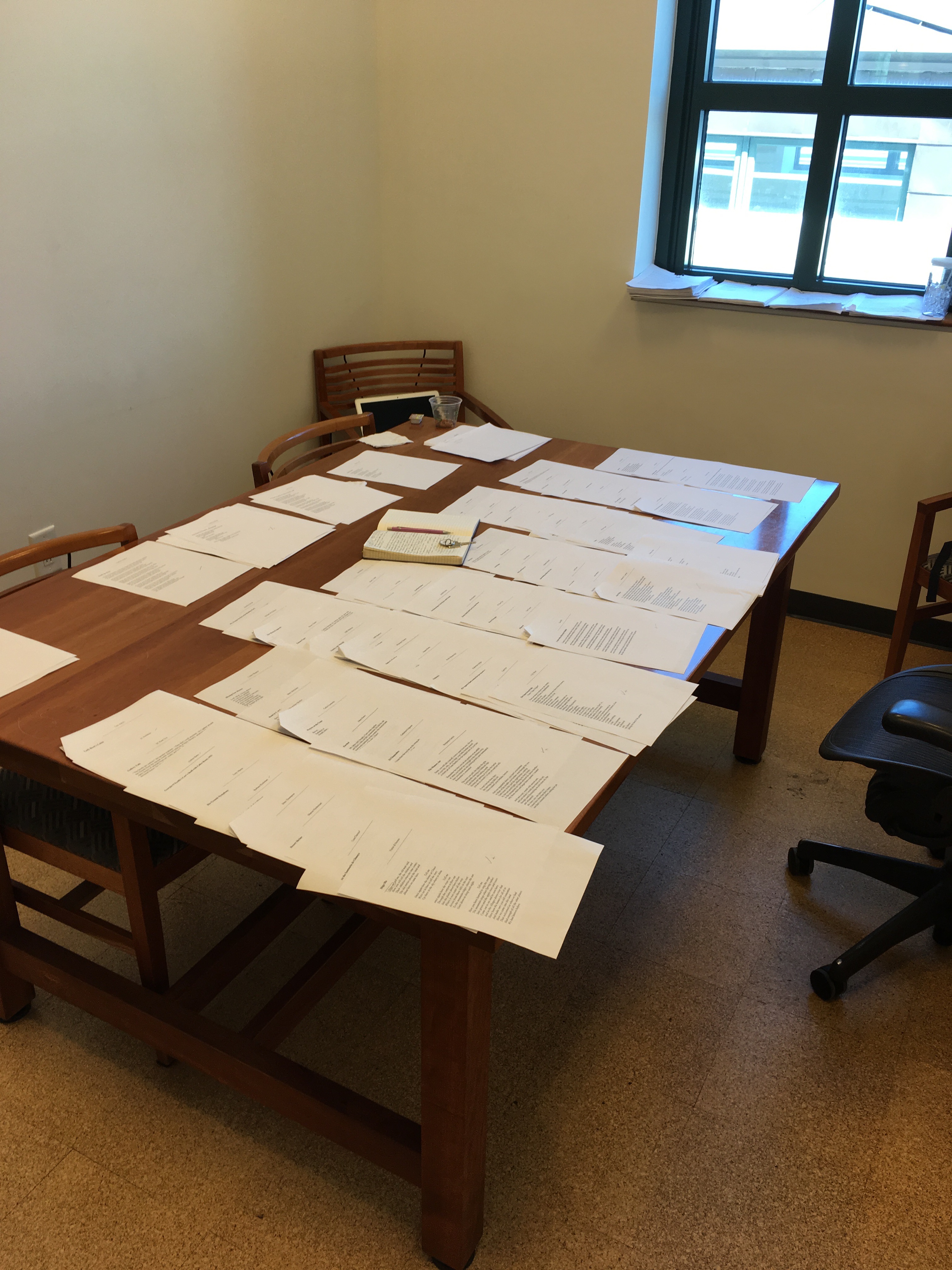
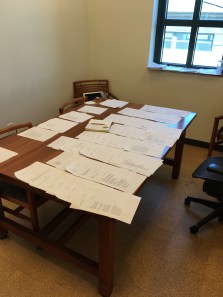 This summer, I have been availing myself of the use of the College of Charleston’s Addlestone Library’s study rooms to focus on several writing projects.
This is the first summer that the library has offered reserved study rooms to faculty, and it all came about in response to popular demand and the advocacy of the Faculty Writer’s Retreat facilitator, Lynn Cherry.
The retreat itself, held during most school breaks, is quite a boon and one that I participate in every chance I get, which has been four times thus far. Unlike a writing conference, which usually involves craft lectures, panels, readings, seminars, and, perhaps, workshops, the College of Charleston’s Faculty Writers Retreat simply provides a distraction-free study room, daily lunches, afternoon snacks, and a sense of accountability. Faculty can apply for a 2, 3, or 5-day stint and available spots fill quickly. Participants agree that they will not use the time to prep for classes, grade or browse social media. Most everyone finds they get a lot done during their selected time period, and even when there are struggles or blocks, most faculty are glad to have had the time to deal with those, too, as it actually helps them move forward.
Though I come away from the Faculty Writer’s Retreat with a different kind of same kind of high that a conference might generate, I always come away feeling productive, and centered and with plenty of evidence of my hard work. The difference is subtle but important.
This year, after a number of participants expressed just how useful it was having access to a study room, myself included, the retreat facilitator inquired into the matter on our behalf. Thanks to her initiative the good folks at Addlestone agreed to set aside three rooms for faculty to reserve for up to three days at a time during any given week this summer, up until the week that classes begin.
And I have been in one of them every week that I’ve been in town.
The first several weeks of the summer I worked almost entirely on the New Mexico Poem anthology, since that was my focus during the retreat in May, and more or less wallowed in rereading every contribution and reconsidering the organization and title of the sections. What I found interesting about the process was how I paired some of the same poems together in the revision as I had paired in the first collection, which I discovered after reviewing both manuscripts. In other instances, and maybe because of the new section titles and focus, poems wound up in very different locations.
I’m sure I’ve spent over 100 hours reconsidering the collection in detail, not including the breaks I took to remain as fresh and as objective as possible. It’s no lie that being hungry, angry, lonely, or tired will drastically affect one’s judgment, so I made sure not to deliberate while experiencing any of those states.
I sent the manuscript off to my co-editor in mid-June, right before taking off for Kansas City to visit family. As is usually the case, I found it very difficult to shift my mental state from contemplating poetry to focusing on family for those few days but finally let go and shifted my focus to the present moment and to enjoying my time away from Charleston. Now that I have returned home, the opposite is more true and I struggle to ease myself back into a life groove.
To help with my re-entry, and in the spirit of easy does it, I “suited up and showed up” to my
 reserved study room on Wednesday, after three weeks away, determined to work on something. I set no specific goal or objective – just brought with me a hard copy of my own manuscript and my computer. After getting settled in, I was able to revise a few poems, rearrange my MS into sections, and, eventually, assemble and submit a six-page manuscript for a literary magazine In which I would very much like to have my poems appear. I think the day was more productive than it would have been had I fallen into either of the two habits that are most common to me: 1) overwhelm myself with a list of a dozen possible projects on which I might focus, or 2) frustrate myself with an improbable goal. It is much better, I am learning, to have an open mind as I approach one small project at a time.
I did wind up canceling my Thursday study room reservation, however, to meet with an exterminator regarding the Yellow Jackets that have taken residence in my yard, most likely as a result of our neglecting yard work those seven months we were living in an apartment while repairs were being made to the house after Hurricane Matthew. (Yes, I can find a way to drop that bit of info into most conversations.) Yellow Jackets, I decided, are just a little more pressing than having a study room for the afternoon.
The week ahead is a busy one. I am to attend a Writing Across the Curriculum conference and have about a half-dozen appointments to see to. I was tempted to cancel my study room reservations for the week, seeing how I will only get a few hours here and there to utilize the space, but decided against it, for when things are especially busy it is especially important to hold space open for my writing. I may not get as much time as I would prefer, but any time I do capture will go under the column for successes this week.
-
Years Later You Walk In by Maryfrances Wagner
Tangled under a blanket
we could melt curbed snow,
smoke up windows,desire unable to hold.
Boiling water, morning
after, sudden laughter.You walk into my dream:
older man, panzer tan,
builder hands.How could I have imagined
you would turn: spoiled meat,
October leaf, yellow teeth.
Maryfrances Wagner’s books include Salvatore’s Daughter, Light Subtracts Itself, Red Silk (Thorpe Menn Book Award for Literary Excellence), Dioramas (Mammoth) and Pouf (FLP). Poems have appeared in New Letters, Midwest Quarterly, Laurel Review, Voices in Italian Americana, Unsettling America: An Anthology of Contemporary Multicultural Poetry (Penguin Books), Literature Across Cultures (Pearson/Longman), Bearing Witness, The Dream Book, An Anthology of Writings by Italian American Women (American Book Award from the Before Columbus Foundation), et.al. She co-edits I-70 Review.
To find out more, enjoy this previous interview with Maryfrances:
Zingara Interview Maryfrances Wagner
Enjoy more poems at Zingara Poetry Picks



 The Zingara Project