Category: Zingara Poetry Review: Poetry Picks

  • Winter Resignation by KB Ballentine

    A shower of snow, ice dust drifting.
    Hands so cold they burn, and hot pink memories
    of bougainvillea, musk rose burst
    into my mind. You, sitting in a grass field, head turned
    away from me, the first clue.

    Wind picks up, and I tug your old sled
    up the track-scabbed hill, lift our son’s small body
    onto the graying wood. Watch him laugh and tip
    into a pool of space before he, too, speeds away.

    KB Ballentine’s work has appeared in numerous journals and publications. A finalist for the 2014 Ron Rash Poetry Award, she was also a 2006 finalist for the Joy Harjo Poetry Award and was awarded the Dorothy Sargent Rosenberg Poetry Prize in 2006 and 2007.  Fragments of Light(2009) and Gathering Stones (2008) were published by Celtic Cat Publishing. Her third collection, What Comes of Waiting, won the 2013 Blue Light Press Book Award.

  • My Eco Crimes by Juan Morales

    Forgive me for running the tap too long,
    houseplants murdered, paper
    towels and paper plates,
    brand new light bulbs dropped, the shabby
    pens lost,
    and house lights left on when no one was home.
    Sorry for the now-extinct mice
    I killed for living in my air conditioner.
    The flowers cut before they went to seed
    the fruits and veggies I didn’t get around to eating
    or bottles and cans too lazy to fish
    from the trash. I apologize for leaving the crust of my bread,
    for pitching
    tin foil after one use.

    But I’m not sorry for
    the smokes I smash out after a few drags
    during the countdown toward a polluted future
    I will miss
    days of excessive living
    with soap or washers and dryers or
    radios or wallets or gas stations
    from a time when I thought
    recycling was good enough.

    Juan Morales is the author of the poetry collections The Siren World, Friday and the Year That Followed, and the forthcoming collection, The Handyman’s Guide to End Times. He is a CantoMundo Fellow, the Editor of Pilgrimage Magazine, and an Associate Professor of English at Colorado State University-Pueblo, where he directs the Creative Writing Program and curates the SoCo Reading Series.

  • The Quincy County Fair Beauty Queen Quits by J.T. Whitehead

    So few are beautiful, inside and out . . .  ugliness is much more generous.  Miss Quincy County, 1983 – she was one of the few . . . carrying out the trash was a weakly task, but for us, she undertook it in a beautifully metaphorical way, once she figured out that cheap excuse for a man – who swore he’d kill her, popped tabs,  screamed at the kids – was a no-good cracker ass, just a turd she could flush with a toilet that worked more than he did . . . you should’ve seen the skids.  They were beautiful . . . she was beautiful . . . No clutch, nor crutch, church, God . . . just . . .  beautiful . . .

    J.T. Whitehead has had over 160 poems accepted for print by over 75 publications.  He is a  Pushcart Prize-nominated short story author, a Pushcart Prize-nominated poet, and a winner of the Margaret Randall Poetry Prize. He is the Editor in Chief of So It Goes: The Literary Journal of the Kurt Vonnegut Memorial Library.  His first full length collection of poetry, The Table of the Elements, (The Broadkill River Press, 2015), was nominated for the National Book Award.

  •  Bass Lake Trail by Marc Thompson

    I keep thinking of the trees
    in this northern boreal forest
    this ocean of green
    splattered with lakes;
    an ocean
    transubstantiating
    to yellow, orange, red

    Of the jack pines and tamaracks
    that spread their roots
    across the forest floor
    twisting and dodging
    large swaths of granite
    before diving in
    to the shallow earth

    Of two million years ago
    when a burning white landscape
    scraped everything away;
    erased ferns and mastodons
    striated the bedrock
    and buried the land
    in ice half a mile higher
    than the top of my head

    Of wolves, bears,
    moose, and humans
    whose lives depend on
    lichen
    pale, green lichen
    digesting billion-year-old quartz
    and expectorating soil.


  • That Little Leaf by Rebecca Oet

    Sheep, grazing in the fields,
    each one’s nose following the other’s furry tail.
    We are like these cloud brained sheep, numbly following the shepherd.
    Me, I was the same, sitting at a stained, cracked desk typing away.
    My window was open,
    and a leaf drifted through,
    the type of leaf that seems to be the same as any other,
    but I saw it anyway. I got up,
    my keyboard falling,
    falling and splintering on the drab carpeted floor.
    My eyes are spinning,
    swirling now.
    The leaf goes back out the open window,
    and I chase it, right out the window.
    Now I have my quest, and I follow it diligently,
    skimming over the oceans, and soaring above the earth.
    I am carefree,
    alive.
    Until I see you. Just that one glance of you disrupts all of my work,
    you have deadened me.
    My little leaf soars away, and I do not follow.
    You, with your jacket flying in the wind, I can’t get you out of my mind.
    You are beautiful, and strong, and clever too.
    You are my highest idol, and I need to meet you, I scramble over the underbrush, desperately seeking you,
    but you are forever unattainable.
    But taking a glance in the mirror, I finally see.
    The you I was seeking, is me as I should have been.
    I cast off my wings, and plummet back to earth to join you.


    Rebecca Oet is a student from Solon, Ohio, USA.  She enjoys reading, writing short stories and poetry, and of course, taking pictures. Rebecca is a national silver medalist in the 2015 Scholastic Art & Writing Awards and has won multiple awards for her writing and photography. She often fantasizes about growing wings and flying through the air.

  • Discovery by Sheila Cowing                   

       (The Ardèche, France)

    DSCN3641

    What they felt beneath that cliff
    at the turn of an old mule path
    from which stretched grape vines,
    on that brushy ledge was a tiny draft
    urging them to clear grass, sticks.

    Wriggling through the hole:
    there by headlamps, translucent
    stalactites, then a rhino,
    red ochre on white rock, red
    dots like blood drops on a lion,

    owl, ibex, aurochs,
    an elegant running horse,
    these, the oldest known paintings
    on earth; bear bones strewn on the orange
    floor, Auragnacian fingerprints.

    What is rare and precious grows
    in dream light, in darkness, earth’s slave,
    the cavern of sleep. The human edge
    of holy, dreams may be packed
    with meaning, mass and presence.

    Among ancient souls the earth
    was created in dreamtime;
    sung by each telling its origin,
    its animals, plants, people,
    songs passed down and down.

    Six years the editor of an award-winning children’s magazine, Sheila Cowing has also been a landscaper, a book salesperson, and hardest of all, mother of three daughters. She has published non-fiction and three collections of poetry.  She enjoys great views of two mountain ranges with her five-year-old cat and her aging hound.

  • Amber by Jeanne DeLarm-Neri

    Before the boots wore out we found
    a vast ridge of desert hills to cross,
    villagers to meet, other hands to hold.
    We talk like we did at fourteen,
    tucked under blankets miles separated,
    at three a.m. Back then, the phone cord
    stretched to the end of its coil.
    We stayed quiet as mice in walls
    but not quiet at all – stop that scurrying!
    Sleep now. The unconscious has surfaced.
    Blood pumps DNA –it twists, dances.
    We’re ancients, you and I.
    The liquid of us received the fall of gnats
    and wasps – their wings fell into us,
    fossilized. These chunks of amber
    once flowed free. We forget how blocks
    form, how eons compress into the size
    of postal cartons till we feel the rush
    that made them, when sap oozed
    and plasma shimmered in its puddles,
    back when the exciting conduit transported
    the minerals of what we’ve become.

    Though Jeanne DeLarm-Neri has written poetry and stories for her entire life, she also earns a living in other fields, particularly as a bookkeeper at a private school, and as a vendor of antiques. Her poems and short fiction have been published in two anthologies (In Gilded Frame 2013 and Poems Of The Super-Moon, 2015), and several literary journals, one of which, Slipstream, nominated a poem for the Pushcart Prize. In 2014 and 2015 she was a contributor at the  Bread Loaf Writers’ Conference. She’s currently working on a book of poems and a novel.

  • My father tells me when I am married I will learn a new trick: by Tiffany St. John

    to make the sun shine brighter

    by my relative dimness, to reflect
    the light of a lover, to speak

    in the tones a cattail speaks in,
    to be the plain, but not the wind across it.

    Sometimes, he says, you can be completely invisible.

    He tells me to be a toothless
    lion, to wait

    in the paleness of night for a brassy star
    to overpower me.

    Joy is in the sacrifice,
    he says. My father says. My father

    who has never been pollen, carried
    from one stamen

    to another, who does not lie like a needle in a pile
    the size of a haystack, or been strings plucked

    until the sound waves grew cancerous,
    who has never steamed away, singular

    into something plural, into pocket-sized ghosts,
    who has never been erased from photographs

    or been a moon.

    Tiffany St. John is an eager pursuer and peruser of Poetry, Psychology, and Philosophy. She lives with her husband and two cats in Columbus, Ohio. She has been published in Black Warrior Review and awaits publication in the upcoming anthology Poetry on Loss through Little Lantern Press.

  • A Small Event by Stanley Kaplan

    The source of the singer’s lament,
    stuck in his clogged throat,
    holds the story in its hideous space.

    Hiding the false meaning he was told,
    tittering like the bird, hiding in its
    plastic cage,

    he tries to sing, but chokes instead,
    too much this day his daily bread,
    his Vegas stint, his small event.

    Stanley Kaplan has published poetry in a number of journals, including Onthebus, Midstream, Chiron, Ragazine, Quiet Courage etc. with more forthcoming. He lives in New York City, where he paints as well as writes, He is the recipient of a Pollock- Krasner Foundation grant and his paintings can be seen at www.pkf.org.

  • Remembering Monk, 1966 by Denise Low

    Thelonius prowls stage
    edges while

    the drummer
    drills a solo

    jigs back backwards
    to the bench

    spreads fingers
    stares at them

    ripples an arpeggio
    see-saw fall

    clunks two
    notes at once

    stops
    for the cymbals

    walks behind curtains
    comes back

    outlines a snake spine
    of notes stops

    walks out maybe
    gone maybe.

    Denise Low, a Kansas Poet Laureate, is award-winning blogger and author of 25 books, including Jackalope and Mélange Block. Her memoir Turtle’s Beating Heart is forthcoming, Univ. of Nebraska Press. Low is past board president of AWP. She has an MFA, Wichita St. Univ., and Ph.D, Univ. of Kansas. www.deniselow.net    


  • 2016 Zingara Poetry Picks Complete

    This morning, I selected the last poem for 2016’s Zingara Poetry Picks and am happy to report that this will be the first time in the site’s history that a poem will be posted for every week of the year. It also represents the achievement of a goal I have been chasing since re-visioning this project in 2010.

    Zingara Poet is a labor of love, one that requires a lot of time which must be carved out of a of a busy life filled with such activities as grading papers, taking the cat to the vet, having the car repaired, paying taxes, fixing dinner, spending time with the husband, seeing the dentist, moving across country, finishing an MFA, and, oh yes, sleeping.

    Still, I always approach the project with anticipation and always look forward to reading the submissions in my inbox. I am frequently impressed by the quality of work and often find myself contemplating a poem for several days — which often means my readers will, too. And because this year’s submissions have been so wonderfully awesome, I’ve lingered even longer than usual in making final selections.

    Let me reiterate that previous point: This year’s submissions were truly wonderful. I am humbly grateful.

    All this careful reading and busy life-living, however, imposes a longer wait-time for those who submit work. Some poets waited for as many as as eight months before hearing from me this year, and though no one has been unreasonably grumpy about this situation, I am looking into ways of cutting that wait-time down.

    Firstly, there will be two submission periods for 2017. Poems submitted during the first submission period, August 15 to December 30, 2016, will be considered for the first half of 2017 (January – June, 2017). See submission guidelines for complete details.

    Poems submitted during the second submission period, February 1 to April 30, 2017, will be considered for the second half of 2017 (July-December) 2017).

    As always, I reserve the right to extend these submission periods.

    Secondly, beginning August 1, (that’s today) I will be bringing an intern on board to help with administrative tasks, thus freeing me up to read and respond to submissions in a more timely manner. I will be introducing her to you in the next week or so.

    Thirdly, well, there isn’t a definite third thing yet, though it is developing and involves a lot of brainstorming on my part. In any event, more great features and opportunities will be unveiled in the weeks and months ahead. Just know that I am moving toward making the project more visible and viable. Besides, building something carefully over time is preferable to doing too much too soon. Two big things can be enough for now.

    Let me close by once again thanking all of this year’s contributors and readers. Zingara Poet means to be the change I wish to see in the publishing world. If you like the direction in which this project is moving, please submit your poems, subscribe to the site, and share widely with your friends.

    Write On!

  • How does the rooster know when to crow by Rae Marie Taylor

    and the fly to start buzzing
    right now
    How do they and
    all the birdsongs know to stop
    and wait

    while the sun
    climbs up the other side of
    Kitchen Mesa sending rose glints
    into the sky
    but not yet, not quite touching
    the soft red earth
    where I stand
    two ravens know to swoon
    past with a soft, throaty greeting
    quickening trills and twitters
    there in the gulch
    below

    the sun’s glowing
    right now
    the purest white
    down the Dakota Sandstone
    caressing
    purple mudstone
    where fossils still lie.

    Rae Marie Taylor performs on Spoken Word stages in Quebec and the American Southwest. Author of the poetry CD Black Grace, Rae’s The Land: Our Gift and Wild Hope also won the 2014 Colorado Independent Publishers’ Merit Award and was Finalist in the 2013 New Mexico-Arizona Book Awards (environment).

  • Sleeping with the Squirrels by Tracy Mishkin

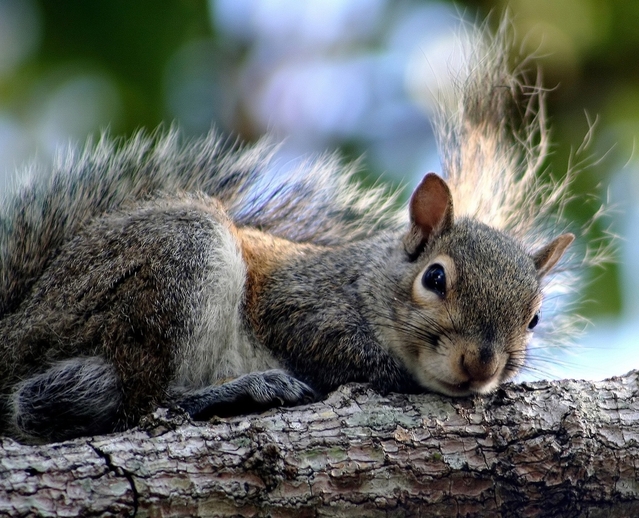
    he-wuvs-me-squirrel-1385571-639x518Leaf-fall reveals their fat nests
    cluttering branches, silhouetted
    against the pale sky like hornet hives.
    Still, I am a guest. I climb.

    Thirty feet up, where two limbs meet,
    the fox squirrel sits in the shadow
    of her tail, invites me into the hollow
    sphere perched on a platform of twigs,
    lined with grass and moss.

    She sets acorns before me, this solitary
    forager, bustling and clucking until
    I take one. We talk of kits and children
    until we can scarcely see each other.
    Her eyes brighten when I accept
    her invitation to spend the night.

    Sleeping with a squirrel is like curling
    up in a hammock. I am warmed
    by the embrace of her luxurious tail
    under a blanket of leaves.

    Tracy Mishkin is a call center veteran with a PhD and an MFA student in Creative Writing at Butler University. Her chapbook, I Almost Didn’t Make It to McDonald’s, was published by Finishing Line Press in 2014.

  • Walking an Old Dog by Lisa Chavez

    we rest more
    often. His eyes clouded
    with cataracts,
    hearing dulled
    so he startles
    sometimes.  His hips sway
    with ache, but he
    whiffles his way
    through a scent rich world.

    Walks are shorter, slower
    and even I see
    more–the caterpillar’s
    circuitous journeys,
    the pinon cones
    opening like fists
    dropping their treasure.
    We pause
    to look or sniff.
    Then head home,
    the sun behind us
    like the span of his years
    and our shadows
    thinning to fade,

    lengthening
    toward the end
    of the day.

    Lisa D. Chavez has published two books of poetry, Destruction Bay and In An Angry Season. Her essays have appeared in Arts and Letters, The Fourth Genre and other magazines, and in anthologies including The Other Latin@: Writing Against a Singular Identity, and An Angle of Vision:  Women Writers on their Poor and Working Class Roots.  She grew up in Alaska and currently lives in New Mexico, and has a keen interest in Japanese dogs and in perfume. Find her online at lisadchavez.com

  • A Wild Hair by K.L. Frank

    A few errant fibers bristle
    from the fallow field
    below my chin, waving goodbye
    to more subtle golden fuzz,
    that once hummed in spring’s
    soft hormonal breezes.
    In blatant disregard
    of harsh depilatories,
    bleaching creams, and tweezers,
    these outlaw strands fly free,
    battle banners
    raised above years ripened
    past their summer prime.
    For now is the autumn
    of more brutish shoots –
    stiff dark hairs that defy
    any downward drag
    and thrust outward, splayed fingers
    reaching toward dreams
    muscles fatigued in the fight
    against gravity can no longer grasp.
    These hairs mark my last attempt
    to step up to the edge of etiquette
    and shout a challenge,
    my final foray into impudence.

    Karin L. Frank is an award-winning author from the Kansas City area. Her poems, including haiku, and prose have been published in both literary journals and genre magazines in the U.S. and abroad.