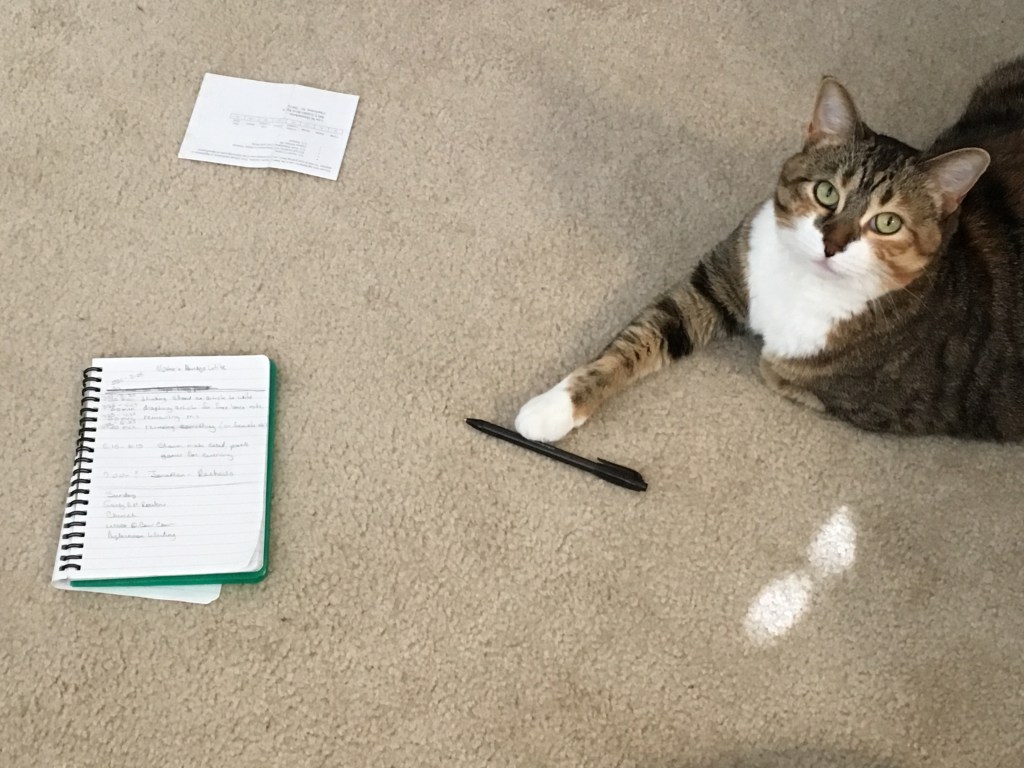
Category: Writing Exercises

  • Submission Deadline Approaching

    Submission Deadline Approaching

    The deadline for submitting poems written in response to prompts 1-6 posted during this year’s Poem-a-Day challenge is Sunday, August 31.

    PROMPT 1: Journal Splunking – Skim entries from old journals and diaries from a year or more ago jotting down interesting words, lines, phrases, sentences or images as you do so. The goal is to compile a page (or more) of fragments that still resonate emotionally but resist nostalgia and thwart typical associations or your own predictable writing patterns.

    PROMPT 2: Protection – What are you protecting yourself from? What are you protecting your loved ones from? Make a short list of items, people, parts of self, or conditions you feel you need to protect or to be protected from. Next, select one or two items from your list, perhaps related, to write about. Describe why protection is needed an how to protect persons, places, items, or condition you listed.

    PROMPT 3: Beginnings – There are several websites who post poems by well-regarded literary poets on a daily basis, including Poets.Org, Poetry Foundation, and Verse Daily. For this prompt, read poems posted for today on one or all three of these websites. Select a first line of your choice to begin a poem of your own. Once your poem draft is more or less complete, remove the first line and give your poem a new and unique title. Alternatively, if you decide to keep the first line, just credit the poem and poet from which the line is borrowed using an epigraph. Something like “after Emily Dickinson.”

    PROMPT 4: Whispers of Work – Write a poem about a profession which does not exist anymore or which is phasing out. If you like, you can aim for an ode, a lament, a diatribe, a docu-poem, narrative poem, or found poem with your chosen profession as the central image, setting, or source. Examples of extinct professions: ice cutter, elevator operator, milkman, lamplighter, switchboard operator; Examples of professions phasing away: farmer, travel agent, mason, tailor, literary translator: Professions at serious risk: writer, teacher, librarian, journalist.

    PROMPT 5: Absence Unfolding – Freewrite about absence, absenteeism, or absent things. Start with real, ordinary absences, both abstract and concrete, then progressively write about larger absences, each growing in size and scope, even to the point of hyperbole, until you find an absence that feels larger than all other absences, larger than the world, larger than the universe. Make one of them the subject of your poem.

    Prompt 6: Transformation – Make a list things in life that you find ugly, shameful, or repulsive–things like foot odor, rudeness, cockroaches, road kill, belching in public, etc. Choose one or more items from your list to include in a poem. For an extra challenge, see if you can transform something usually deemed ugly into something desirable, beautiful, and worthy of admiration.

    GUIDELINES

    Please send 1-2 poems inspired by any prompt posted during National Poetry Month April, 2025 in the body of an email to ZingaraPoet(at)gmail.com.

    Include NAME OF THE PROMPT in the subject line of your email.

    Include a few sentences about your writing process (how you got from prompt to final draft) in your email. It’s not necessary to explain what your poem is about, rather I am interested in why you made the choices that you made. For instance, why did you chose couplets (or other stanza length)? How did you discover the imagery or metaphors used in your poem? How many revisions did you make? Not these exact questions, but questions like these can serve as your guide.

    For a great example of a poet writing about their process, take a look at the most recent guest blog post at Marsh Hawk Press in which Ellen Bass explicates some of her work. You do not have to be anywhere as involved or detailed as this example, but it does exemplify the kind of approach I am looking for.

    Poems may be overtly related to any of the prompts, or have only a thread of connection. If you wrote a poem in response to a prompt and threw out all but one line during revision, that counts. Surprising is preferred to the predictable.

    Be sure to also mention if you happened to use any of the revision prompts posted during May and June in the process.

    Include a brief professional biography of 50 words or fewer, also in the body of your email.

    Simultaneous submissions are fine, but please let ZPR know immediately if submitted work is accepted elsewhere.
  • Fail Better

    Seems like, when it come to revision, my work becomes better when I keep the stakes low.

    For today’s prompt, try revising a poem with the aim of making it worse.

    Alternatively, revise a poem by un-poeming it. That is, take away its lyricism, imagery, meter, and figurative language.

    When finished, pat yourself on the back for a job well done.

  • Mash Up

    Today’s revision exercise suggests you select several rough and unfinished poem drafts to remix or combine. Here are a few approaches for consideration:

    More is More: Combine two (or more) poems into one longer poem. Feel free to rearrange stanzas or lines. Consider creating a sectioned poem or a poem with parts.

    Half and Half: Cut two poems in half and switch them around so the first half of poem one is now the first half of poem two and the first half of poem two is now the first half of poem one. Try variations of this process using three poem draft, or even four.

    Print and Cut: Print copies of your chosen poem drafts and cut them apart by lines, stanzas or words. Place these cutouts on a clean table top and move them around. Experiment with different layouts and ordering until you have a new poem — one that feels finished or one that could be finished with just a little more revision or editing. Alternatively, the process may trigger an entirely different poem.

    Line Roulette: Write a new poem using random lines from several poem drafts. You can add order to the process by making your own rules, such as using first lines from four or more poems for the first stanza, second lines for the second stanza, and so on.

  • Find Your Rhythm

    I’m never one to impose rigid patterning into or onto a poem, but if a rhythmic pattern exists, the poet may want to take advantage of it.

    Scan several poems you wrote in April and determine if they have a natural rhythm and/or meter.

    Did you serendipitously write a poem in iambic pentameter or some other meter?

    Do your lines seem to consistently contain a certain number of syllables?

    Whatever you discover about your poems’ rhythms, lean into those rhythms and make them more intentional, more deliberate.

    Once you identify a poem’s pattern, interrupt it once or twice to create interest and tension.

    For example, if your poem contain 8 syllables per line, revise or write a line or two that contains 7 or 9 syllables.

    If your poems seems to utilize anapestic hexameter, throw a dactyl or a heptameter into the mix.

    Remember to keep the rhythm as natural as possible to avoid slipping into sing-songi-ness or Yoda speak.

    Below is a quick review of feet and meters for reference.

    See what arises for you, but don’t feel compelled to force anything.

    Feet in Poetry

              Iamb: a metrical foot containing two syllables, the first of which is unstressed and the latter of which is stressed (e.g., “today”).

              Trochee: a metrical foot containing two syllables, the first of which is stressed and the second of which is unstressed (e.g., “matter”).

              Spondee: a less common metrical foot in which two consecutive syllables are stressed (e.g., “A.I.”).

              Anapest: a metrical foot containing three syllables, the first two of which are unstressed and the last of which is stressed (e.g., “unaware”).

              Dactyl: a metrical foot containing three syllables, the first stressed and the following two unstressed (e.g., “Waverly”).

    Meter in Poetry

    The length of poetic meter is described using Greek suffixes:

              Monometer – one foot, one beat per line

              Dimeter – two feet, two beats per line

              Trimeter – three feet, three beats per line

              Tetrameter – four feet, four beats per line

              Pentameter – five feet, five beats per line

              Hexameter – six feet, six beats per line

              Heptameter – seven feet, seven beats per line

              Octameter – eight feet, eight beats per line

  • Be Kind, Rewind

    One of the earliest revision exercises I remember experimenting with in my early days of writing poetry was to write an existing poem in reverse, a tactic, it turns out, that has variety of approaches:

    • Writing a poem backwards, literally word for word, perhaps adjusting grammar and syntax to accommodate the new structure, perhaps not.
    • Writing a poem backwards line by line, adjusting for grammar and syntax along the way, or not.
    • Writing a poem in reverse stanza by stanza (stanzas retain their line order, but the order of the stanzas are reversed).
    • Leaving each line in place but reverse the order of the words.
    • Leaving each stanza in place but reversing the order of the lines.
    • Writing a poem in reverse in terms of imagery (last image first, first image last).

    The point really is not to write perfectly reversed poem to show that you are able to follow instructions correctly, though that may be the end result, but to rearrange the ways we see and interpret the poem and how it works and to follow where new discoveries lead. To allow the poem to lead rather than to impose meaning on the poem.

  • Focus Prompt

    Use the Emily Dickinson’s poem “Hope is the thing with feathers,” included below, as the main focus for a free writing exercise (writing without lifting your pencil or stopping to make corrections to grammar, spelling, capitalization, or punctuation, for a set period of time). Aim for 20 minute of continuous writing.

    If helpful, you can center your freewrite on a specific image or line from the poem or expand on the larger abstract idea of hope itself.

    Write quickly without overthinking, but keep your writing legible too (if handwriting).

    The goal is to capture your inspired ideas as they arise. If the first few minutes are awkward, that’s okay. The good stuff is usually buried underneath those initial, oftan banal thoughts and concerns. Write PAST the “crap.”

    After a day or so, return to your free-write and use it as basis for a new poem.

    Hope is the thing with feathers
    That perches in the soul
    And sings the tune without the words
    And never stops at all,

    And sweetest in the gale is heard;
    And sore must be the storm
    That could abash the little bird
    That kept so many warm.

    I’ve heard it in the chillest land
    And on the strangest sea;
    Yet, never, in extremity
    It asked a crumb of me.

    Poem for inspiration:

    Emily Dickinson May Be Weary” by Rikki Santer, Zingara Poetry Review


  • When Writing Feels Unreachable: Ten Easy Writing Activities

    Because when you get busy, you get better:

    • Take a walk, a swim, a bike ride, or otherwise stimulate your endorphins. Endorphins make you feel good!
    • Read something unfamiliar to create new neural pathways in your brain.
    • Get to know your work, and voice, by rereading favorite works by you — objectively. Take notes.
    • Paint a picture. Plenty of studies support that learning to paint improves writing.
    • Make a list. Doesn’t matter what kind, it will engage, and quiet, your inner editor.
    • Iron clothes, mindfully. It helps with focus (and you’ll look extra sharp for that next dress-well affair). Alternately, do a jigsaw puzzle.
    • Talk with a writer or artist friend. They know what you’re going through.
    • Get negative. Imagine all possible negative outcomes of your not writing, now or forever. See, things aren’t that bad!
    • Watch a favorite movie and take notes on plot, characterization, dialog, setting, etc.
    • Listen to a favorite podcast, preferably one involving writers (think interviews, readings, craft discussions). One of my favorites is On Being. Krista Tippet frequently interviews poets and writers.

    WRITE ON!

    Like writing prompts? Check out Fast Friday Poetry Prompts

  • When You’re Feeling Casual on a Saturday it Must be #Caturday

    Keeping it Casual, or should I say, catual?

    The calendar reveals a falling away of days, as does the light that changes with the earth’s slight tilt and the urgency with which cicadas call to one another.

    The new semester begins soon.

    Indolence is becoming sparse, time for staring out windows at a premium. Already my dreams are peppered with classroom scenarios and visions of students misunderstanding the purpose of peer review. The books in my bags and on my bedside table have transformed from fiction & poetry, a graphic novel or two, to texts and opinions on pedagogy.

    These next two weeks will slip through my fingers as if I were grasping water.

    I cannot keep time from fleeing, but today I will embrace the casual.

    Casual as in relaxed and unconcerned, as in not regular or permanent. As in irregular.

    Casual as in eating out of the refrigerator, watching old movies with bad reviews, sitting on the broken lawn chair on the front porch even though the weather is hot and humid, wearing pjs for most of the day.

    I mean ˈkaZHo͞oəl/, as in  acting without sufficient care or thoroughness, puttering around the house, starting projects and not finishing them. Mooching.

    And maybe later it will mean a happenstance discovery of a good deal at the local record store (it is vinyl Saturday, after all) and grabbing a iced something from a local someplace.

    Just as long as it is informal,
         without style,
              almost accidental.


    Like writing prompts? Try one of these: Fast Friday Poetry Prompts

  • New: “Writing from the Heart” Begins This Week in Summerville

    IMG_0586[1]Writing from the Heart
    2nd and 4th Tuesdays of the Month
    Beginning September 14, 2016
    7:00 – 8:00 PM
    Serenity Center
    820 Central Avenue
    Summerville, SC
    No Registration Required, Drop-ins Welcome
    $12.00 per session

    Writing from the Heart

    Whether retraining thought patterns or drafting a lyric poem, journal-writing helps normalize the stuff of life. It is where we make sense of life events and give voice to complex and nuanced emotions. It is where we have permission to rant, wax nostalgic for the good old days, dream about the future, or write crappy sentences. Most of all, it is a space where we can deepen our connections to the world in which we find ourselves.

    Bring your journal, and your heart, to this bi-weekly workshop to learn techniques that will deepen your relationship with your journal and yourself to discover fresh new ways to approach your writing time. Each session will begin with a brief discussion of a meaningful piece of writing, such as an essay, poem, or excerpt from a memoir, which will be followed by a meditation or invention activity. Participants are then invited to write a response in their journals. There will be at least fifteen minutes dedicated to writing time and participants may share if moved to do so.

    Topics include:

    • How to bring a sense of playfulness to our writing (and life)
    • Deepening our inner resources
    • Creativity through self-understanding
    • Overcoming writing blocks
    • Discovering how we limit ourselves (and stop doing so)
    • Changing neuropathways through writing

    About the facilitator:
    tutor photoA passionate teacher who is dedicated to (and fascinated with) the writing process, Lisa Hase-Jackson has been teaching and coaching writers since 2004 when she was granted a fellowship in the Washburn Writing Fellowship program at Washburn University in Topeka, KS. Since then she has facilitated writing circles, workshops, and seminars in such places as Albuquerque, NM, Anyang, South Korea, Kansas City, MO, Toronto, Canada, Allentown, PA, and Charleston, SC. She holds an MA in English with an emphasis in poetry from Kansas State University and an MFA in poetry from Converse College in Spartanburg, SC. Her poems have been published in numerous literary journals and magazines as have her articles on writing and the writing life. A few of them have won awards.

    A recent transplant to Charleston, Lisa teaches Poetry and Honors English at the College of Charleston and particularly enjoys spending time at the beach or going on bird walks at Caw Caw Interpretive Center. She continues work on her poetry blog, ZingaraPoet.net, and is actively (and hopefully) submitting her poetry manuscript to suitable markets. She is an avid journal writer and has a shelf of journals to show for it. When not writing, teaching, working, or exploring, Lisa enjoys spending time assembling scrap quilts and doing simple knitting projects.


  • Living Poetry Prompt

    Misc iPhone 2015 004

    It’s amazing that we are here at all.

    What I mean is, we human beings are a complex mix of resiliency and vulnerabilities. We take risks dashing across busy streets, regularly travel great distances over vast oceans in planes and boats, forget and leave the oven on, encounter dozens of harmful germs and bacteria while moving through our lives, and still manage do out best to help others every day. We survive heartache, bounce back from job terminations, mourn the death of loved ones, and still, on a whole, manage to get up every morning and, more or less, do it all again.

    Maybe we deal with insomnia or indigestion, maybe our cholesterol is high and our metabolism is low, maybe we get depressed, and maybe we drink too much, but were’ alive, damn it, and as long as we are, we remain determined.

    For today’s prompt, write a list of every near miss you’ve had in your life. Include the time that guy in the red Corvette DIDN’T hit you when he ran the red light, or the time you THOUGHT you were drowning but really just got water up your nose. Also include those near misses you don’t distinctly remember but which likely happened, like surviving 300 consecutive days of rush-hour traffic in Los Angeles, or something like that. Get fantastical, get lyrical, and make your list long, true, doubtful, and outrageous.

    Once you’ve compiled an impressive list of near misses, which may or may not have really occurred, use them as inspiration for a poem.

    If you feel up to a challenge, include every singe item on your list, even though the resulting poem may feel contrived. It’s OK, you can always revise.

    Otherwise, just pick and choose the most interesting, significant, or unusual instances on your list and use them as motivation to write your next AMAZING poem.

    And don’t forget to revise.

    When you’ve finished your draft, take a look at this finsihed poem by Laura Kasichke, which is all about “Near Misses.”

  • Modern Ode Prompt

    Thanks to Erin Adair-Hodges for today’s poetry prompt inspiration:

    Today’s prompt is to write an ode. Not a classical or even English ode, which follow particular formats, but rather, just write a poem in praise of something. Except, since we’re post-post-post, not really. Write an ode to something not usually praised or for which you have, at best, mixed feelings. Here is a great example, Kevin Young’s “Ode to the Midwest.”

    This exercise is inspired by my trip to the dentist today. There were kitten posters on the ceiling.

  • Help Yourself Prompt

    Here is my version of an exercise that’s been floating around the writing world for some time. It’s simple, straight-forward and pretty powerful. Please complete each step before moving on to the next.

    —–

    First, list the things in life that get between you and your writing and creativity – even those things that are legitimate, like taking care of the kids and washing the dishes. Include on this list any pesky internal obstructions and voices, like “I can’t write about that, it would hurt ____.” Make the list as long as you have time for – you can return to it for future writing exercises.

    Second, read over your list and select one or two things that are particularly vexing for you at this very moment. It might be different the next time you approach this exercise – that’s fine. For now, go with your instinct and choose one or two items from your list that are really giving you a tough time or bogging you down in some way today.

    Third, imagine yourself in a private sanctuary or someplace like Superman’s fortress of solitude. You are safe and everything you say is completely protected and will never be heard by another living soul. Spend the next 20 or so minutes writing, in first person, a detailed description of a specific time you wrestled with one of the challenges on your list. Where did it happen? When? How? It’s important that you don’t generalize here. Be as specific as you possibly can.

    Fourth, reread the story you’ve just written but change the voice and perspective from first to third person (that is, change every I to a she/he or to a proper noun – like Joe). You may need to adjust verbs while you’re at it.

    Fifth, do not continue until you’ve completed step three.

    Sixth, read and listen to yourself as you read the new story (aloud or silently in your fortress of solitude). Put yourself in the role of sympathetic advisor and offer some useful, helpful and empathetic words of support and advice for the person (that’s you) in the new story. Notice how you feel a little lighter and more empowered?

    You can use these steps as a kind of template with which you can experiment in order to overcome writing or any creativity block. It is adjustable and can be made to fit any circumstance.

    Happy writing!

  • Write With Joy Prompt

    Today’s writing exercise is adapted from Rebecca McClanahan’s “Write Your Heart Out. ”

    We find it relatively easy to write when times are tying or when we experience grief, sadness or anger. We are, after all, encouraged to use our journals to vent about difficult situations so that we might work through them. Experience may have even taught us that this approach to our discomfort and confusion is preferable to sitting with these frustrations for an inordinate amount of time. McClanahan refers to this tendency to write only when in pain as the “foxhole syndrome: writing as desperate prayer.” When happiness returns, we suddenly have nothing to say.

    Perhaps this is because happiness so absorbs us that we don’t stop to think about writing. Maybe we fear writing about our happiness is tantamount to testing the fates. McCallahan writes that:

    French theologian Francois Mauriac called happiness the most dangerous of all experiences, ‘because all the happiness possible increases our thirst and the voice of love makes an emptiness, a solitude reverberate.’ Seen this way, happiness is a scary proposition. As our capacity for joy increases, so does our capacity to feel all emotions. So won’t we be sadder than ever when the happiness ends?(98)

    Or maybe we just forget to notice the small things that do make us happy. Our brains are finely tuned to notice the dangers that surround us and dismiss that which cannot immediately hurt us. If it is not a threat, we do not make note of it.

    Take some time this week to notice things that bring you joy, no matter how small, and make a daily list. Start with yourself – your eyes, hands, ears, nose, etc. From there, take in your surroundings and note that which bring you joy – music, books, a warm blanket and a comfy couch.

    This exercise only takes minutes a day and will result in a more joyful you.

    Good luck, and happy writing.

  • Write Despite Distraction

    Even writers with a room of their own have to deal with distractions. Family members, loved ones, and friends all quickly figure out how to encroach on whatever protected time or space a writer manages to carve out for herself. Fight fire with fire by desensitizing yourself to distractions. Set an alarm clock or kitchen timer to go off in increments of varying length, ten minutes for the fist session, fifteen or twenty for the second, five for the third, or whatever combination suites your needs. Try this exercise for a period of sixty full minutes if possible. Each time the alarm sounds, take just enough time to reset it, then get right back to writing.

    If it is difficult at first to shift your focus from alarm to page, and it probably will, try taking a few deep breaths and center yourself mentally by repeating the following incantation before returning to your writing: inhale and say,  “I am…” exhale and say “writing right now.”

    Remember, learning to regain your writing focus after a distraction is the goal of this exercise. It will likely feel uncomfortable and difficult at first, but will become easier with practice.Completing this exercise will give your brain a point of reference – a successful experience of dealing with distractions – that it can recall when more pressing distractions arise. It’s not possible to eliminate all distractions from life, but it is possible to learn to write despite them.

    Good luck, and happy writing.

  • Write While Standing

    Among writers who are known to enjoy writing while standing are Vladimir Nobokov, Thomas Wolfe and Ernest Hemingway. This week, take a stand and dedicate at least one of your writing sessions to writing standing up and discover the many benefits, including: freedom of movement and therefore freedom of thought, better posture and therefore less back pain, passive exercise (you burn more calories when standing than you do when sitting), and a general change of pace that may result in clearer writing and fresh ideas.

    Not sure what to write on while taking this new approach to working? Try a clipboard, your kitchen counters (clean and dried), the top of a waist-high bookshelf, a piece of plywood resting atop a few bar stools, or one of those tall tables at the library.  If you like the results, you can build or purchase something permanent, like a drafting table, later.

    Remember, the best way to get your writing done is to write – so don’t over think it, just write right now!