Author: Lisa Hase-Jackson

  • Rick Mulkey’s “Ravenous” Book Launch, Hub City Book Store

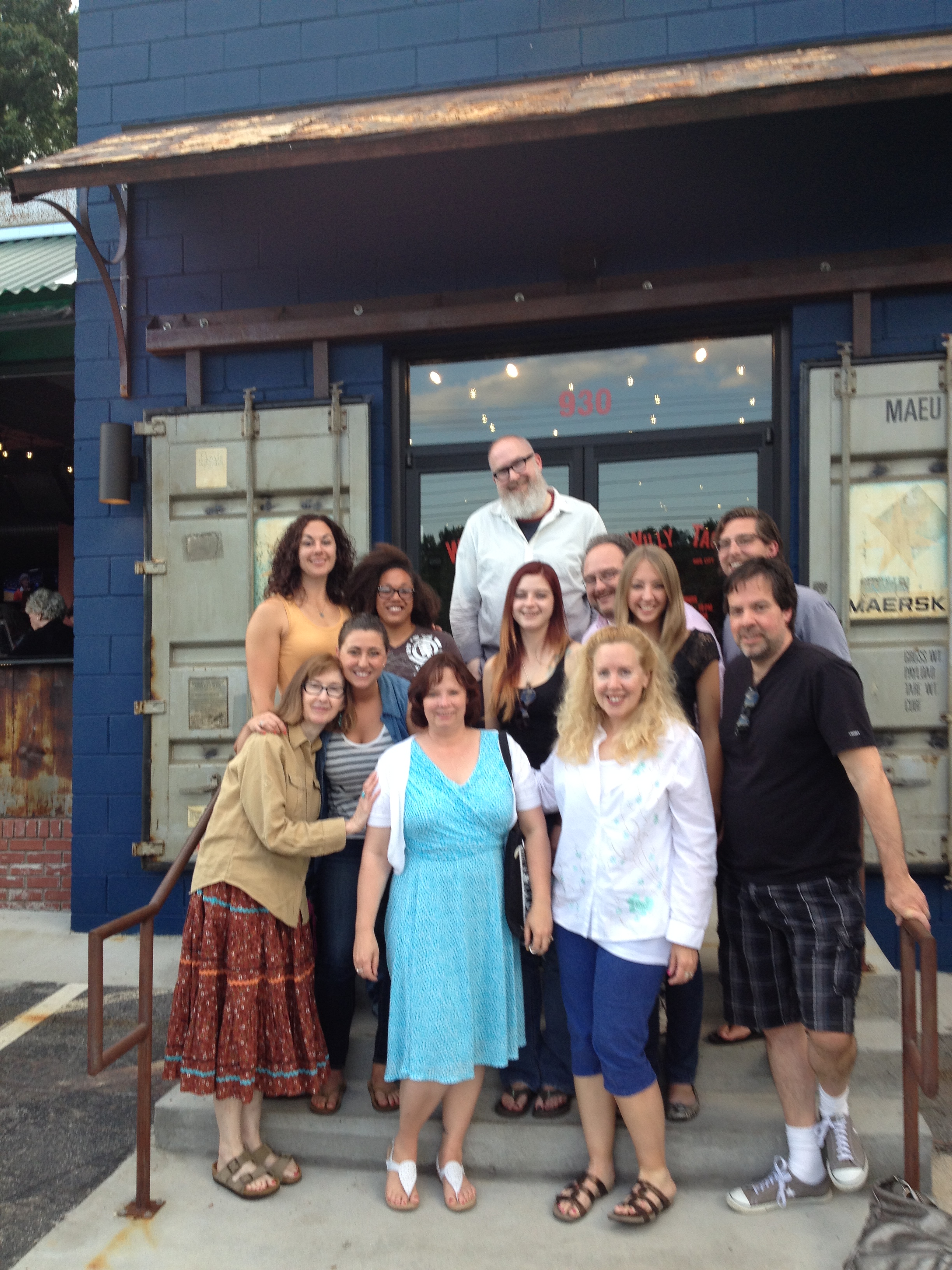
    Ravenous CoverOn Thursday, August 28 at 7:00 PM, Hub City Bookshop in Spartanburg, S.C. hosted a book launch for poet Rick Mulkey’s newest collection of poems, Ravenous: New and Selected Poems. On hand to read poems from the collection and celebrate Mulkey’s fifth publication were literary friends and notable poets Tom Johnson, Angela Kelly, and Claire Bateman as well as composer Scott Robbins and award-winning fiction writer Susan Teculve. Light refreshments of soft cheese, hummus, table crackers and a variety of wines were provided for guests attending the standing-room only event.

    Hub City Executive Director, Betsy Teter, offered a warm, heartfelt introduction to the evening’s event and expressed gratitude for Mulkey’s considerable contributions to Spartanburg’s literary community. In addition to writing poetry, Mulkey happens to be the director of the Converse College Creative Writing MFA program, also in Spartanburg, and participates in writing groups as well as promotes writers, publishers, and artists in the area. After a generous and deserving applause, audience members settled into their seats just as the setting sun cast an ambient glow through the plate glass window.

    Mulkey took the microphone first to thank everyone for coming and explained that the evening’s guest readers had been asked to read their favorite poems from the collection. A happy challenge, according to the readers, who each admitted to having had a difficult time narrowing their choices down to just one poem.

    The first of Mulkey’s literary friends to read was poet and visual artist, Tom Johnson, who read “Blind-Sided.” A discursive narrative weaving memoir-like reflections triggered by the poem’s epigraph about the only known incident of a person being hit by a meteorite, “Blind-Sided” presents scenes in which the speaker or other characters of the poem are taken unaware, or literally “Blind-Sided” by the kinds of bizarre events the universe and its inhabitants have a way of throwing at individuals. Both corporeal in its acknowledgement of the pure weirdness of being human and existential in its incorporation of heavenly bodies (such as meteorites), “Blind-Sided” is as satisfying in its lyrical story-telling when read aloud as when read silently. It’s easy to understand Tom’s choice and his flawless recitation was appreciated. As an aside, Johnson has a book of poems just out with 96 Press and an exhibit of his visual art, “A World of Readers,” is on display from September 6 through November 13 at the Pickens County Museum of Art & History in Pickens, S.C.

    Next, poet and author of Voodoo for the Other Woman, Angela Kelly, read “Outlaws,” a short poem that she said appealed to her for its subject matter – moonshine. It begins “My father ran moonshine, corn whiskey, / white lightning, Devil’s Rum, from Bramwell / through Bluefield to Bland” (1-3) and contemplates how possessing an “outlaw” gene might nuance the speaker’s life. Kelly’s spunky reading suggests her appreciation for self-sufficiency and her selection provided another facet through which to view Mulkey’s style.

    Poet Claire Bateman chose the poem “Music Theory,” one of Mulkey’s newer poems. This persona poems marvels at a son’s ability to play the bass “with so much passion the framed family portraits / in the room beneath his grind against walls” (1-2) and suggests that, on his journey out of the underworld, “Orpheus didn’t look back in doubt, but in amazement, / that…one tuned string…/ could make us believe all would be right” (12-14). Bateman’s soft, lyrical voice had the added benefit of making audience members sit very still as they leaned forward to listen with anticipation.

    Scott Robbins, a bit of a rule breaker, read two selections: “The Well-Tempered Clavier” and “Sontagmusick,” from Mulkey’s quartet of poems about Fanny Mendelssohn titled “The Invisible Life.” Robbins began by apologizing in advance should he start singing his selection as he previously set the entire quartet to music so remembers them as song. The first poem of the quartet, written from Fanny’s perspective, evokes a youthful confusion over what she wishes to be versus what she is expected to be: “As father said,” the poet writes, “femininity alone is becoming in a woman. / Yet this morning I woke to write a lied, and last week / finished another” (6-7).  Robbins’ second selection, and fourth section of the quartet, depicts Franny as a successful composer within the salon concert culture, or “Sontagmusick” (despite her father’s avid discouragement). This section contemplates things overlooked, including “the Prussian peasant, the exiled virtuoso, / the swallow’s cry” (6-7) and asks “What story aches behind the tongue?” (10). The entire quartet is a haunting and empathetic study into the fleeting nature of creativity and life, and as apt as Robbins’ rendition was, justice for the entire poem would be hard to capture on such occasion, causing this review to insist readers of this blog read the poem for themselves. While at it, they should explore Robbins’ compositional work of Blue Ridge A Capella.

    Fifth to share their reading talent was Mulkey’s biggest fan, and wife, Susan Tekulve, who began by humorously admitting to liking Mulkey’s poems about herself most. As an act of resistance to her preferences, she chose to read “Hummingbird,” which begins “Imagine each liqueur-soaked rose as a potential love affair / on this capricious tour of blossom-scented air” (1-2) and evokes a plethora of sensuous images throughout, illustrating yet another facet of Mulkey’s poetry; and if it were not already clear to anyone who knows Rick and Susan, Teculve’s fondness for her husband and his poetry certainly came through her reading of this poem.

    At last, Mulkey returned to the microphone and once again thanked his audience and literary guests before bringing denouement to the event in the very best way possible: by reading his poetry. Included in his selection where “What Superman Feared Most,” which contemplates the daily worries of the average American, “Cheese,” celebrating the working class, and “Earning a Living,” an unflinching look at mediocrity. Concluding his “set” was the deeply touching “Why I Believe in Angels,” a poem that simply has to be among Susan’s favorites.

    Ravenous is described as a collection of stylistic variety and deep concerns. This reviewer would add that within these pages readers will also find empathy and irreverence, contemplation and assessment, lyric moments and engaging narrative, prompting me to wonder why you are still sitting there – go buy a copy now! In the meantime, here’s a selection of Rick Mulkey’s poems for your reading enjoyment:

    Insomina, at Verse Daily

    Betrayal, at Serving House Journal

    Connecting the Dots  at Valparaiso Poetry Review

    Bluefield Breakdown,  at The Writer’s Almanac

    Ravenous: New and Selected Poem
    Rick Mulkey
    Serving House Books (June 24, 2014)
    ISBN-13:
    978-0991328147
    $12.00

    Available at Barnes and Noble.com

  • A Classification of Poets by Roy Beckemeyer

    All those poets, with their delicate
    faces, the rote way I relegate
    their taut verses : Alluvial traces,
    Marsupial purses, Tightly coiled cases.

    Their animal hands, their angelic minds,
    the various cants of their labored lines.
    I draw from this strange sonnet’s brevity
    a taxonomic range of verse levity.

    Roy Beckemeyer, from Wichita, Kansas has recently published in The Midwest Quarterly, The North Dakota Quarterly, Nebo, Straylight, and The Bluest Aye. His debut collection of poetry, Music I Once Could Dance To is available from Coal City Press.

  • If Poetry Prompt

    Read “Bound” by Aline Murray Kilmer at Poets.org:

    If I had loved you, soon, ah, soon I had lost you.
    Had I been kind you had kissed me and gone your faithless way.
    The kiss that I would not give is the kiss that your lips are holding:
    Now you are mine forever, because of all I have cost you.

    You think that you are free and have given over your sighing,
    You think that from my coldness your love has flown away:
    But mine are the hands you shall dream that your own are holding,
    And mine is the face you shall look for when you are dying.

    Write an eight line formal poem that begins with “If I had love you,”

    OR

    write an equally haunting poem that is concerned with war or loss.

  • Voice and Technology: A Brief Meditation

    Vocal communication is one of the most ancient modes of technology still utilized in modern times. It is the mode by which we first learn to persuade others to see our point of view and call them to act, and it still holds great power and rhetorical value today. More than engaging the intellect through well-chosen words, the voice is the body’s singular channel for connecting with others and conveying emotional meaning through intonation, stressed syllables, meter, rhyme, and volume. Poetry, with its attention to sound and sensuous appeal, naturally evolved from the human need to remember and convey oral histories. Combining the technology of written expression with the oral tradition of story-telling, poetry expands the limits of language to engage the listener’s soul. We can say, then, that poetry is a technology older than the iPad, the laptop or the analog phone. Older still than cave-dwelling drawings or the written word; older even perhaps than prose.

    While poetry continues to evolve in response to new theories on form and function and even in response to historical upheaval that would require it to conform, it still resists and overcomes language barriers, gender perception, and political influence. Read or spoken aloud, poetry continues to be one of the most effective means of conveying emotional truth today.

  • Quatrina by Neil Fulwood

    A half halved. A quarter moon. The Sign of Four.
    Two slices across the pie chart. I’m sorry; let
    me start again. I’m talking about dividing or
    multiplying by four, the answer or image you get

    by quartering or quadrupling. Or what little you get
    from a quick trawl of the library shelves: The Four
    Feathers, Four Past Midnight, Four Quartets, and let
    us not forget Four Children and It. Why do five or

    seven get the better deal? Enid Blyton and the rich ore
    of children’s fiction, that’s why! If it’s not Five Get
    Kidnapped by Somali Pirates then it’s Seven for
    the Cup, Good Show, Hooray! Give me a break. Let

    me disentangle from their tea-time adventures, let
    the tomboy and the girly-girl get better acquainted, or
    the dog make a break for freedom, run wild, get
    its Jack London funk on. Let anarchy come to the fore

    and words give numbers what for. Yes! And let
    no quarter be asked or given. And let the reader forget.

    Neil Fulwood was born in 1972 and got involved with poetry at an impressionable age. His interests include visiting inns and taverns of architectural interest. Some people confuse this with pub-crawling.
  • Landing Phase by Don Maker

    (dedicated to Space Shuttle Enterprise)

    From out of the endless void we fell at over Mach twenty-five;
    with an L to D of four-to-one, our descent was more of a dive.
    But the stick was dead and the hull was red,
    so we rode her down to the onrushing ground
    and just hoped we would somehow survive.

    At seventeen-thousand feet we began our so-called landing phase,
    and the blessed CPU kicked in without its normal delays.
    So, despite the glows from the blazing nose,
    we could feel some float start around the bird’s throat,
    and we sang that great programmer’s praise.

    We didn’t hit much of a thermal, but then, it doesn’t matter much—
    because she’s a silo with stubs for wings, the bird doesn’t have much touch.
    Since her normal place is flying through space,
    we try not to mind if the landing aren’t kind…
    if they don’t leave us needing a crutch.

    That last roll-reversal left us dead center of the glideslope corridor;
    at twenty degrees and three-hundred knots, the bird is begging for more.
    But the pathy lights have just come into sight,
    and the CRTs swear that it’s time for pre-flare,
    ‘though the vehicle still wants to soar.

    The horizon blazes with whiteness as the sand reflects the sun,
    and we know, one way or another, we’ll soon come to the end of our run.
    With hardly a sound the gear quickly drops down,
    and tension runs high as we drop from the sky
    in a bird that weighs ninety-nine tons.

    We’ve resumed the controls, and it’s time to find out exactly what we’re worth,
    for the place that we’ve been makes us feel we’ve returned to find our soul’s rebirth.
    And when we anoint the long waited touchpoint,
    the drums seem to roll as I say to control:
    “The first spaceship has landed on Earth.”

  • Interview with Santa Fe Poet Laureate, Joan Logghe

    DRESSING DOWN FOR LOVE

    Put on your love dress.
    Take off your other garments
    the ones that cost you most.
    Wear your heart out.
    Become a transvestite
    for love. Dress as a heart.
    Establish a municipality
    with eyes you meet on the street.
    Enter the election for Darling.
    Let kindness reign. Put on
    no airs. Be plain as feet
    which also may carry you away
    along the Love Highway.
    Hello. What is your name?
    I have forgotten. Remind me.

    What did you take away from your experience as Santa Fe Poet Laureate?

    First of all, this interview reflects today February 20, 2013 at 6 AM and at any other day and moment, you’d get that set of answers.

    I called the two years my experiment with Happiness.  I was ecstatic to be given the opportunity to do my work, the work I love to do and am suited for, with recognition and appreciation from the outer world.  I also learned that being a poet, being called a poet, is a tricky thing.  It doesn’t depend on the outer nearly as much as the inner, the private act of setting aside time, concentration, opening to inspiration, and hoping to be struck by an idea, a music of phrase that results in poetry.  As for the outer, I was riding a wave of invitation and had energy to do everything asked of me.  It reinforced my experience that when we are on our path, the energy is there to buoy or surf one along.

    What were some of the most difficult aspects of carrying out the duties of Poet Laureate?

    Having to publicize everything I did was very challenging.  I didn’t want to bother my mailing list friends, the press would only have so much of the Poet Laureate activities.  People would ask if I was writing, and indeed, I was taking notes on my life, on the city of Santa Fe, and I wrote one hundred pages of poetry, some occasional and some my usual writing from the domestic. So that was not a problem.  It was hard to say no to people who asked impossible little jaunts for me, so mostly I said yes. I went on a few poetry goose chases.  Valerie Martinez, the city’s second poet laureate told me she mostly said yes, as it was only two years.  I thought I’d be different.  I would say no.  I m older, have grandkids to mind.  But that was exactly why I kept saying yes.

    Tell me how you approach putting a manuscript of poetry together for publication.

    I often draw from years of work, once I have a focus, theme, topic, some organizational thrust. So, most of my manuscripts come from fifteen years of work.  The only exception was Rice, where

    I began keeping a sonnet journal, informal sonnets of 14 lines that surprisingly spanned a crisis.  Good luck for the poem comes from seemingly bad luck.  Then I spent several years organizing, editing,

    and culling the over 100 poems down to 78 in the book.  For that final honing down, I had input from the other two chicas in Tres Chicas Books, Miriam Sagan and Renée Gregorio.  It was amusing as after they read the manuscript, I saw that they hardly ever agreed on which poems to omit. So I had to make that decision.

    All the other manuscripts I organize in sections.  I like sections, as I am a pretty chaotic organizer, as evidenced by my office.  The books are my aesthetic opportunity to get it together and make some order in my life.

    What has been the role of poetry in your development as a creative person?

    Since I was a kid I was making things, gift wrapping elaborately, learning to knit, and drawing horses.  In High school I fell for Emily Dickinson and then the Beats.  Who could be more disparate than Allen Ginsberg plying his harmonium as the Children of Light danced in drag on stage, and Emily holed up in Amherst?  I loved poetry.  Friends of my parents saw that and gave me poetry books.  I got to talk with Flo Levitt this year, in her 90’s and in a poetry group. She and her late husband, Irv, gave me books of poems. I have been thanking people who saw me and encouraged me.

    If I hadn’t done poetry, it would have been photography. I took over 100 rolls of film, developed them in a series of funky darkrooms around America.  I applied for a job in photography, got turned down, and that was that. With poetry I never applied for the job.  I did what I thought were poetic things, drove a school bus, lived in San Francisco, substitute taught, and worked in a garden center seven springs.  Poetry mostly was in the background, though for six or seven years when I had my first two children and we physically built this house, I stopped. I never went to graduate school, but when I came back to poetry I was fierce about it.  I went to readings, took little workshops.  I studied with the lesbian feminist Melanie Kaye Kantrowich who introduced me to feminist poets.  My mother was a feminist who ran a beauty shop, so I didn’t know the feminist literary tradtion and missed it in college.  Melanie had a partner called Michael, as I did, only hers was a woman. Birds flew around their house in Santa Fe, no cages, just little finches pooping and chirping as we critiqued.  I wrote about the beauty shop.

    I think staying with one art form, having a creative aim, was most helpful.  I know people who do several things and very well.  I looked down on that, but now find myself wanting to paint a little, sew, have some relief from having to be on call for poetry all the time.

    Who are you reading right now?

    Such a sensible question.  This morning I read a Gerald Stern poem out loud from American Poet: the Journal of the Academy of American Poets.  I love his voice and the recently deceased Jack Gilbert, my Pittsburgh guys.  I keep a stack of poetry books by my bed and in the bathroom and in my car.  I have stacks that a friend who designed the Penguin Poetry Series gave me.  I find it hard to fall in love, but when I do I am very faithful, like this 40+ year marriage.  I maybe have a dalliance, but I have a monogamy of art form, and I truly love the poets I love.

    Do you have a consistent writing practice?

    How embarrassing that you asked.  I encourage students to do so, and I am wildly undisciplined.  Yet I am true to the muse.  If a phrase catches me I grab a pen. I write in the middle of the night, in a car, near and far, like eating green eggs and ham. I write at my typewriter, a manual Olivetti just like I had as a girl and through college, and San Fran and the dairy farm in Wisconsin, until it was stolen in Penasco, New Mexico, I loaned to a friend named Rhonda Velkovitch.  So, I say it’s like meditation where you are asked to return to the breath.  I return to the breath of poetry.  So on the short term I am pathetic, but in the long run, and I am lucky enough to have lived 65 years, I have a very consistent practice.


  • Bathing by Susanna Lang

    Every morning now
    you draw the washcloth down
    my arm, careful not to
    rub too hard—the scar

    is still a little sore.
    You lift my breasts to wash
    beneath, and turn me round
    as if some music played

    and not the shower. You scrub
    my back, invite me out
    into the towel’s blind
    embrace and yours, although

    you see it all—the skin
    that puckers and flakes, an arm
    that will not bring my hand
    to my mouth, or bear a weight.

    Still you get up with tired
    eyes to test the water,
    and make my bath a dance
    to open up the day.

    Susanna Lang’s most recent collection of poems is Tracing the Lines (Brick Road Poetry Press, 2013). She lives in Chicago, where she teaches in the Chicago Public Schools.

  • If Januarians Who Dream of June by James Penha

    If Januarians who dream of June
    awake on Ides with centrophobic stress,
    while scientists see over Saturn’s moon
    a future compulsively to obsess,
    then surely some contemporary snake
    has made the apple of the present moot:

    as if we receive a gingerbread cake
    we decline to cut cause it’s all dried fruit!
    or we’re those fans who used to stalk Greta Garbo
    outside Sutton Place in hopes she would play
    her last great scene with us–while the hobo
    round the corner earned Ninotchka’s smile each day.

    Why imagine a ruby in rhinestone
    or trail the scents of the perfect cologne?

    A native New Yorker, James Penha has lived for the past twenty years in Indonesia. He has been nominated for Pushcart Prizes in fiction and in poetry. No Bones to Carry, a volume of his poetry, the 2007 New Sins Press Editors’ Choice Award. Penha edits The New Verse News, an online journal of current-events poetry.

  • Interview with Redmond, Washington Poet Laureate Jeannine Hall Gailey

    JHG200x300 (2)I Forgot to Tell You the Most Important Part…

    Without this knowledge, you’ll never make it:
    it’s one part fashion advice and two parts survivalist.
    Learn to talk to people so they think you’re honest
    but never be honest. Cooking eggs may save your life,
    so crack them, neat and firm, pour into the skillet,
    stir gently. Forget about your shoes; people will judge
    you by your shine, the imminent light you offer them.
    Be a lamppost in wilderness, be the elephant
    in the showroom.  If you steal the idol, make sure
    to carry a weighted bag of sand. No surprises: we’ve lied
    about having it all. It’s either the piano or the pit viper.
    Cinderella’s shoe came off at midnight because it hurt,
    and Red Riding Hood’s real story involves cannibalism and a striptease.
    Don’t wear red lipstick, don’t you kiss your mother with that mouth?
    Long bangs hide a multitude of sins. Ask your grandmother
    about the herbs she used to swallow while pregnant.
    The butterflies here didn’t start out black, they were white
    as onion skin – and the forest was more ominous
    before the smokestacks. Well, here’s your little basket
    and red coat, sweetheart, sweetmeat, smile like you mean it,
    shake what you’ve got while you’ve got it,
    go out into the world and knock them dead.

    Tell me about the moment you learned you were chosen as Poet Laureate for Redmond, Washington.

    Well, the process was somewhat complicated. I was nominated, then I had submit materials, then I had two sets of interviews, then I was told I was chosen for the position. I was only the city’s second Poet Laureate, so I think a lot of the process was new for the city. I got to meet with the Mayor as well. That was a pretty exciting day!

    What were/are some of your outreach projects as Poet Laureate?

    I’ve had a couple, under the umbrella slogan “Geeks for Poetry, Poetry for Geeks!” Since our community is mostly made up of technical workers (among other companies, Microsoft and Nintendo are here) I was working hard to reach out to a techie crowd with multimedia (an art show with comic-book-style illustrations to go along with my inaugural reading’s poems based on comic books and anime, for instance) and bringing in poets and editors from around the community to talk about subjects like e-publishing, social media, and scientific poetry. I’m also working with the local library, choosing a book of poetry a quarter for the “Redmond Reads Poetry” project.

    Discuss your view of the role of education in the creative process? Is an MFA an important credential for artists and writers to attain?

    Education of some kind is essential for the creative process. That is, I don’t believe you can become a great writer without a good deal of practice as well as a lot of reading. Reading voraciously – the things being published in contemporary magazines, books from thirty to fifty to two hundred years ago, books popular and unpopular, lauded and unlauded – can only help you improve your sense of voice, your sense of where you belong as a writer. I love fiction and literary criticism as well as poetry, and I think a broad knowledge of all genres is helpful when it comes to building your literary “toolkit.” Is that a phrase, literary toolkit? My very favorite instructional guide to poetry is “Introduction to Poetry” by X.J. Kennedy, and I’m particularly fond of the 1969 and 1989 versions, if you can find them used. For me, speculative fiction writers like Margaret Atwood, Kelly Link and Haruki Murakami have all helped me develop my voice as a poet, so you have to cast a large net, as “your” essential writers may be writers you haven’t discovered yet.

    You know, I got my MFA fairly late, in my early thirties, and I had been writing seriously for some years before I got it, which I think made it a more satisfying experience than my earlier degrees. I got an MA in English back in my twenties while I was working full-time for AT&T, and just wasn’t able to get the time to go back until much later, but I never lost my interest in poetry. I think if I had kept on with my poetry routine pre-MFA – that is, going to poetry conferences, regular workshops and writing groups and readings, trying to create my own reading list by visiting at Open Books (Seattle’s poetry-only bookstore with very knowledgeable owner/curators) – I would probably have been fine and eventually published my books anyway, but the MFA gave me a boost in terms of confidence and a focus that is only available when you devote yourself to something singularly for a couple of years.  Encouragement from my very kind mentors made me feel like the writing life wasn’t, in fact, impossible. But encouragement from my regular writing group of ten years (!!) has given me a community, which I think is just as important as an MFA to continuing writing through rejection, setbacks, discouragements, and regular life. We can’t think of the writing life as something that only happens in the academy – that’s not a realistic regimen for most people – but something that can occur along with family and job obligations as well, something we can nurture through reading, attending poetry events, cultivating friendships with other writers.

    The MFA used to be required for a teaching position, and there is some evidence that today, in a very competitive environment for non-adjunct positions, a PhD is even encouraged among creative writers, which didn’t used to be the case, so if you want to teach at the college level, I’d say yes, it’s probably necessary (either that or the PhD.) It wouldn’t hurt you to win some big book contests or book awards, either. Did I mention that it’s difficult to get a non-adjunct teaching position in creative writing these days?

    But I would encourage people who don’t have the time or money (or inclination) for an MFA to look at other resources, such as writer’s centers (such as The Richard Hugo House here in Seattle or The Loft Literary Center in Minneapolis,) and the myriad writer’s conferences and writing retreats available through listings in places like Poets & Writers. I’d encourage them to go to readings in their area, volunteer with local literary magazines, and arrange meetings with other writers on a regular basis.  If I haven’t already mentioned it enough, reading a lot – poetry and fiction, both contemporary and the classics – will never ever hurt your writing.

    What has been the role of poetry in your development as a creative person?

    I’ve loved poetry a long time, ever since my mom gave me her college textbook when I was about ten years old and I fell in love with “Love Song of J. Alfred Prufrock!” I’m also very interested and inspired by the visual arts, and spend lots of time at galleries and museums, but my abilities with my hands (when I’ve taken art classes) are at odds with the limits of my imagination. I don’t feel the same limitations with the written word. I’m also not much of a public person, and feel much more comfortable with e-mail than phone calls and personal meetings – probably not too strange a characteristic for writers, as we tend to be introverts. I tend to think of “writing projects” in bigger terms – like, a series of poems rather than a single poem, and am often inspired by something – a piece of music, a film, an artifact like a painting or a comic book image – to write an entire book at a time. That, of course, can take years, but the inspiration or idea usually happens all at once.

    Who are you reading right now?

    I just finished a wonderful re-release, Stella Gibbons Nightingale Wood, a sort of re-telling of the Cinderella story with a Downton Abbey-esque British-class-structure satirical spin  – and now I’m looking (mosty in vain) for her out-of-print re-telling of the Snow Queen called The Snow-Woman. In terms of poetry, I end up reading mostly books I’m sent for review and I always feel I’m behind on my stack – I know I am, in fact – but I must give glowing recommendations to several new books: Annette Spaulding-Convy’s In Broken Latin, Kelly Davio’s Burn This House, and Jehanne Dubrow’s Red Army Red. I’m also really enjoying the tragi-comic poetry stylings of Gregory Sherl and Noel Sloboda’s mythic-with-a-twist Our Rarer Monsters. I’m also reading the new Philip Pullman edition of Fairy Tales from the Brothers Grimm and the new Jack Zipes, The Irresistible Fairy Tale.

    Do you have a consistent writing practice?

    Besides my blog, which I’ve been keeping faithfully since 2005, I probably write about two poems a week and maybe a piece of essay or flash fiction or pseudo-memoir (I’ve been experimenting with genres outside poetry, mostly for fun, not for publication.) When I have freelance writing assignments, they usually take up all my writing energy until they’re turned in – which ends up being a good motivator for getting those assignments done ahead of schedule.


    Jeannine Hall Gailey is the Poet Laureate of Redmond, Washington, and the author of Becoming the Villainess (Steel Toe Books, 2006) and She Returns to the Floating World (Kitsune Books, 2011). Her upcoming book, Unexplained Fevers, will be available from New Binary Press this spring. Her work has been featured on NPR’s The Writer’s Almanac, Verse Daily, and in The Year’s Best Fantasy and Horror. She was a multiple Dorothy Sargent Rosenberg Award winner (in 2011 and 2007) and is a 2013 Jack Straw Writer. Her poems have appeared in journals such as The Iowa Review, American Poetry Review, and Prairie Schooner. She volunteers as an editorial consultant for Crab Creek Review. Her web site is www.webbish6.com.

  • Submission News

    I am nearly caught up with reading submissions. April and May submissions have been read and largely decided upon. If you submitted during those months and have not heard from me, I am either deliberating or trying to figure out how to format something on WordPress. I am still reading June, July and August submissions.

    October’s theme is Ekphrastic poetry.

    Thanks everyone for your patience, and happy writing!


    Lisa

  • On Sunday by Karen Loeb

    Tomorrow I will make potato latkes.
    I will be a renegade and use sweet potatoes,
    not the white potatoes I grew up with,
    the white potatoes that were always
    used in the pancakes. The white potatoes
    that my mother never questioned,
    that she placed on the table in many
    different disguises—mashed, baked,
    boiled and cold in salad with mayo stuck
    on everything, obscuring what lay beneath
    the slick white coat.

    I will use sweet potatoes when I make
    my latkes. I will use minced scallions
    instead of yellow onions cut in chunks.
    I will even use the green leaves that
    arc out from the white bulb like a dancer
    extending a leg. I will cut off the roots.

    Of course I will do that.

    I will grate the potatoes in a processor,
    something my mother never had. I will
    not feel guilt for doing this. My latkes
    will not be less authentic because the potatoes
    were whirled around and chopped into many
    small bits. I will invite friends over
    to eat the small round cakes with a
    tinge of orange. They cannot be mistaken
    for white potato latkes. I’ve made sure of that.

    Karen Loeb writes and teaches in Eau Claire, Wisconsin.  Recent publications have been a story in Thema, poems in The Main Street Rag, Bloodroot and Hanging Loose.

  • There is Darkness to the Water by Martin Willitts Jr.

    There is darkness to water
    of intent and revenge for what we’ve done,
    as the earth becomes hotter and hotter.

    What will we tell our sons and daughters?
    In our destruction, what have we won?
    There is darkness to the water.

    It thirsts for revenge and in its anger
    it flattens cities, ending what we begun,
    causing the earth to become hotter and hotter.

    Who was the leaders? Why did they falter?
    Our forests, ruined land, both made barren.
    There is darkness in the water.

    What will we tell children after?
    We ruined the earth and all we were given,
    and made the air sulfur, becoming hotter.

    Now we cannot go back. The winds stir
    nothing and we cannot alter
    the intense darkness in the water
    which floods as things get hotter.

    Martin Willitts Jr forthcoming poetry books include “Waiting for the Day to Open Its Wings” (UNBOUND Content), “City Of Tents” (Crisis Chronicles Press), “Swimming in the Ladle of Stars” (Kattywompus Press), “A Is For Aorta” (Kind of Hurricane Press, e-book), “Martin Willitts Jr, Greatest Hits” (Kattywompus Press), “The Way Things Used To Be” (Writing Knights Press), “Irises, the Lightning Conductor For Van Gogh’s Illness” (Aldrich Press).

  • Swedish Flooring by Jeannie E. Roberts

    The old linoleum spoke,
    kept track, took note,
    of scuffs and cracks,
    marked anecdote, recalled
    a lifetime worn by others;
    where, thoughts of feet
    made floorboards creak,
    caused stabs near grab
    of knob and turn meant
    throbs when dotard trod
    with memory-mud and
    gore; still, shine imbued
    in servitude, light infused
    this floor, where pets were
    friends, pledged care―no end,
    and softness sat times four, sat
    just beyond the door.

    Jeannie E. Roberts is the author of two books, including the newly released Nature of it All, a collection of poems (Finishing Line Press). For more, visit http://www.jrcreative.biz.

  • NeverNever Holes by Karen Bovenmyer

    NeverNever Holes

    We have been together for fifteen years and
    Never, never
    Have you left a hole in my wall

    There’ve been holes in other things
    to-do lists, clothes, missed birthdays,
    valentines days, anniversaries, sometimes
    But never, never
    A fist-sized hole in my bedroom wall

    Your voice saying
    What do you want? I don’t know what you want, I can’t be what you want
    Tearing your hair, scratching your arms, punching a
    heart-shaped hole in my wall

    And I stand there, sobbing
    Like the eight-year-old I suddenly am again watching my sister
    throw dishes at my mother
    I said, I will never, never be like her

    And under the thick sounds I am making
    Like fifteen holes knocked into fifteen walls
    I am saying, I will never, never leave you

    And you are saying, I will never change
    But
    There is a hole in my wall now
    An opening that wasn’t there before

    And finally I am hearing
    Please, please love me for who I am

    And so, I say again
    Fifteen times

    I do, I do, I do
    I do, I do, I do
    I do,  , I do
    I do, I do, I do
    I do, I do, I do

    Karen Bovenmyer holds an MFA in Creative Writing: Popular Fiction from the University of Southern Maine. She teaches and mentors students at Iowa State University.