They didn’t have to throw a parade for G and me. I thought that was awful nice though. Saying it was for the state fair was a good cover. keeps us humble.




They didn’t have to throw a parade for G and me. I thought that was awful nice though. Saying it was for the state fair was a good cover. keeps us humble.
This is a suggested timeline just to give the project some structure and motivate those of you who work best with a deadline.
| Prompt | Due Date | Pub Date Range |
| April 1: Journal Mining | Aug. 31 | Jan. 1-11 |
| April 2: Protection | Aug. 31 | Jan. 12-23 |
| April 3: Beginnings | Aug. 31 | Jan. 24-Feb 4 |
| April 4: Whispers of Work | Aug. 31 | Feb. 5-16 |
| April 5: Absences Unfolded | Aug. 31 | Feb. 17-28 |
| April 6: Transformation | Aug. 31 | Mar. 1-11 |
| April 7: Humor | Sept. 30 | Mar. 12-23 |
| April 8: Utterance | Sept. 30 | Mar. 24-Apr. 4 |
| April 9: Contradictions | Sept. 30 | Apr. 4-16 |
| April 10: Game On | Sept. 30 | Apr. 17-28 |
| April 11: Collect, Remix, Repeat | Sept. 30 | Apr. 29-May 10 |
| April 12: Pro-prose-al | Sept. 30 | May 11-22 |
| April 13: What You Leave Behind | Oct. 31 | May 23-Jun 3 |
| April 14: The Thin Veil | Oct. 31 | Jun 4-15 |
| April 15: Eyesore | Oct. 31 | Jun 16-27 |
| April 16: Apocryphal | Oct. 31 | Jun 28-July 9 |
| April 17: 17 Syllables | Oct. 31 | July 10-21 |
| April 18: Elemental | Oct. 31 | July 22-July 31 |
| April 19: Chance It | Nov. 31 | Aug. 1-11 |
| April 20: Temp-orality | Nov. 31 | Aug. 12-23 |
| April 21: Focus Prompt | Nov. 31 | Aug. 24-Sept. 4 |
| April 22: Intangible Inheritance | Nov. 31 | Sept. 5-16 |
| April 23: By Any Other Name | Nov. 31 | Sept. 17-28 |
| April 24: Hands On | Nov. 31 | Sept. 29-Oct. 10 |
| April 25: In Tune | Nov. 31 | Oct. 11-22 |
| April 26: Not the Kind You Flip | Dec. 31 | Oct. 23-31 |
| April 27: Top of the Morning | Dec. 31 | Nov. 1-11 |
| April 28: Child’s Play | Dec. 31 | Nov. 11-22 |
| April 29: Endings that Shape Us | Dec. 31 | Nov. 23-Dec. 3 |
| April 30: Course and Method | Dec. 31 | Dec. 3-14 |
| Revision Prompts | Dec. 31 | Dec. 15-31 |
The Zingara Poetry Project celebration of prompts continues. Please send poems for the following prompts by September 30, 2025:
While I have several nice poems to represent prompts posted during tose first week of April, I am still accepting submissions for the following categories:
I’m asking poets to send 1-2 previously unpublished poems inspired by these prompts in the body of an email to ZingaraPoet(at)gmail.com with the NAME OF THE PROMPT included in the subject line. (Replace the (at) with @)
Please also include a few sentences about your writing process (how you got from prompt to final draft) in your email, including any of the revision prompts that helped you along the way (if you used one). I want to know about why you made the choices you made. If even one line, image, or theme from your original draft appears in the final version, it qualifies for this challenge.
Feel free to include an image to accompany your poem.
Poems may be overtly related to any of the prompts, or have only a thread of connection. If you wrote a poem in response to a prompt and threw out all but one line during revision, that counts. Surprising is preferred to the predictable.
Include a brief professional biography of 50 words or fewer, also in the body of your email.
Simultaneous submissions are fine, just please let me know immediately if submitted work is accepted elsewhere.
2026 Editorial Calendar with Due Dates and Publication Ranges
| Prompt | Due Date | Pub Date Range |
| April 1: Journal Mining | Aug. 31 | Jan. 1-11 |
| April 2: Protection | Aug. 31 | Jan. 12-23 |
| April 3: Beginnings | Aug. 31 | Jan. 24-Feb 4 |
| April 4: Whispers of Work | Aug. 31 | Feb. 5-16 |
| April 5: Absences Unfolded | Aug. 31 | Feb. 17-28 |
| April 6: Transformation | Aug. 31 | Mar. 1-11 |
| April 7: Humor | Sept. 30 | Mar. 12-23 |
| April 8: Utterance | Sept. 30 | Mar. 24-Apr. 4 |
| April 9: Contradictions | Sept. 30 | Apr. 4-16 |
| April 10: Game On | Sept. 30 | Apr. 17-28 |
| April 11: Collect, Remix, Repeat | Sept. 30 | Apr. 29-May 10 |
| April 12: Pro-prose-al | Sept. 30 | May 11-22 |
| April 13: What You Leave Behind | Oct. 31 | May 23-Jun 3 |
| April 14: The Thin Veil | Oct. 31 | Jun 4-15 |
| April 15: Eyesore | Oct. 31 | Jun 16-27 |
| April 16: Apocryphal | Oct. 31 | Jun 28-July 9 |
| April 17: 17 Syllables | Oct. 31 | July 10-21 |
| April 18: Elemental | Oct. 31 | July 22-July 31 |
| April 19: Chance It | Nov. 31 | Aug. 1-11 |
| April 20: Temp-orality | Nov. 31 | Aug. 12-23 |
| April 21: Focus Prompt | Nov. 31 | Aug. 24-Sept. 4 |
| April 22: Intangible Inheritance | Nov. 31 | Sept. 5-16 |
| April 23: By Any Other Name | Nov. 31 | Sept. 17-28 |
| April 24: Hands On | Nov. 31 | Sept. 29-Oct. 10 |
| April 25: In Tune | Nov. 31 | Oct. 11-22 |
| April 26: Not the Kind You Flip | Dec. 31 | Oct. 23-31 |
| April 27: Top of the Morning | Dec. 31 | Nov. 1-11 |
| April 28: Child’s Play | Dec. 31 | Nov. 11-22 |
| April 29: Endings that Shape Us | Dec. 31 | Nov. 23-Dec. 3 |
| April 30: Course and Method | Dec. 31 | Dec. 3-14 |
| Revision Prompts | Dec. 31 | Dec. 15-31 |

For the first time in countless years of trying, an AWP panel I’m a part of has been accepted, my first and only so far.
I’m very excited to be presenting with Emmy Perez, Lorna Dee Cervantes and Guadalupe Mendez and deeply appreciate Rebecca Aronson, our moderator, for pulling this excellent panel together and including me on the roster.
So, this year I won’t just be tagging along or volunteering to man a booth or table, I’ll actually be part of the program.


Gary and I will be returning to one of our hometowns for Rebecca Aronson’s Bad Mouth poetry reading series in just under two weeks.
We can hardly believe it has taken twelve years for us to return to Albuquerque.
Leaving the mountains, the high desert, and our good friends that summer twelve years ago was heart wrenching and we thought for certain we would get back to visit often, even made promises to do so, but building careers and navigating hurricanes with limited funds and, of course, dealing with the Covid Pandemic all bent our futures and our wills to other priorities.
Actually, I was scheduled to do a live Bad Mouth reading back in 2020, but lock-down conditions required we do a virtual event instead. I think one person has viewed it in all these years, probably because I am terrible at self-promoting, but I read poems from my first collection, Flint & Fire (Word Works Books) for that reading, which you can view here, as a kind of teaser, if you are interested: 2020 Bad Mouth Reading with Lisa Hase-Jackson.
I have since published my second collection, Insomnia in another Town (Clemson University Press), from which I will be reading on September 6.
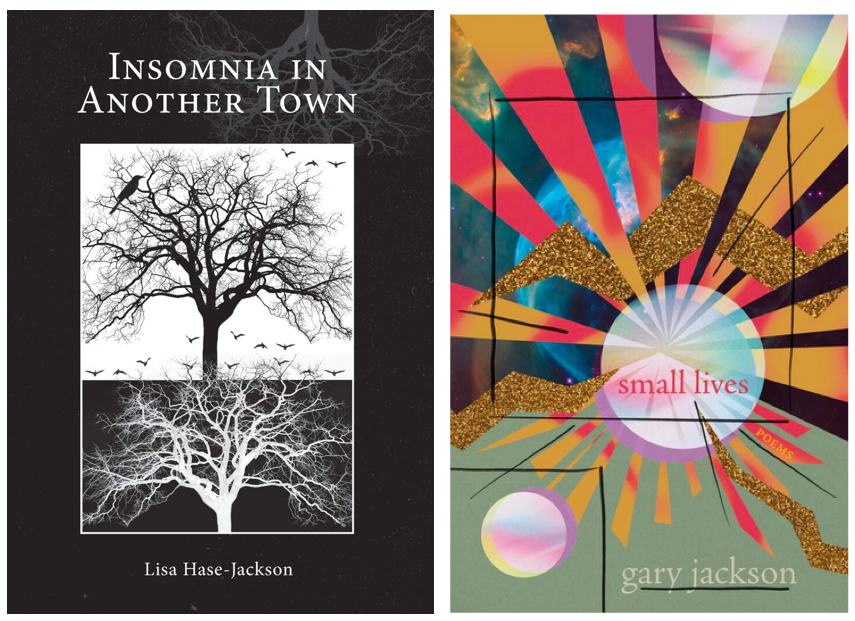
Gary will be reading from his newly published collection, Small Lives (UNM Press), as well as from his previous two collections, Origin Story (UNM Press) and Missing You Metropolis (Graywolf Press). This is the first time he will be reading from Small Lives, so I guess that makes this a kind of book launch. Appropriate, since UNM Press is locating in Albuquerque.
Now that I think about it, Gary and I read together at a salon-style gathering in Rebecca’s home that last week we were in Albuquerque, so I guess this means we’ve come full circle. Or at least completed one of the many circles we find our selves a part of.
So, if you’re in Albuquerque on September 6, please do try to come by. As the flyer mentions, most of the proceeds from donations will go to support NM Dream Team, which I’ve linked here so you can get a sense of the good work they do.
If you are unable to make the Saturday reading, Gary will also be interviewing with Sara Daniele Rivera at Beastly Books (yes, the bookstore owned by George R.R. Martin) up in Santa Fe the night before, Friday September 5, from 5-6:30 PM.

Or, better yet, come to BOTH readings!!
It’s so cool that we get to promote our newest books and do a mini book tour together. Please come out and help us celebrate. We’re excited to get to see everyone again!


Gearing up to prep and teach this semester’s “The Fairy Tale and the Poem” topics in poetry class beginning August 26.
At the edge of a wood there lived an old man who had only one son, and one day he called the boy to him and said he wanted some corn ground, but the youth must be sure never to enter any mill where the miller was beardless.
The boy took the corn and set out, and before he had gone very far he saw a large mill in front of him, with a beardless man standing in the doorway.
‘Good greeting, beardless one!’ cried he.
‘Good greeting, sonny,’ replied the man.
‘Could I grind something here?’
‘Yes, certainly! I will finish what I am doing and then you can grind as long as you like.’
But suddenly the boy remembered what his father had told him, and bade farewell to the man, and went further down the river, till he came to another mill, not knowing that as soon as his back was turned the beardless man had picked up a bag of corn and run hastily to the same mill before him. When the boy reached the second mill, and saw a second beardless man sitting there, he did not stop, and walked on till he came to a third mill. But this time also the beardless man had been too clever for him, and had arrived first by another road. When it happened a fourth time the boy grew cross, and said to himself, ‘It is no good going on; there seems to be a beardless man in every mill’; and he took his sack from his back, and made up his mind to grind his corn where he was.
The beardless man finished grinding his own corn, and when he had done he said to the boy, who was beginning to grind his, ‘Suppose, sonny, we make a cake of what you have there.’
Now the boy had been rather uneasy when he recollected his father’s words, but he thought to himself, ‘What is done cannot be undone,’ and answered, ‘Very well, so let it be.’
Then the beardless one got up, threw the flour into the tub, and made a hole in the middle, telling the boy to fetch some water from the river in his two hands, to mix the cake. When the cake was ready for baking they put it on the fire, and covered it with hot ashes, till it was cooked through. Then they leaned it up against the wall, for it was too big to go into a cupboard, and the beardless one said to the boy:
‘Look here, sonny: if we share this cake we shall neither of us have enough. Let us see who can tell the biggest lie, and the one who lies the best shall have the whole cake.’
The boy, not knowing what else to do, answered, ‘All right; you begin.’
So the beardless one began to lie with all his might, and when he was tired of inventing new lies the boy said to him, ‘My good fellow, if THAT is all you can do it is not much! Listen to me, and I will tell you a true story.
‘In my youth, when I was an old man, we had a quantity of beehives. Every morning when I got up I counted them over, and it was quite easy to number the bees, but I never could reckon the hives properly. One day, as I was counting the bees, I discovered that my best bee was missing, and without losing a moment I saddled a cock and went out to look for him. I traced him as far as the shore, and knew that he had crossed the sea, and that I must follow. When I had reached the other side I found a man had harnessed my bee to a plough, and with his help was sowing millet seed.
‘ “That is my bee!” I shouted. “Where did you get him from?” ‘ “Brother,” replied the man, “if he is yours, take him.” And he not only gave me back my bee, but a sack of millet seed into the bargain, because he had made use of my bee. Then I put the bag on my shoulders, took the saddle from the cock, and placed it on the back of the bee, which I mounted, leading the cock by a string, so that he should have a rest. As we were flying home over the sea one of the strings that held the bag of millet broke in two, and the sack dropped straight into the ocean. It was quite lost, of course, and there was no use thinking about it, and by the time we were safe back again night had come. I then got down from my bee, and let him loose, that he might get his supper, gave the cock some hay, and went to sleep myself. But when I awoke with the sun what a scene met my eyes! During the night wolves had come and had eaten my bee. And honey lay ankle-deep in the valley and knee-deep on the hills. Then I began to consider how I could best collect some, to take home with me.
‘Now it happened that I had with me a small hatchet, and this I took to the wood, hoping to meet some animal which I could kill, whose skin I might turn into a bag. As I entered the forest I saw two roe-deer hopping on one foot, so I slew them with a single blow, and made three bags from their skins, all of which I filled with honey and placed on the back of the cock. At length I reached home, where I was told that my father had just been born, and that I must go at once to fetch some holy water to sprinkle him with. As I went I turned over in my mind if there was no way for me to get back my millet seed, which had dropped into the sea, and when I arrived at the place with the holy water I saw the seed had fallen on fruitful soil, and was growing before my eyes. And more than that, it was even cut by an invisible hand, and made into a cake.
‘So I took the cake as well as the holy water, and was flying back with them over the sea, when there fell a great rain, and the sea was swollen, and swept away my millet cake. Ah, how vexed I was at its loss when I was safe on earth again.
‘Suddenly I remembered that my hair was very long. If I stood it touched the ground, although if I was sitting it only reached my ears. I seized a knife and cut off a large lock, which I plaited together, and when night came tied it into a knot, and prepared to use it for a pillow. But what was I to do for a fire? A tinder box I had, but no wood. Then it occurred to me that I had stuck a needle in my clothes, so I took the needle and split it in pieces, and lit it, then laid myself down by the fire and went to sleep. But ill-luck still pursued me. While I was sleeping a spark from the fire lighted on the hair, which was burnt up in a moment. In despair I threw myself on the ground, and instantly sank in it as far as my waist. I struggled to get out, but only fell in further; so I ran to the house, seized a spade, dug myself out, and took home the holy water. On the way I noticed that the ripe fields were full of reapers, and suddenly the air became so frightfully hot that the men dropped down in a faint. Then I called to them, “Why don’t you bring out our mare, which is as tall as two days, and as broad as half a day, and make a shade for yourselves?” My father heard what I said and jumped quickly on the mare, and the reapers worked with a will in the shadow, while I snatched up a wooden pail to bring them some water to drink. When I got to the well everything was frozen hard, so in order to draw some water I had to take off my head and break the ice with it. As I drew near them, carrying the water, the reapers all cried out, “Why, what has become of your head?” I put up my hand and discovered that I really had no head, and that I must have left it in the well. I ran back to look for it, but found that meanwhile a fox which was passing by had pulled my head out of the water, and was tearing at my brains. I stole cautiously up to him, and gave him such a kick that he uttered a loud scream, and let fall a parchment on which was written, “The cake is mine, and the beardless one goes empty-handed.” ‘
With these words the boy rose, took the cake, and went home, while the beardless one remained behind to swallow his disappointment.
From The Violet Fairy Book edited by Andrew Lange
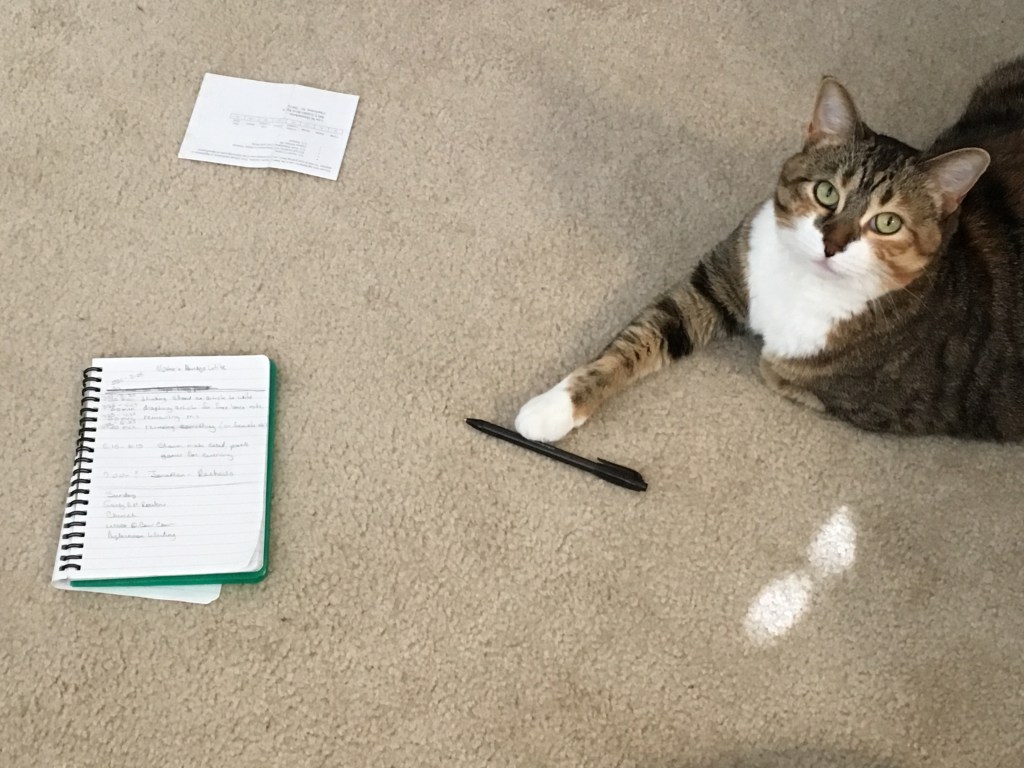
The deadline for submitting poems written in response to prompts 1-6 posted during this year’s Poem-a-Day challenge is Sunday, August 31.
PROMPT 1: Journal Splunking – Skim entries from old journals and diaries from a year or more ago jotting down interesting words, lines, phrases, sentences or images as you do so. The goal is to compile a page (or more) of fragments that still resonate emotionally but resist nostalgia and thwart typical associations or your own predictable writing patterns.
PROMPT 2: Protection – What are you protecting yourself from? What are you protecting your loved ones from? Make a short list of items, people, parts of self, or conditions you feel you need to protect or to be protected from. Next, select one or two items from your list, perhaps related, to write about. Describe why protection is needed an how to protect persons, places, items, or condition you listed.
PROMPT 3: Beginnings – There are several websites who post poems by well-regarded literary poets on a daily basis, including Poets.Org, Poetry Foundation, and Verse Daily. For this prompt, read poems posted for today on one or all three of these websites. Select a first line of your choice to begin a poem of your own. Once your poem draft is more or less complete, remove the first line and give your poem a new and unique title. Alternatively, if you decide to keep the first line, just credit the poem and poet from which the line is borrowed using an epigraph. Something like “after Emily Dickinson.”
PROMPT 4: Whispers of Work – Write a poem about a profession which does not exist anymore or which is phasing out. If you like, you can aim for an ode, a lament, a diatribe, a docu-poem, narrative poem, or found poem with your chosen profession as the central image, setting, or source. Examples of extinct professions: ice cutter, elevator operator, milkman, lamplighter, switchboard operator; Examples of professions phasing away: farmer, travel agent, mason, tailor, literary translator: Professions at serious risk: writer, teacher, librarian, journalist.
PROMPT 5: Absence Unfolding – Freewrite about absence, absenteeism, or absent things. Start with real, ordinary absences, both abstract and concrete, then progressively write about larger absences, each growing in size and scope, even to the point of hyperbole, until you find an absence that feels larger than all other absences, larger than the world, larger than the universe. Make one of them the subject of your poem.
Prompt 6: Transformation – Make a list things in life that you find ugly, shameful, or repulsive–things like foot odor, rudeness, cockroaches, road kill, belching in public, etc. Choose one or more items from your list to include in a poem. For an extra challenge, see if you can transform something usually deemed ugly into something desirable, beautiful, and worthy of admiration.
Please send 1-2 poems inspired by any prompt posted during National Poetry Month April, 2025 in the body of an email to ZingaraPoet(at)gmail.com.
Include NAME OF THE PROMPT in the subject line of your email.
Include a few sentences about your writing process (how you got from prompt to final draft) in your email. It’s not necessary to explain what your poem is about, rather I am interested in why you made the choices that you made. For instance, why did you chose couplets (or other stanza length)? How did you discover the imagery or metaphors used in your poem? How many revisions did you make? Not these exact questions, but questions like these can serve as your guide.
For a great example of a poet writing about their process, take a look at the most recent guest blog post at Marsh Hawk Press in which Ellen Bass explicates some of her work. You do not have to be anywhere as involved or detailed as this example, but it does exemplify the kind of approach I am looking for.
Poems may be overtly related to any of the prompts, or have only a thread of connection. If you wrote a poem in response to a prompt and threw out all but one line during revision, that counts. Surprising is preferred to the predictable.
Be sure to also mention if you happened to use any of the revision prompts posted during May and June in the process.
Include a brief professional biography of 50 words or fewer, also in the body of your email.
Simultaneous submissions are fine, but please let ZPR know immediately if submitted work is accepted elsewhere.
by Sir Walter Scott
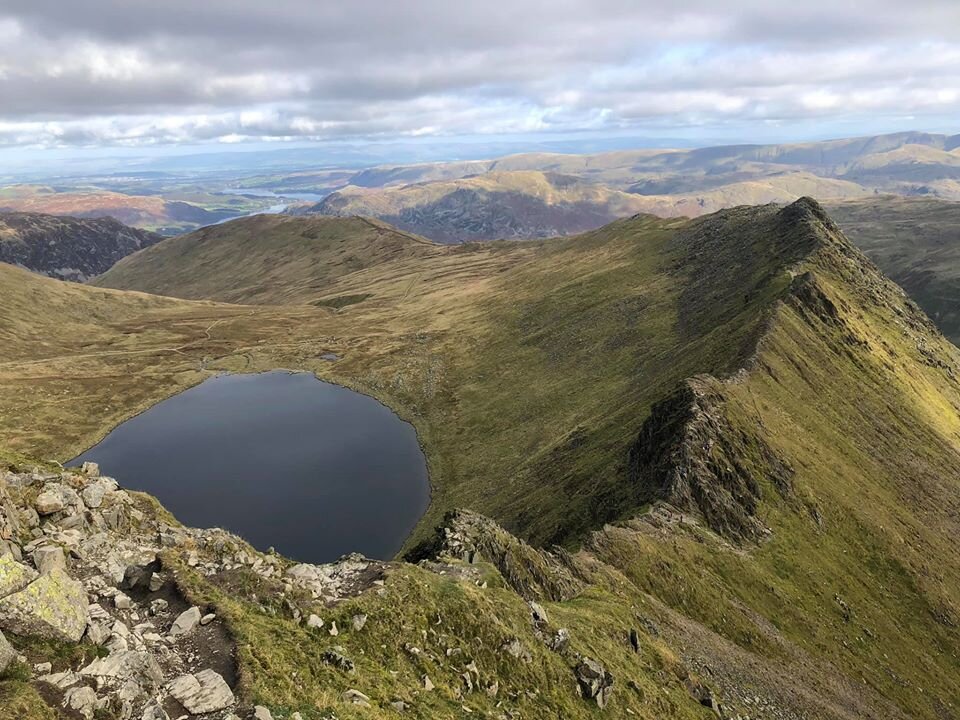
“In the spring of 1805,” says Scott,” a young gentleman of talents, and of a most amiable disposition of talents, perished by losing his way on the mountain Hellvellyn. His remains were not discovered till three months afterwards, when they were found guarded by a faithful terrier, his constant attendant during frequent solitary rambles through the wilds of Cumberland and Westmoreland.” The poem was written at that time.
I climbed the dark brow of the mighty Hellvellyn,
Lakes and mountains beneath me gleamed misty and wide;
All was still, save by fits, when the eagle was yelling,
And starting around me the echoes replied.
On the right, Striding-edge round the Red-tarn was bending,
And Catchedicam its left verge was defending,
One huge nameless rock in the front was ascending,
When I marked the sad spot where the wanderer had died.
Dark green was that spot ‘mid the brown mountain heather,
Where the Pilgrim of Nature lay stretched in decay,
Like the corpse of an outcast abandoned to weather,
Till the mountain winds wasted the tenantless clay.
Nor yet quite deserted, though lonely extended,
For, faithful in death, his mute favourite attended,
The much-loved remains of her master defended,
And chased the hill-fox and the raven away.
How long didst thou think that his silence was slumber?
When the wind waved his garment, how oft didst thou start?
How many long days and long weeks didst thou number,
Ere he faded before thee, the friend of thy heart?
And, oh! was it meet, that — no requiem read o’er him—
No mother to weep, and no friend to deplore him,
And thou, little guardian, alone stretched before him
Unhonoured the Pilgrim from life should depart?
When a prince to the fate of the peasant has yielded,
The tapestry waves dark round the dim-lighted hall;
With scutcheons of silver the coffin is shielded,
And pages stand mute by the canopied pall:
Through the courts, at deep midnight, the torches are gleaming;
In the proudly-arched chapel the banners are beaming,
Far adown the long aisle sacred music is streaming,
Lamenting a chief of the people should fall.
But meeter for thee, gentle lover of nature,
To lay down thy head like the meek mountain lamb,
When, wildered, he drops from some cliff huge in stature,
And draws his last sob by the side of his dam.
And more stately thy couch by this desert lake lying,
Thy obsequies sung by the gray plover flying,
With one faithful friend but to witness thy dying,
In the arms of Hellvellyn and Catchedicam.
From Scott’s Complete Poetical Works edited by Horace E. Scudder, copyright 1900
Suiwo, the disciple of Hakuin, was a good teacher. During one summer seclusion period, a pupil came to him from a southern island of Japan.
Suiwo gave him the problem: “Hear the sound of one hand.”
The pupil remained three years but could not pass this test. One night he came in tears to Suiwo. “I must return south in shame and embarrassment,” he said, “for I cannot solved my problem.”
“Wait one week more and meditate constantly,” advised Suiwo. Still no enlightenment came to the pupil. “Try for another week,” said Suiwo. The pupil obeyed, but in vain.
“Still another week.” Yet this was of no avail. In despair the student begged to be released, but Suiwo requested another meditation of five days. They were without result. The he said: “Meditate for three days longer, then if you fail to attain enlightenment, you had better kill yourself.”
On the second day the pupil was enlightened.
From Zen Flesh Zen Bones: A Collection of Zen and Pre-Zen Writings compiled by Paul Reps and Nyogen Senzaki
Seems like, when it come to revision, my work becomes better when I keep the stakes low.
For today’s prompt, try revising a poem with the aim of making it worse.
Alternatively, revise a poem by un-poeming it. That is, take away its lyricism, imagery, meter, and figurative language.
When finished, pat yourself on the back for a job well done.
The Zingara Project posted a poetry prompt every day in April for National Poetry Month and now seeks submissions of poems written in response to those prompts for Zingara Poetry Review.
Please send 1-2 poems inspired by any prompt posted during National Poetry Month April, 2025 in the body of an email to ZingaraPoet(at)gmail.com.
Include NAME OF THE PROMPT in the subject line of your email.
Include a few sentences about your writing process (how you got from prompt to final draft) in your email. It’s not necessary to explain what your poem is about, rather I am interested in why you made the choices that you made. For instance, why did you chose couplets (or other stanza length)? How did you discover the imagery or metaphors used in your poem? How many revisions did you make? Not these exact questions, but questions like these can serve as your guide.
For a great example of a poet writing about their process, take a look at the most recent guest blog post at Marsh Hawk Press in which Ellen Bass explicates some of her work. You do not have to be anywhere as involved or detailed as this example, but it does exemplify the kind of approach I am looking for.
Poems may be overtly related to any of the prompts, or have only a thread of connection. If you wrote a poem in response to a prompt and threw out all but one line during revision, that counts. Surprising is preferred to the predictable.
Be sure to also mention if you happened to use any of the revision prompts posted during May and June in the process.
Include a brief professional biography of 50 words or fewer, also in the body of your email.
Simultaneous submissions are fine, but please let ZPR know immediately if submitted work is accepted elsewhere.
If accepted work is later published elsewhere, please acknowledge that the piece first appeared in Zingara Poetry Review.
There are no fees to submit.
Zingara Poetry Review retains first digital rights, though rights revert back to the author upon publication.
Today’s revision exercise suggests you select several rough and unfinished poem drafts to remix or combine. Here are a few approaches for consideration:
More is More: Combine two (or more) poems into one longer poem. Feel free to rearrange stanzas or lines. Consider creating a sectioned poem or a poem with parts.
Half and Half: Cut two poems in half and switch them around so the first half of poem one is now the first half of poem two and the first half of poem two is now the first half of poem one. Try variations of this process using three poem draft, or even four.
Print and Cut: Print copies of your chosen poem drafts and cut them apart by lines, stanzas or words. Place these cutouts on a clean table top and move them around. Experiment with different layouts and ordering until you have a new poem — one that feels finished or one that could be finished with just a little more revision or editing. Alternatively, the process may trigger an entirely different poem.
Line Roulette: Write a new poem using random lines from several poem drafts. You can add order to the process by making your own rules, such as using first lines from four or more poems for the first stanza, second lines for the second stanza, and so on.
I’m never one to impose rigid patterning into or onto a poem, but if a rhythmic pattern exists, the poet may want to take advantage of it.
Scan several poems you wrote in April and determine if they have a natural rhythm and/or meter.
Did you serendipitously write a poem in iambic pentameter or some other meter?
Do your lines seem to consistently contain a certain number of syllables?
Whatever you discover about your poems’ rhythms, lean into those rhythms and make them more intentional, more deliberate.
Once you identify a poem’s pattern, interrupt it once or twice to create interest and tension.
For example, if your poem contain 8 syllables per line, revise or write a line or two that contains 7 or 9 syllables.
If your poems seems to utilize anapestic hexameter, throw a dactyl or a heptameter into the mix.
Remember to keep the rhythm as natural as possible to avoid slipping into sing-songi-ness or Yoda speak.
Below is a quick review of feet and meters for reference.
See what arises for you, but don’t feel compelled to force anything.
Feet in Poetry
Iamb: a metrical foot containing two syllables, the first of which is unstressed and the latter of which is stressed (e.g., “today”).
Trochee: a metrical foot containing two syllables, the first of which is stressed and the second of which is unstressed (e.g., “matter”).
Spondee: a less common metrical foot in which two consecutive syllables are stressed (e.g., “A.I.”).
Anapest: a metrical foot containing three syllables, the first two of which are unstressed and the last of which is stressed (e.g., “unaware”).
Dactyl: a metrical foot containing three syllables, the first stressed and the following two unstressed (e.g., “Waverly”).
Meter in Poetry
The length of poetic meter is described using Greek suffixes:
Monometer – one foot, one beat per line
Dimeter – two feet, two beats per line
Trimeter – three feet, three beats per line
Tetrameter – four feet, four beats per line
Pentameter – five feet, five beats per line
Hexameter – six feet, six beats per line
Heptameter – seven feet, seven beats per line
Octameter – eight feet, eight beats per line
Revise a poem by reorganizing its stanzas considering how each choice affects the poem’s structure, language, syntax, continuity, rhythm, chronology, and imagery as you work.
Some approaches worth exploring include:
As you might guess, the goal is to discover the poem’s “about-ness” through serious play and experimentation. Aim for process rather than product, change over predictability.
Once upon a time in the country of Japan there lived two frogs, one of whom made his home in a ditch near the town of Osak, on the sea coast, while the other dwelt in a clear little stream which ran through the city of Kioto. At such great distance apart, they had never even heard of each other; but, funnily enough, the idea came into both their heads at once that they should like to see a little of the world, and the frog who lived at Kioto wanted to visit Osaka, and the frog who lived at Osaka wished to go to Kioto, where the great Mikado had his palace.
So one fine morning in the spring they both set out along the road that led from Kioto to Osaka, one from one end and the other from the other. The journey was more tiering than they expect, for they did not know much about traveling, and half way between the two towns there arose a mountain which had to be climbed. It took them a long time and a great many hops to reach the top, but there they were at last, and what was the surprise of each to see another frog before him! They looked at each other for a moment without speaking, and then fell into conversation, explaining the cause of their meeting so far from their homes. It was delightful to find that they both felt the same wish — to learn a little more of their native country — and as there was no sort of hurry they stretched themselves out in a cool damp place, and agreed that they would have a good rest before they parted to go their ways.
“What a pity we are not bigger,” said the Osaka frog; “for then we could see both town from here, and tell if it is worth our while going on.”
“Oh that is easily managed,” returned the Kioto frog. “We have only got to stand up on our hind legs, and hold on to each other, and then we can each look at the town he is traveling to.”
The idea pleased the Osaka frog so much that he at once jumped up and put his fron paws on the shoulders of his friend, who had risen also. There they both stood, stretching themselves as high as they could, and holding each other tightly, so that they might not fall down. The Kioto frog turned his nose toward Osaka, and the Osaka frog turned his nose toward Kioto; but the foolish things forgot that when the stood up their great eyes lay in the backs of their head, and that though their noses might point to the placed to which they wanted to go their eyes beheld the places from which they had come.
“Dear me!” cried the Osaka frog, “Kioto is exactly like Osaka. It is certainly not worth such a long journey. I shall go home!”
“If I had had any idea that Osaka was only a copy of Kioto I should never have travelled all this way,” exclaimed the frog from Kioto, and as he spoke he took his hands from his friend’s shoulders, and they both fell down on the grass. Then they took a polite farewell of each other, and set off for home again, and to the end of their lives they believed that Osaka and Kioto, which are as different to look at as two towns can be, were as like as two peas.
From The Violet Fairy Book edited by Andrew Lang
 The Zingara Project