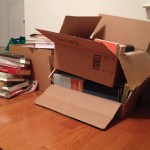
With July coming to a close and a new semester hot on its heels, this weekend seemed like a good time to “revise” my workspace. This has involved: 1) moving my meditation and yoga accoutrements from my office to the bedroom, where there is more space for such activities, 2) ordering a couple of new bookshelves, and 3) boxing up the stacks of books that were lining the baseboard under the printer table.
Though I’ll have to step around boxes of books until the new bookshelves arrive, I am happy with the shape this little project is taking, and particularly like having a meditation space that is separate from my work space. Once the books make their final migration to the living room, where the new bookshelves will be placed, I will have a reasonably clutter-free, dedicated workspace for freelance work and writing.
I also went through a stack of notebooks stashed in the closet to see what was important enough to keep and what could possibly be recycled or re-purposed. There were a couple of half-filled notebooks whose pages were occupied with lists and![IMG_0585[1]](https://zingarapoet.net/wp-content/uploads/2015/07/img_05851.jpg?w=150) musings that I was willing to tear out and toss for the sake of using the last of the notebook paper. Other notebooks were filled with lesson plans and agendas from classes I’ve taught in the past, most of which have also found their way to the recycling bin. This leaves one and one-half smaller notebooks filled with favorite poems that I copied from various sources over the years that I will continue to use, and two daily planners marked with copious notes, task lists, and the names and phone numbers for people I barely remember. I’m pretty sure these are headed for the shredder.
musings that I was willing to tear out and toss for the sake of using the last of the notebook paper. Other notebooks were filled with lesson plans and agendas from classes I’ve taught in the past, most of which have also found their way to the recycling bin. This leaves one and one-half smaller notebooks filled with favorite poems that I copied from various sources over the years that I will continue to use, and two daily planners marked with copious notes, task lists, and the names and phone numbers for people I barely remember. I’m pretty sure these are headed for the shredder.
What remains are journals spanning the years from 2017 to the present which were written during the years I spent living in New Mexico, Korea, Kansas City, and, in the case of the the latest addition, Charleston.
![IMG_0586[1]](https://zingarapoet.net/wp-content/uploads/2015/07/img_05861.jpg?w=150) The year 2008 is especially well represented with over two spiral-bound college-ruled notebooks dedicated to, well, mostly morning pages. That was the year I dedicated myself to the ideas in Julia Cameron’s “The Artist’s Way” and was writing three pages worth of thoughts every day. I was all about process over product and writing through the superficial stuff to get to the good stuff those days. The problem was that by the time I finished my morning pages, I had to get to work, so didn’t have time to work on the creative stuff. The other issue that I kept coming up against was that I was pretty much writing about the same crap every day, so much so that I felt like I was beginning to affirm the things in my character that I didn’t particularly want reaffirmed. I thought that writing about what worried me would help me get past them, but instead it seemed just to compound them. So, after about six months of devoting my early morning hours to morning pages, I revised my practice and started writing about other things, like ideas, images and poems. There is still plenty of complaining and fretting going on in these later notebooks, but at least a few of their entries are interesting. The rest, well, the rest was necessary, even if it doesn’t exactly show my best, most intelligent self. They were the crap I needed to write though to get to the good stuff.
The year 2008 is especially well represented with over two spiral-bound college-ruled notebooks dedicated to, well, mostly morning pages. That was the year I dedicated myself to the ideas in Julia Cameron’s “The Artist’s Way” and was writing three pages worth of thoughts every day. I was all about process over product and writing through the superficial stuff to get to the good stuff those days. The problem was that by the time I finished my morning pages, I had to get to work, so didn’t have time to work on the creative stuff. The other issue that I kept coming up against was that I was pretty much writing about the same crap every day, so much so that I felt like I was beginning to affirm the things in my character that I didn’t particularly want reaffirmed. I thought that writing about what worried me would help me get past them, but instead it seemed just to compound them. So, after about six months of devoting my early morning hours to morning pages, I revised my practice and started writing about other things, like ideas, images and poems. There is still plenty of complaining and fretting going on in these later notebooks, but at least a few of their entries are interesting. The rest, well, the rest was necessary, even if it doesn’t exactly show my best, most intelligent self. They were the crap I needed to write though to get to the good stuff.
The most interesting notebooks are probably the ones I kept while living in Korea, a year in which the value of a journal became most obvious to me. I was very careful about documenting everything that happened to me and every activity I tried because I knew I would only be there for twelve months. Some of those entries spilled over into a scrapbook, which I am still putting together, and others developed into blog posts, like this one about Building 63. Still others served as inspiration for a number of poems written and will probably serve to inspire poems yet born. Of all the journals in my closet, these are probably the ones I most enjoy rereading.
Journals I’ve kept since returning from Korea contain a lot of projects and plans. Their pages are filled with notes on how to ![IMG_0588[1]](https://zingarapoet.net/wp-content/uploads/2015/07/img_058811.jpg?w=150) develop ZingaraPoet.net in 2011 and how to organize 200 New Mexico Poems posts and readings in 2012. Their pages are where I discuss the poems of poets I admire as well as the progress (or lack thereof) I experienced in the writing of my own poetry. Still peppered with concerns about my career, complaints about my environment, and commentary about my current mood, these journals were invaluable tools for deepening my relationship with self, leading me to understand that I could, and can, depend on my own inner resources rather than on externals.
develop ZingaraPoet.net in 2011 and how to organize 200 New Mexico Poems posts and readings in 2012. Their pages are where I discuss the poems of poets I admire as well as the progress (or lack thereof) I experienced in the writing of my own poetry. Still peppered with concerns about my career, complaints about my environment, and commentary about my current mood, these journals were invaluable tools for deepening my relationship with self, leading me to understand that I could, and can, depend on my own inner resources rather than on externals.
The most recent journal, added to the collection just this week, is mostly concerned with my transition to Charleston, and, having spent most of my life west of the Mississippi, this transition has been considerable. The despair, confusion, and hope for better days expressed in its early pages are still fresh, allowing me to bring only a small degree of perspective to these past two years. But, like the journal I kept in Korea, this one represents intense growth of the kind only available when living far outside one’s comfort zone. The kind of growth experienced when a person is determined to move from survival to efficacy.
![IMG_0589[1]](https://zingarapoet.net/wp-content/uploads/2015/07/img_05891.jpg?w=150) So what will I do with this stack of water-stained, yellow-paged, dog-eared spiral notebooks and bound journals from the past? Well, appreciating these well-documented years is a worthy activity. I suppose, too, so is the sense of posterity I get in seeing the stack expand and grow.
So what will I do with this stack of water-stained, yellow-paged, dog-eared spiral notebooks and bound journals from the past? Well, appreciating these well-documented years is a worthy activity. I suppose, too, so is the sense of posterity I get in seeing the stack expand and grow.
David Sedaris once said in an interview that he indexes his journals, a practice that I sort of tried — only I used multi-colored tabs to indicate which entries were poems and which entries had potential to become essays or memoirs.
For now I am content reading through my notebooks and journal with no particular purpose or plan in mind – just an opportunity to cultivate a healthy relationship with myself and a way to spend my time —
waiting for the new bookshelves to arrive.

![IMG_0585[1]](https://zingarapoet.net/wp-content/uploads/2015/07/img_05851.jpg)
![IMG_0586[1]](https://zingarapoet.net/wp-content/uploads/2015/07/img_05861.jpg)
![IMG_0588[1]](https://zingarapoet.net/wp-content/uploads/2015/07/img_058811.jpg)
![IMG_0589[1]](https://zingarapoet.net/wp-content/uploads/2015/07/img_05891.jpg)
 The Zingara Project