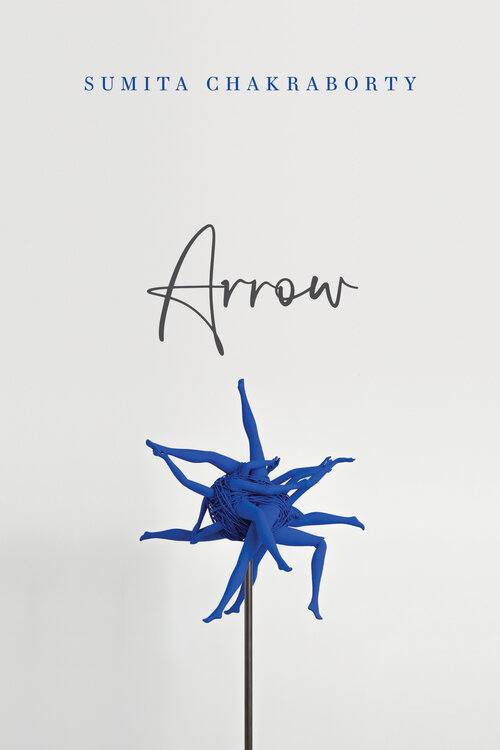
 Arrow
Arrow
by Sumita Chakraborty
Farmington, ME: Alice James Books
Paperback: 2020
Review by Dana Delibovi
One night this past fall, I stood in the backyard, staring at a big, white moon in the branches of a tall and leafless tree. An eerie moonlight revealed clouds in the night sky.
I was amazed, anxious, and not a little afraid. I grabbed my notebook to capture this image, but I was powerless to seize it. As it turned out, the job had already been done, in Sumita Chakraborty’s exquisite new book of poetry, Arrow. In this impeccably curated collection, Chakraborty pierces us with an overriding truth: We can feel but never understand the sheer mass of existence that we behold, from moon to tree to cloud to our own astonished breathing.
The poems in Arrow range from the short lyric to the long, imagist montage. They share, however, vocabulary, syntax, and aura that allow the poems to flow together with a satisfying logic and cohesiveness. The book is not merely a batch of best poems. It is a series where the progression and groupings of the poems add up to something greater than the sum of parts. Chakraborty’s poetry often makes clear the appeal of such order and philosophic rigor, while also pointing out that this kind of regularity is imposed on truly unfathomable mysteries by needy human minds. As she writes in the paragraphed prose-poem, “Essay on the Order of Time”:
…Here, the argument is that death requires the
most discrete borders of all things, and that there is a clear order to how it functions as an
event in time. The concerto was being performed in honor of a poet who had recently died.
To face this loss, this man required the myth of order.
Trying—and failing—to escape the mysterious continually drives the poems in Arrow to hit their mark. Sometimes, it’s the enigma of love that remains impervious to any effort at rational explanation. Love is an eclipse, weighty but transitory. Love is ungraspable—the poet proves she longer loves is by cutting off her hands. Just as often, it’s the enormity and variety of the universe that resists all reason. In the lyric poem, “Marigolds,” for example, Chakraborty asks (but cannot answer) the most basic of questions—why this?
…if we made incisions
from breastbone to rectum, the caves within
would reveal themselves to house celestial ash.
As the stag, I fear the mouth of the rifle.
As the rifle, I point my mouth, deadly, toward you.
As the hunter, I execute myself so I may feast.
Worlds such as this were not thought possible to exist.
My lord, I aim a mile beyond the honeyed moon.
Many of the images in Chakraborty’s poems, along with the emotional vehemence of her writing, bring to mind an association with the poetry of St. Teresa of Ávila (1515–1582). I have written about Teresa and her literary and philosophic legacy. I am also currently translating Teresa’s corpus of 40 extant poems, so I am very close to her work, and perhaps call it to mind too easily. Certainly, Teresa’s 16th-century rhymes and Chakraborty’s modern free verse are worlds apart in terms of prosody. Still, I couldn’t help but notice that many of Chakraborty’s important or recurring nouns—stag, hunter, arrow, breast, cave, spirit, beloved—are Teresinian nouns. Both poets are unabashed as they cry out or breakdown over their inability to understand the world. Both address the divine. Even the one poem I did not like in Chakraborty’s book, “Dear, Beloved,” had enough of these Teresinian features to resonate with me. Although I found “Dear, Beloved” too long to sustain its rapid-fire succession of images, I did appreciate the wild heart, the spiritual spark, and the rich vocabulary that linked the poem to Teresa, and indeed, to all the other poems in Arrow.
Chakraborty’s volume culminates in the multipartite title poem, “Arrow.” This is followed by a chorus of utter amazement at what exists, aptly titled, “O.” “Arrow” begins with a monologue spoken by the night, personified as the Titan goddess, Nyx, a recurring figure in the collection. After the monologue come 24 prose poems, each “titled” with a small icon of the moon’s phases. The invocation of night, the poem’s title, and the moon phases conjure up another night goddess, the Olympian archer Artemis, as well as the steampunk and tattoo images of moon phases on a double-pointed arrow.
An arrow, shot by night, aims for its target in a landscape always obscure to us. When the barb wounds us, shock follows; we feel what the Wisława Szymborska described in her Nobel Prize acceptance speech: “Whatever else we might think of this world—it is astonishing.” We are left panting, scared, and powerlessness, just as I was that night in the backyard, gazing at the moon, the tree, and the illuminated clouds. Chakraborty has been there, too:
Truth be told. I have never lacked for amazement…
This also means I have also always held an affinity for fear, for shifting
uneasily toward the next dazzling thing. For the categories of nocturnal and diurnal
alike, not to mention crepuscular and cathemeral, the uncanny is the house best lived in.
The same could be said for Chakraborty’s Arrow. The book never lacks for amazement. It is a house to live in, and a dazzling thing.
—-
Dana Delibovi is a poet, essayist, and translator from Lake Saint Louis, Missouri. In 2020, her work appeared in The Confluence, After the Art, Apple Valley Review, Linden Avenue, Noon, and Witty Partition. She is the 2019 winner of the James Haba Award for Poetry and a 2020 Pushcart Prize nominee.


 The Zingara Project