Tag: Andrew Lang

  • The Monkey and the Jellyfish

    Children must often have wondered why jelly-fishes have no shells, like so many of the creatures that are washed up every day on the beach. In old times this was not so; the jelly-fish had as hard a shell as any of them, but he lost it through his own fault, as may be seen in this story.

    The sea-queen Otohime, whom you read of in the story of Uraschimatoro, grew suddenly very ill. The swiftest messengers were sent hurrying to fetch the best doctors from every country under the sea, but it was all of no use; the queen grew rapidly worse instead of better. Everyone had almost given up hope, when one day a doctor arrived who was cleverer than the rest, and said that the only thing that would cure her was the liver of an ape. Now apes do not dwell under the sea, so a council of the wisest heads in the nation was called to consider the question how a liver could be obtained. At length it was decided that the turtle, whose prudence was well known, should swim to land and contrive to catch a living ape and bring him safely to the ocean kingdom.

    It was easy enough for the council to entrust this mission to the turtle, but not at all so easy for him to fulfill it. However he swam to a part of the coast that was covered with tall trees, where he thought the apes were likely to be; for he was old, and had seen many things. It was some time before he caught sight of any monkeys, and he often grew tired with watching for them, so that one hot day he fell fast asleep, in spite of all his efforts to keep awake. By-and-by some apes, who had been peeping at him from the tops of the trees, where they had been carefully hidden from the turtle’s eyes, stole noiselessly down, and stood round staring at him, for they had never seen a turtle before, and did not know what to make of it. At last one young monkey, bolder than the rest, stooped down and stroked the shining shell that the strange new creature wore on its back. The movement, gentle though it was, woke the turtle. With one sweep he seized the monkey’s hand in his mouth, and held it tight, in spite of every effort to pull it away. The other apes, seeing that the turtle was not to be trifled with, ran off, leaving their young brother to his fate.

    Then the turtle said to the monkey, ‘If you will be quiet, and do what I tell you, I won’t hurt you. But you must get on my back and come with me.’

    The monkey, seeing there was no help for it, did as he was bid; indeed he could not have resisted, as his hand was still in the turtle’s mouth.

    Delighted at having secured his prize, the turtle hastened back to the shore and plunged quickly into the water. He swam faster than he had ever done before, and soon reached the royal palace. Shouts of joy broke forth from the attendants when he was seen approaching, and some of them ran to tell the queen that the monkey was there, and that before long she would be as well as ever she was. In fact, so great was their relief that they gave the monkey such a kind welcome, and were so anxious to make him happy and comfortable, that he soon forgot all the fears that had beset him as to his fate, and was generally quite at his ease, though every now and then a fit of home-sickness would come over him, and he would hide himself in some dark corner till it had passed away.

    It was during one of these attacks of sadness that a jelly-fish happened to swim by. At that time jelly-fishes had shells. At the sight of the gay and lively monkey crouching under a tall rock, with his eyes closed and his head bent, the jelly-fish was filled with pity, and stopped, saying, ‘Ah, poor fellow, no wonder you weep; a few days more, and they will come and kill you and give your liver to the queen to eat.’

    The monkey shrank back horrified at these words and asked the jelly-fish what crime he had committed that deserved death.

    ‘Oh, none at all,’ replied the jelly-fish, ‘but your liver is the only thing that will cure our queen, and how can we get at it without killing you? You had better submit to your fate, and make no noise about it, for though I pity you from my heart there is no way of helping you.’ Then he went away, leaving the ape cold with horror.

    At first he felt as if his liver was already being taken from his body, but soon he began to wonder if there was no means of escaping this terrible death, and at length he invented a plan which he thought would do. For a few days he pretended to be gay and happy as before, but when the sun went in, and rain fell in torrents, he wept and howled from dawn to dark, till the turtle, who was his head keeper, heard him, and came to see what was the matter. Then the monkey told him that before he left home he had hung his liver out on a bush to dry, and if it was always going to rain like this it would become quite useless. And the rogue made such a fuss and moaning that he would have melted a heart of stone, and nothing would content him but that somebody should carry him back to land and let him fetch his liver again.

    The queen’s councilors were not the wisest of people, and they decided between them that the turtle should take the monkey back to his native land and allow him to get his liver off the bush, but desired the turtle not to lose sight of his charge for a single moment. The monkey knew this, but trusted to his power of beguiling the turtle when the time came, and mounted on his back with feelings of joy, which he was, however, careful to conceal. They set out, and in a few hours were wandering about the forest where the ape had first been caught, and when the monkey saw his family peering out from the tree tops, he swung himself up by the nearest branch, just managing to save his hind leg from being seized by the turtle. He told them all the dreadful things that had happened to him, and gave a war cry which brought the rest of the tribe from the neighbouring hills. At a word from him they rushed in a body to the unfortunate turtle, threw him on his back, and tore off the shield that covered his body. Then with mocking words they hunted him to the shore, and into the sea, which he was only too thankful to reach alive. Faint and exhausted he entered the queen’s palace for the cold of the water struck upon his naked body, and made him feel ill and miserable. But wretched though he was, he had to appear before the queen’s advisers and tell them all that had befallen him, and how he had suffered the monkey to escape But, as sometimes happens, the turtle was allowed to go scot-free, and had his shell given back to him, and all the punishment fell on the poor jelly-fish, who was condemned by the queen to go shield-less for ever after.

    From The Violet Fairy Book edited by Andrew Lange
  • How the Dragon Was Tricked

    How the Dragon Was Tricked

    From Griechtsche und Albanesische Marchen, von J. G. von Hahn. (Leipzig: Engelmann. 1864.)

    Once upon a time there lived a man who had two sons but they did not get on at all well together, for the younger was much handsomer than his elder brother who was very jealous of him. When they grew older, things became worse and worse, and at last one day as they were walking through a wood the elder youth seized hold of the other, tied him to a tree, and went on his way hoping that the boy might starve to death.

    However, it happened that an old and humpbacked shepherd passed the tree with his flock, and seeing the prisoner, he stopped and said to him, ‘Tell me, my son why are you tied to that tree?’ ‘Because I was so crooked,’ answered the young man; ‘but it has quite cured me, and now my back is as straight as can be.’ ‘I wish you would bind me to a tree,’ exclaimed the shepherd, ‘so that my back would get straight.’ ‘With all the pleasure in life,’ replied the youth. ‘If you will loosen these cords I will tie you up with them as firmly as I can.’ This was soon done, and then the young man drove off the sheep, leaving their real shepherd to repent of his folly; and before he had gone very far he met with a horse boy and a driver of oxen, and he persuaded them to turn with him and to seek for adventures.

    By these and many other tricks he soon became so celebrated that his fame reached the king’s ears, and his majesty was filled with curiosity to see the man who had managed to outwit everybody. So he commanded his guards to capture the young man and bring him before him.

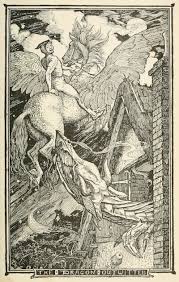
    And when the young man stood before the king, the king spoke to him and said, ‘By your tricks and the pranks that you have played on other people, you have, in the eye of the law, forfeited your life. But on one condition I will spare you, and that is, if you will bring me the flying horse that belongs to the great dragon. Fail in this, and you shall be hewn in a thousand pieces.’ ‘If that is all,’ said the youth, ‘you shall soon have it.’ So he went out and made his way straight to the stable where the flying horse was tethered. He stretched his hand cautiously out to seize the bridle, when the horse suddenly began to neigh as loud as he could. Now the room in which the dragon slept was just above the stable, and at the sound of the neighing he woke and cried to the horse, ‘What is the matter, my treasure? is anything hurting you?’ After waiting a little while the young man tried again to loose the horse, but a second time it neighed so loudly that the dragon woke up in a hurry and called out to know why the horse was making such a noise. But when the same thing happened the third time, the dragon lost his temper, and went down into the stable and took a whip and gave the horse a good beating. This offended the horse and made him angry, and when the young man stretched out his hand to untie his head, he made no further fuss, but suffered himself to be led quietly away. Once clear of the stable the young man sprang on his back and galloped off, calling over his shoulder, ‘Hi! dragon! dragon! if anyone asks you what has become of your horse, you can say that I have got him!’ But the king said, ‘The flying horse is all very well, but I want something more. You must bring me the covering with the little bells that lies on the bed of the dragon, or I will have you hewn into a thousand pieces.’ ‘Is that all?’ answered the youth. ‘That is easily done.’ And when night came he went away to the dragon’s house and climbed up on to the roof. Then he opened a little window in the roof and let down the chain from which the kettle usually hung, and tried to hook the bed covering and to draw it up. But the little bells all began to ring, and the dragon woke and said to his wife, ‘Wife, you have pulled off all the bed-clothes!’ and drew the covering towards him, pulling, as he did so, the young man into the room. Then the dragon flung himself on the youth and bound him fast with cords saying as he tied the last knot, ‘To-morrow when I go to church you must stay at home and kill him and cook him, and when I get back we will eat him together.’ So the following morning the dragoness took hold of the young man and reached down from the shelf a sharp knife with which to kill him. But as she untied the cords the better to get hold of him, the prisoner caught her by the legs, threw her to the ground, seized her and speedily cut her throat, just as she had been about to do for him, and put her body in the oven. Then he snatched up the covering and carried it to the king.

    The king was seated on his throne when the youth appeared before him and spread out the covering with a deep bow. ‘That is not enough,’ said his majesty; ‘you must bring me the dragon himself, or I will have you hewn into a thousand pieces.’ ‘It shall be done,’ answered the youth; ‘but you must give me two years to manage it, for my beard must grow so that he may not know me.’ ‘So be it,’ said the king. And the first thing the young man did when his beard was grown was to take the road to the dragon’s house and on the way he met a beggar, whom he persuaded to change clothes with him, and in the beggar’s garments he went fearlessly forth to the dragon. He found his enemy before his house, very busy making a box, and addressed him politely, ‘Good morning, your worship. Have you a morsel of bread?’ ‘You must wait,’ replied the dragon, ’till I have finished my box, and then I will see if I can find one.’ ‘What will you do with the box when it is made?’ inquired the beggar.

    ‘It is for the young man who killed my wife, and stole my flying horse and my bed covering,’ said the dragon. ‘He deserves nothing better,’ answered the beggar, ‘for it was an ill deed. Still that box is too small for him, for he is a big man.’ ‘You are wrong,’ said the dragon. ‘The box is large enough even for me.’ ‘Well, the rogue is nearly as tall as you,’ replied the beggar, ‘and, of course, if you can get in, he can. But I am sure you would find it a tight fit.’ ‘No, there is plenty of room,’ said the dragon, tucking himself carefully inside. But no sooner was he well in, than the young man clapped on the lid and called out, ‘Now press hard, just to see if he will be able to get out.’ The dragon pressed as hard as he could, but the lid never moved.

    ‘It is all right,’ he cried; ‘now you can open it.’ But instead of opening it, the young man drove in long nails to make it tighter still; then he took the box on his back and brought it to the king. And when the king heard that the dragon was inside, he was so excited that he would not wait one moment, but broke the lock and lifted the lid just a little way to make sure he was really there. He was very careful not to leave enough space for the dragon to jump out, but unluckily there was just room for his great mouth, and with one snap the king vanished down his wide red jaws. Then the young man married the king’s daughter and ruled over the land, but what he did with the dragon nobody knows.