 didn't need them this time
 White Bear Eagle Sea Turtle
 Ivory Dove
 just directly to the motel room
 himself  sitting at the foot of the bed
 finished and finished and
 entirely seized
 (Merlin and Morgana)
 and you standing to the right
 behind him in
 your black bra and slip
 never looking so lost
 possessed
 by all that losing
    he snapped to
    like a slap
    a mystic
    rear end collision
 lost your number
 and has passed
 you by every day since
 his dearest friend
 quizzical hurt saved

---

Wayne-Daniel Berard, an adoptee who found and embraced his
Jewishness, teaches English and Humanities at Nichols College,
Dudley, MA. He is an interfaith clergy person, and co-founding
editor of Soul-Lit, an online journal of spiritual poetry. He
lives in Mansfield, MA with his wife, The Lovely Christine.
Category: Zingara Poetry Review: Poetry Picks
-
the shaman sees the Dread Unless by Wayne-Daniel Berard
-
Rest Stop by Allyson Whipple
~For Harrison Porobil
You’ve survived worse odds
than this: childhood,
hurricanes, homelessness.
This time it’s just a broken
lock that has you stuck
here, taking stock
of misfortune. What a way
to spend Christmas
morning, trapped on I-10.
Gas station toilet a stinking
pen. But no matter
how you turn and pull
and push until your muscles
burn you’re stuck with stale
air and stink and more time
than you’d like to think
about the turning of the year.There’s sweat upon your brow
from fighting with the force
that holds you in. As it’s always been:
you’re a man of motion. Kick
the door open, get in the car.—
Allyson Whipple has an M.A. in English and a black belt in Kung Fu. She is currently studying poetry through the UT-El Paso Online MFA Program. Allyson serves as co-editor of the Texas Poetry Calendar, and is the author of the chapbook We’re Smaller Than We Think We Are. She teaches at Austin Community College.

-
Submissions Open Today
Zingara Poetry Picks seeks submissions of previously unpublished poems (on-line or in print) of 40 lines or fewer for 2016 picks. New, emerging, and established poets are encouraged to submit and all submissions will be given careful consideration.
Please keep the following in mind when submitting your best poems:
- Reading period for Zingara Poetry Picks is from August 15 to December 31st. Unless the deadline is extended, submissions received outside of this time period will not be acknowledged or considered. In fact, they will be deleted.
- There is no fee to submit
- Title of poem(s) should appear in the email subject line. Poems should be attached as word documents and mailed to zingarapoet@gmail.com
- The body of the email should include a cover letter and a professional biography of 50 words or fewer written in the third person
- Attach a word document with no more than three poems of 40 or fewer lines
- Only one submission at a time (please wait to hear back before submitting more poems)
- Simultaneous submissions are fine, but please let ZingraPoet know immediately if submitted work is accepted elsewhere
- ZingaraPoet does not accept previously published work
- Published poets receive bragging rights and the chance to share their work with a diverse audience
- Poets who are published on Zingara Poetry Pick should wait 24 months before submitting again
- Do not submit if you have had a poem featured on Zingara Poetry Picks in the last 24 months.
- Submissions which do not follow these guidelines will be deleted without acknowledgement
- If accepted work is later published elsewhere, please acknowledge that the piece first appeared as a Zingara Poetry Pick.
What I look for in a poem:
Like all editors, I like to see interesting poems that do what they do well. Whether traditional, conceptual, lyrical, or formal, they should exhibit the poet’s clear understanding of craft and, just as importantly, revision. Very elemental poems that have not undergone effective revision will probably not make the cut. Likewise, poems which are contrived, sacrifice meaning for the sake of rhyme, feel incomplete, do not risk sentimentality (or are too sentimental), or lack tension when tension is needed, will also be dismissed. Finally, poems which perpetuate harmful stereotypes of gender, race, or class will most certainly not be considered.
For a very good discussion on the elements of effective poetry, take a look at Slushpile Musings by James Swingle, publisher and editor of Noneucildean Cafe’
A note on formatting: poems that contain lines which are flush with the left margin are more conducive to publication on a blog site than those which have unconventional indention or unusual margin settings. Likewise, poems which feature long lines may require additional line breaks or may require the right-scrolling function to be viewed in full.
Response time is 6 months.
-
Remorse by Gary Beck
Men of purpled cloisters
I see your heavy robes of 3:00 a.m.
guttered on Fifth Avenue
as the long night passes
to a woman’s frightened scream.
O woman who I love
whose gift is pain,
in my midnight self
I cry in secret horror
at my abusive hands
which give you hurt.
If I could tear my granite chest,
pluck my pulsing love,
you would see my madness die,
the marks of cruel fingers fade.—
Gary Beck has spent most of his adult life as a theater director. Published chapbooks include Remembrance, Origami Condom Press; The Conquest of Somalia, Cervena Barva Press; and The Dance of Hate, Calliope Nerve Media, among others. His novel Extreme Change was published by Cogwheel Press and his collection of short stories, A Glimpse of Youth was published by Sweatshoppe Publications. His original plays and translations of Moliere, Aristophanes and Sophocles have been produced Off Broadway. His poetry, fiction and essays have appeared in hundreds of literary magazines. He currently lives in New York City.
. -
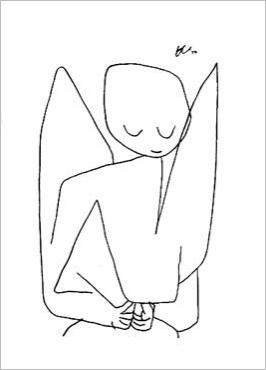
Klee’s Angel by bz niditch
Like moving
the wings
and cloudlets
of our history
the futurists
turn back to
acknowledge
the high art
embodied
in you,
Angelus Novus
speak to us
of all possibilities
on an unshaven
earth time span
where the voice
of fern and grass
belongs to us,
the ocean is clear
for salmon
whale and dolphin,
unpolluted city masks
now familial
be removed,
for wheat and grains
to again grow
on threshing floors.—
-
How I Arrived Here by Karen Neuberg
When still young, I left
the safe home of myself
and ad/ventured into
a waiting, twisting threadof freedom
and misinformation.
The original speck of entry
opened, became my new home,
where I foundI wasn’t a total stranger
to myself. I still carried
my barriers, my fences, walls,
doors, battlements, weaponry,armor, shields…
At first, they transported.
easily as a cloud of feathers;
but over time they turned
to stone, to ice.What else to do
but carve and chip
and make the most
of sun and rain.—
Karen Neuberg holds an MFA from The New School. Her chapbook, Detailed Still, was published by Poets Wear Prada, and her chapbook, Myself Taking Stage, is newly available from Finishing Line Press.
-
Three Tanka by SuzAnne C. Cole
summer garden show
at Hampton Court Palace
drunk on color
I pass parking lot sign—
please stagger your way home***
travel dilemma—
walk faint trails, enter dark caves
trust most strangers
or stay at Howard Johnson’s
safe with other tourists***
young girls yearning
for status not yet theirs
pinch off fireflies’ gold
adorn grimy fingers
with circlets of light—-
SuzAnne C. Cole writes in the Texas Hill Country. Both a juried and featured poet for Houston Poetry Fest, she’s won a Japanese haiku contest. -
Leaving Garden Court by Ira Schaeffer
It was spring, when tulips
show their pretty colors
and robins make nests
for small blue eggs.
I was ten, feeling cozy
on the sofa, leafing through
Mad, when comic book violence
came alive.Driven by another fierce defense
of some imagined line crossed,
my parents had attacked
our upstairs neighbors.
Shrieks and pounding
clashed up and down
our common hall.Our door slammed shut.
I didn’t want to but saw
my mother’s harrowed
face and arms,
my father dripping sweat
and his panting like a dog.
There was no place to hide.For days, a strange quiet,
my parents were like ghosts.
A letter arrived,
then the cardboard boxes.
Books and jeans were packed
along with scars and ruin.
We were moving to a smaller flat.On the way we passed a cemetery
with branches of dark trees
hanging above rows of stones.
I pictured myself underground
My stone said something sad;
most of the letters were faded.After we got to the new place
I thought of surprising my parents
with something funny.
I crayoned a sign, making a blue
R.I.P., black for my name and dates
and red for birds in each corner.
I held the cardboard to my chest,
stretched out on the floor—
shut my eyes and waited.—
Ira Schaeffer is a poet who reads his own poems and those of professional writers in various public venues throughout Rhode Island. His poetry has been published in a variety of small presses.
-
A Classification of Poets by Roy Beckemeyer
All those poets, with their delicate
faces, the rote way I relegate
their taut verses : Alluvial traces,
Marsupial purses, Tightly coiled cases.Their animal hands, their angelic minds,
the various cants of their labored lines.
I draw from this strange sonnet’s brevity
a taxonomic range of verse levity.
—Roy Beckemeyer, from Wichita, Kansas has recently published in The Midwest Quarterly, The North Dakota Quarterly, Nebo, Straylight, and The Bluest Aye. His debut collection of poetry, Music I Once Could Dance To is available from Coal City Press.
-
Quatrina by Neil Fulwood
A half halved. A quarter moon. The Sign of Four.
Two slices across the pie chart. I’m sorry; let
me start again. I’m talking about dividing or
multiplying by four, the answer or image you getby quartering or quadrupling. Or what little you get
from a quick trawl of the library shelves: The Four
Feathers, Four Past Midnight, Four Quartets, and let
us not forget Four Children and It. Why do five orseven get the better deal? Enid Blyton and the rich ore
of children’s fiction, that’s why! If it’s not Five Get
Kidnapped by Somali Pirates then it’s Seven for
the Cup, Good Show, Hooray! Give me a break. Letme disentangle from their tea-time adventures, let
the tomboy and the girly-girl get better acquainted, or
the dog make a break for freedom, run wild, get
its Jack London funk on. Let anarchy come to the foreand words give numbers what for. Yes! And let
no quarter be asked or given. And let the reader forget.—
Neil Fulwood was born in 1972 and got involved with poetry at an impressionable age. His interests include visiting inns and taverns of architectural interest. Some people confuse this with pub-crawling. -
Landing Phase by Don Maker
(dedicated to Space Shuttle Enterprise)
From out of the endless void we fell at over Mach twenty-five;
with an L to D of four-to-one, our descent was more of a dive.
But the stick was dead and the hull was red,
so we rode her down to the onrushing ground
and just hoped we would somehow survive.At seventeen-thousand feet we began our so-called landing phase,
and the blessed CPU kicked in without its normal delays.
So, despite the glows from the blazing nose,
we could feel some float start around the bird’s throat,
and we sang that great programmer’s praise.We didn’t hit much of a thermal, but then, it doesn’t matter much—
because she’s a silo with stubs for wings, the bird doesn’t have much touch.
Since her normal place is flying through space,
we try not to mind if the landing aren’t kind…
if they don’t leave us needing a crutch.That last roll-reversal left us dead center of the glideslope corridor;
at twenty degrees and three-hundred knots, the bird is begging for more.
But the pathy lights have just come into sight,
and the CRTs swear that it’s time for pre-flare,
‘though the vehicle still wants to soar.The horizon blazes with whiteness as the sand reflects the sun,
and we know, one way or another, we’ll soon come to the end of our run.
With hardly a sound the gear quickly drops down,
and tension runs high as we drop from the sky
in a bird that weighs ninety-nine tons.We’ve resumed the controls, and it’s time to find out exactly what we’re worth,
for the place that we’ve been makes us feel we’ve returned to find our soul’s rebirth.
And when we anoint the long waited touchpoint,
the drums seem to roll as I say to control:
“The first spaceship has landed on Earth.” -
Bathing by Susanna Lang
Every morning now
you draw the washcloth down
my arm, careful not to
rub too hard—the scaris still a little sore.
You lift my breasts to wash
beneath, and turn me round
as if some music playedand not the shower. You scrub
my back, invite me out
into the towel’s blind
embrace and yours, althoughyou see it all—the skin
that puckers and flakes, an arm
that will not bring my hand
to my mouth, or bear a weight.Still you get up with tired
eyes to test the water,
and make my bath a dance
to open up the day.
—Susanna Lang’s most recent collection of poems is Tracing the Lines (Brick Road Poetry Press, 2013). She lives in Chicago, where she teaches in the Chicago Public Schools.
-
If Januarians Who Dream of June by James Penha
If Januarians who dream of June
awake on Ides with centrophobic stress,
while scientists see over Saturn’s moon
a future compulsively to obsess,
then surely some contemporary snake
has made the apple of the present moot:as if we receive a gingerbread cake
we decline to cut cause it’s all dried fruit!
or we’re those fans who used to stalk Greta Garbo
outside Sutton Place in hopes she would play
her last great scene with us–while the hobo
round the corner earned Ninotchka’s smile each day.Why imagine a ruby in rhinestone
or trail the scents of the perfect cologne?
—
A native New Yorker, James Penha has lived for the past twenty years in Indonesia. He has been nominated for Pushcart Prizes in fiction and in poetry. No Bones to Carry, a volume of his poetry, the 2007 New Sins Press Editors’ Choice Award. Penha edits The New Verse News, an online journal of current-events poetry. -
Submission News
I am nearly caught up with reading submissions. April and May submissions have been read and largely decided upon. If you submitted during those months and have not heard from me, I am either deliberating or trying to figure out how to format something on WordPress. I am still reading June, July and August submissions.
October’s theme is Ekphrastic poetry.
Thanks everyone for your patience, and happy writing!
Lisa
-
On Sunday by Karen Loeb
Tomorrow I will make potato latkes.
I will be a renegade and use sweet potatoes,
not the white potatoes I grew up with,
the white potatoes that were always
used in the pancakes. The white potatoes
that my mother never questioned,
that she placed on the table in many
different disguises—mashed, baked,
boiled and cold in salad with mayo stuck
on everything, obscuring what lay beneath
the slick white coat.I will use sweet potatoes when I make
my latkes. I will use minced scallions
instead of yellow onions cut in chunks.
I will even use the green leaves that
arc out from the white bulb like a dancer
extending a leg. I will cut off the roots.Of course I will do that.
I will grate the potatoes in a processor,
something my mother never had. I will
not feel guilt for doing this. My latkes
will not be less authentic because the potatoes
were whirled around and chopped into many
small bits. I will invite friends over
to eat the small round cakes with a
tinge of orange. They cannot be mistaken
for white potato latkes. I’ve made sure of that.—
Karen Loeb writes and teaches in Eau Claire, Wisconsin. Recent publications have been a story in Thema, poems in The Main Street Rag, Bloodroot and Hanging Loose.
 The Zingara Project