Category: Lit Sunday

  • The Monkey and the Jellyfish

    Children must often have wondered why jelly-fishes have no shells, like so many of the creatures that are washed up every day on the beach. In old times this was not so; the jelly-fish had as hard a shell as any of them, but he lost it through his own fault, as may be seen in this story.

    The sea-queen Otohime, whom you read of in the story of Uraschimatoro, grew suddenly very ill. The swiftest messengers were sent hurrying to fetch the best doctors from every country under the sea, but it was all of no use; the queen grew rapidly worse instead of better. Everyone had almost given up hope, when one day a doctor arrived who was cleverer than the rest, and said that the only thing that would cure her was the liver of an ape. Now apes do not dwell under the sea, so a council of the wisest heads in the nation was called to consider the question how a liver could be obtained. At length it was decided that the turtle, whose prudence was well known, should swim to land and contrive to catch a living ape and bring him safely to the ocean kingdom.

    It was easy enough for the council to entrust this mission to the turtle, but not at all so easy for him to fulfill it. However he swam to a part of the coast that was covered with tall trees, where he thought the apes were likely to be; for he was old, and had seen many things. It was some time before he caught sight of any monkeys, and he often grew tired with watching for them, so that one hot day he fell fast asleep, in spite of all his efforts to keep awake. By-and-by some apes, who had been peeping at him from the tops of the trees, where they had been carefully hidden from the turtle’s eyes, stole noiselessly down, and stood round staring at him, for they had never seen a turtle before, and did not know what to make of it. At last one young monkey, bolder than the rest, stooped down and stroked the shining shell that the strange new creature wore on its back. The movement, gentle though it was, woke the turtle. With one sweep he seized the monkey’s hand in his mouth, and held it tight, in spite of every effort to pull it away. The other apes, seeing that the turtle was not to be trifled with, ran off, leaving their young brother to his fate.

    Then the turtle said to the monkey, ‘If you will be quiet, and do what I tell you, I won’t hurt you. But you must get on my back and come with me.’

    The monkey, seeing there was no help for it, did as he was bid; indeed he could not have resisted, as his hand was still in the turtle’s mouth.

    Delighted at having secured his prize, the turtle hastened back to the shore and plunged quickly into the water. He swam faster than he had ever done before, and soon reached the royal palace. Shouts of joy broke forth from the attendants when he was seen approaching, and some of them ran to tell the queen that the monkey was there, and that before long she would be as well as ever she was. In fact, so great was their relief that they gave the monkey such a kind welcome, and were so anxious to make him happy and comfortable, that he soon forgot all the fears that had beset him as to his fate, and was generally quite at his ease, though every now and then a fit of home-sickness would come over him, and he would hide himself in some dark corner till it had passed away.

    It was during one of these attacks of sadness that a jelly-fish happened to swim by. At that time jelly-fishes had shells. At the sight of the gay and lively monkey crouching under a tall rock, with his eyes closed and his head bent, the jelly-fish was filled with pity, and stopped, saying, ‘Ah, poor fellow, no wonder you weep; a few days more, and they will come and kill you and give your liver to the queen to eat.’

    The monkey shrank back horrified at these words and asked the jelly-fish what crime he had committed that deserved death.

    ‘Oh, none at all,’ replied the jelly-fish, ‘but your liver is the only thing that will cure our queen, and how can we get at it without killing you? You had better submit to your fate, and make no noise about it, for though I pity you from my heart there is no way of helping you.’ Then he went away, leaving the ape cold with horror.

    At first he felt as if his liver was already being taken from his body, but soon he began to wonder if there was no means of escaping this terrible death, and at length he invented a plan which he thought would do. For a few days he pretended to be gay and happy as before, but when the sun went in, and rain fell in torrents, he wept and howled from dawn to dark, till the turtle, who was his head keeper, heard him, and came to see what was the matter. Then the monkey told him that before he left home he had hung his liver out on a bush to dry, and if it was always going to rain like this it would become quite useless. And the rogue made such a fuss and moaning that he would have melted a heart of stone, and nothing would content him but that somebody should carry him back to land and let him fetch his liver again.

    The queen’s councilors were not the wisest of people, and they decided between them that the turtle should take the monkey back to his native land and allow him to get his liver off the bush, but desired the turtle not to lose sight of his charge for a single moment. The monkey knew this, but trusted to his power of beguiling the turtle when the time came, and mounted on his back with feelings of joy, which he was, however, careful to conceal. They set out, and in a few hours were wandering about the forest where the ape had first been caught, and when the monkey saw his family peering out from the tree tops, he swung himself up by the nearest branch, just managing to save his hind leg from being seized by the turtle. He told them all the dreadful things that had happened to him, and gave a war cry which brought the rest of the tribe from the neighbouring hills. At a word from him they rushed in a body to the unfortunate turtle, threw him on his back, and tore off the shield that covered his body. Then with mocking words they hunted him to the shore, and into the sea, which he was only too thankful to reach alive. Faint and exhausted he entered the queen’s palace for the cold of the water struck upon his naked body, and made him feel ill and miserable. But wretched though he was, he had to appear before the queen’s advisers and tell them all that had befallen him, and how he had suffered the monkey to escape But, as sometimes happens, the turtle was allowed to go scot-free, and had his shell given back to him, and all the punishment fell on the poor jelly-fish, who was condemned by the queen to go shield-less for ever after.

    From The Violet Fairy Book edited by Andrew Lange

  • Sonnet XLII

    Elizabeth Barrett Browning

    "My future will not copy fair my past"--
    I wrote that once; and thinking at my side
    My ministering life-angel justified
    The word by his appealing look upcast
    To the white throne of God, I turned at last,
    And there, instead, saw thee, not unallied
    To angels in thy soul! Then I, long tried
    By natural ills, received the comfort fast,
    While budding, at thy sight, my pilgrim's staff
    Gave out green leaves with morning dews impearled.
    I seek no copy now of life's first half:
    Leave here the pages with long musing curled,
    And write me new my future's epigraph,
    New angel mine, unhoped for in the world!
  • How the Dragon Was Tricked

    How the Dragon Was Tricked

    From Griechtsche und Albanesische Marchen, von J. G. von Hahn. (Leipzig: Engelmann. 1864.)

    Once upon a time there lived a man who had two sons but they did not get on at all well together, for the younger was much handsomer than his elder brother who was very jealous of him. When they grew older, things became worse and worse, and at last one day as they were walking through a wood the elder youth seized hold of the other, tied him to a tree, and went on his way hoping that the boy might starve to death.

    However, it happened that an old and humpbacked shepherd passed the tree with his flock, and seeing the prisoner, he stopped and said to him, ‘Tell me, my son why are you tied to that tree?’ ‘Because I was so crooked,’ answered the young man; ‘but it has quite cured me, and now my back is as straight as can be.’ ‘I wish you would bind me to a tree,’ exclaimed the shepherd, ‘so that my back would get straight.’ ‘With all the pleasure in life,’ replied the youth. ‘If you will loosen these cords I will tie you up with them as firmly as I can.’ This was soon done, and then the young man drove off the sheep, leaving their real shepherd to repent of his folly; and before he had gone very far he met with a horse boy and a driver of oxen, and he persuaded them to turn with him and to seek for adventures.

    By these and many other tricks he soon became so celebrated that his fame reached the king’s ears, and his majesty was filled with curiosity to see the man who had managed to outwit everybody. So he commanded his guards to capture the young man and bring him before him.

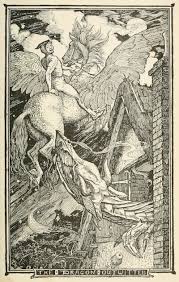
    And when the young man stood before the king, the king spoke to him and said, ‘By your tricks and the pranks that you have played on other people, you have, in the eye of the law, forfeited your life. But on one condition I will spare you, and that is, if you will bring me the flying horse that belongs to the great dragon. Fail in this, and you shall be hewn in a thousand pieces.’ ‘If that is all,’ said the youth, ‘you shall soon have it.’ So he went out and made his way straight to the stable where the flying horse was tethered. He stretched his hand cautiously out to seize the bridle, when the horse suddenly began to neigh as loud as he could. Now the room in which the dragon slept was just above the stable, and at the sound of the neighing he woke and cried to the horse, ‘What is the matter, my treasure? is anything hurting you?’ After waiting a little while the young man tried again to loose the horse, but a second time it neighed so loudly that the dragon woke up in a hurry and called out to know why the horse was making such a noise. But when the same thing happened the third time, the dragon lost his temper, and went down into the stable and took a whip and gave the horse a good beating. This offended the horse and made him angry, and when the young man stretched out his hand to untie his head, he made no further fuss, but suffered himself to be led quietly away. Once clear of the stable the young man sprang on his back and galloped off, calling over his shoulder, ‘Hi! dragon! dragon! if anyone asks you what has become of your horse, you can say that I have got him!’ But the king said, ‘The flying horse is all very well, but I want something more. You must bring me the covering with the little bells that lies on the bed of the dragon, or I will have you hewn into a thousand pieces.’ ‘Is that all?’ answered the youth. ‘That is easily done.’ And when night came he went away to the dragon’s house and climbed up on to the roof. Then he opened a little window in the roof and let down the chain from which the kettle usually hung, and tried to hook the bed covering and to draw it up. But the little bells all began to ring, and the dragon woke and said to his wife, ‘Wife, you have pulled off all the bed-clothes!’ and drew the covering towards him, pulling, as he did so, the young man into the room. Then the dragon flung himself on the youth and bound him fast with cords saying as he tied the last knot, ‘To-morrow when I go to church you must stay at home and kill him and cook him, and when I get back we will eat him together.’ So the following morning the dragoness took hold of the young man and reached down from the shelf a sharp knife with which to kill him. But as she untied the cords the better to get hold of him, the prisoner caught her by the legs, threw her to the ground, seized her and speedily cut her throat, just as she had been about to do for him, and put her body in the oven. Then he snatched up the covering and carried it to the king.

    The king was seated on his throne when the youth appeared before him and spread out the covering with a deep bow. ‘That is not enough,’ said his majesty; ‘you must bring me the dragon himself, or I will have you hewn into a thousand pieces.’ ‘It shall be done,’ answered the youth; ‘but you must give me two years to manage it, for my beard must grow so that he may not know me.’ ‘So be it,’ said the king. And the first thing the young man did when his beard was grown was to take the road to the dragon’s house and on the way he met a beggar, whom he persuaded to change clothes with him, and in the beggar’s garments he went fearlessly forth to the dragon. He found his enemy before his house, very busy making a box, and addressed him politely, ‘Good morning, your worship. Have you a morsel of bread?’ ‘You must wait,’ replied the dragon, ’till I have finished my box, and then I will see if I can find one.’ ‘What will you do with the box when it is made?’ inquired the beggar.

    ‘It is for the young man who killed my wife, and stole my flying horse and my bed covering,’ said the dragon. ‘He deserves nothing better,’ answered the beggar, ‘for it was an ill deed. Still that box is too small for him, for he is a big man.’ ‘You are wrong,’ said the dragon. ‘The box is large enough even for me.’ ‘Well, the rogue is nearly as tall as you,’ replied the beggar, ‘and, of course, if you can get in, he can. But I am sure you would find it a tight fit.’ ‘No, there is plenty of room,’ said the dragon, tucking himself carefully inside. But no sooner was he well in, than the young man clapped on the lid and called out, ‘Now press hard, just to see if he will be able to get out.’ The dragon pressed as hard as he could, but the lid never moved.

    ‘It is all right,’ he cried; ‘now you can open it.’ But instead of opening it, the young man drove in long nails to make it tighter still; then he took the box on his back and brought it to the king. And when the king heard that the dragon was inside, he was so excited that he would not wait one moment, but broke the lock and lifted the lid just a little way to make sure he was really there. He was very careful not to leave enough space for the dragon to jump out, but unluckily there was just room for his great mouth, and with one snap the king vanished down his wide red jaws. Then the young man married the king’s daughter and ruled over the land, but what he did with the dragon nobody knows.

  • Red Riding Hood and the Wolf (Lang version)

    Red Riding Hood and the Wolf (Lang version)

    from the Blue Fairy Book edited by Andrew Lang

    Once upon a time there lived in a certain village a little country girl, the prettiest creature was ever seen. Her mother was excessively fond of her; and her grandmother doted on her still more. This good woman had made for her a little red riding-hood; which became the girl so extremely well that everybody called her Little Red Riding-Hood.

    One day her mother, having made some custards, said to her:

    “Go, my dear, and see how thy grandmamma does, for I hear she has been very ill; carry her a custard, and this little pot of butter.”

    Little Red Riding-Hood set out immediately to go to her grandmother, who lived in another village.

    As she was going through the wood, she met with Gaffer Wolf, who had a very great mind to eat her up, but he dared not, because of some faggot-makers hard by in the forest. He asked her whither she was going. The poor child, who did not know that it was dangerous to stay and hear a wolf talk, said to him:

    “I am going to see my grandmamma and carry her a custard and a little pot of butter from my mamma.”

    “Does she live far off?” said the Wolf.

    “Oh! ay,” answered Little Red Riding-Hood; “it is beyond that mill you see there, at the first house in the village.”

    “Well,” said the Wolf, “and I’ll go and see her too. I’ll go this way and you go that, and we shall see who will be there soonest.”

    The Wolf began to run as fast as he could, taking the nearest way, and the little girl went by that farthest about, diverting herself in gathering nuts, running after butterflies, and making nosegays of such little flowers as she met with. The Wolf was not long before he got to the old woman’s house. He knocked at the door—tap, tap.

    “Who’s there?”

    “Your grandchild, Little Red Riding-Hood,” replied the Wolf, counterfeiting her voice; “who has brought you a custard and a little pot of butter sent you by mamma.”

    The good grandmother, who was in bed, because she was somewhat ill, cried out:

    “Pull the bobbin, and the latch will go up.”

    The Wolf pulled the bobbin, and the door opened, and then presently he fell upon the good woman and ate her up in a moment, for it was above three days that he had not touched a bit. He then shut the door and went into the grandmother’s bed, expecting Little Red Riding-Hood, who came some time afterward and knocked at the door—tap, tap.

    “Who’s there?”

    Little Red Riding-Hood, hearing the big voice of the Wolf, was at first afraid; but believing her grandmother had got a cold and was hoarse, answered:

    “‘Tis your grandchild, Little Red Riding-Hood, who has brought you a custard and a little pot of butter mamma sends you.”

    The Wolf cried out to her, softening his voice as much as he could:

    “Pull the bobbin, and the latch will go up.”

    Little Red Riding-Hood pulled the bobbin, and the door opened.

    The Wolf, seeing her come in, said to her, hiding himself under the bed-clothes:

    “Put the custard and the little pot of butter upon the stool, and come and lie down with me.”

    Little Red Riding-Hood undressed herself and went into bed, where, being greatly amazed to see how her grandmother looked in her night-clothes, she said to her:

    “Grandmamma, what great arms you have got!”

    “That is the better to hug thee, my dear.”

    “Grandmamma, what great legs you have got!”

    “That is to run the better, my child.”

    “Grandmamma, what great ears you have got!”

    “That is to hear the better, my child.”

    “Grandmamma, what great eyes you have got!”

    “It is to see the better, my child.”

    “Grandmamma, what great teeth you have got!”

    “That is to eat thee up.”

    And, saying these words, this wicked wolf fell upon Little Red Riding-Hood, and ate her all up.

  • Great Waves

    In the early days of the Meiji era there lived a well-known wrestler called O-nami, Great Waves.

    O-nami was immensely strong and knew the art of wrestling. In his private bouts he defeated even his teacher, but in public he was so bashful that his own pupils threw him.

    O-nami felt he should go to a Zen master for help. Hakuju, wandering teacher, was stopping in a little temple nearby, so O-nami went to see him and told him of his trouble.

    “Great Waves is your name,” the teacher advised, “so stay in this temple tonight. Imagine that you are those billows. You are no longer a wrestler who is afraid. You are those huge waves sweeping everything before them, swallowing all in their path. Do this and you will be the greatest wrestler in the land.”

    The teacher retired. O-nami sat in meditation trying to imagine himself as waves. He thought of many different things. Then gradually he turned more and more to the feeling of the waves. As the night advanced the waves became larger and larger. They swept away the flowers in their vases. Even the Buddha in the shrine was inundated. Before dawn the temple was nothing but the ebb and flow of an immense sea.

    In the morning the teacher found O-nami meditating, a faint smile on his face. He patted the wrestler’s should. “Now nothing can disturb you,” he said. “You are those waves. You will sweep everything before you.”

    The same day O-nami entered the wrestling contests and won. After that, no one in Japan was able to defeat him.

    From Zen Flesh Zen Bones: A Collection of Zen and Pre-Zen Writings compiled by Paul Reps and Nyogen Senzaki

  • XLV As imperceptibly as grief

    XLV As imperceptibly as grief

    Emily Dickinson

  • The Finest Liar in the World

    The Finest Liar in the World

    Gearing up to prep and teach this semester’s “The Fairy Tale and the Poem” topics in poetry class beginning August 26.


    At the edge of a wood there lived an old man who had only one son, and one day he called the boy to him and said he wanted some corn ground, but the youth must be sure never to enter any mill where the miller was beardless.

    The boy took the corn and set out, and before he had gone very far he saw a large mill in front of him, with a beardless man standing in the doorway.

    ‘Good greeting, beardless one!’ cried he.

    ‘Good greeting, sonny,’ replied the man.

    ‘Could I grind something here?’

    ‘Yes, certainly! I will finish what I am doing and then you can grind as long as you like.’

    But suddenly the boy remembered what his father had told him, and bade farewell to the man, and went further down the river, till he came to another mill, not knowing that as soon as his back was turned the beardless man had picked up a bag of corn and run hastily to the same mill before him. When the boy reached the second mill, and saw a second beardless man sitting there, he did not stop, and walked on till he came to a third mill. But this time also the beardless man had been too clever for him, and had arrived first by another road. When it happened a fourth time the boy grew cross, and said to himself, ‘It is no good going on; there seems to be a beardless man in every mill’; and he took his sack from his back, and made up his mind to grind his corn where he was.

    The beardless man finished grinding his own corn, and when he had done he said to the boy, who was beginning to grind his, ‘Suppose, sonny, we make a cake of what you have there.’

    Now the boy had been rather uneasy when he recollected his father’s words, but he thought to himself, ‘What is done cannot be undone,’ and answered, ‘Very well, so let it be.’

    Then the beardless one got up, threw the flour into the tub, and made a hole in the middle, telling the boy to fetch some water from the river in his two hands, to mix the cake. When the cake was ready for baking they put it on the fire, and covered it with hot ashes, till it was cooked through. Then they leaned it up against the wall, for it was too big to go into a cupboard, and the beardless one said to the boy:

    ‘Look here, sonny: if we share this cake we shall neither of us have enough. Let us see who can tell the biggest lie, and the one who lies the best shall have the whole cake.’

    The boy, not knowing what else to do, answered, ‘All right; you begin.’

    So the beardless one began to lie with all his might, and when he was tired of inventing new lies the boy said to him, ‘My good fellow, if THAT is all you can do it is not much! Listen to me, and I will tell you a true story.

    ‘In my youth, when I was an old man, we had a quantity of beehives. Every morning when I got up I counted them over, and it was quite easy to number the bees, but I never could reckon the hives properly. One day, as I was counting the bees, I discovered that my best bee was missing, and without losing a moment I saddled a cock and went out to look for him. I traced him as far as the shore, and knew that he had crossed the sea, and that I must follow. When I had reached the other side I found a man had harnessed my bee to a plough, and with his help was sowing millet seed.

    ‘ “That is my bee!” I shouted. “Where did you get him from?” ‘ “Brother,” replied the man, “if he is yours, take him.” And he not only gave me back my bee, but a sack of millet seed into the bargain, because he had made use of my bee. Then I put the bag on my shoulders, took the saddle from the cock, and placed it on the back of the bee, which I mounted, leading the cock by a string, so that he should have a rest. As we were flying home over the sea one of the strings that held the bag of millet broke in two, and the sack dropped straight into the ocean. It was quite lost, of course, and there was no use thinking about it, and by the time we were safe back again night had come. I then got down from my bee, and let him loose, that he might get his supper, gave the cock some hay, and went to sleep myself. But when I awoke with the sun what a scene met my eyes! During the night wolves had come and had eaten my bee. And honey lay ankle-deep in the valley and knee-deep on the hills. Then I began to consider how I could best collect some, to take home with me.

    ‘Now it happened that I had with me a small hatchet, and this I took to the wood, hoping to meet some animal which I could kill, whose skin I might turn into a bag. As I entered the forest I saw two roe-deer hopping on one foot, so I slew them with a single blow, and made three bags from their skins, all of which I filled with honey and placed on the back of the cock. At length I reached home, where I was told that my father had just been born, and that I must go at once to fetch some holy water to sprinkle him with. As I went I turned over in my mind if there was no way for me to get back my millet seed, which had dropped into the sea, and when I arrived at the place with the holy water I saw the seed had fallen on fruitful soil, and was growing before my eyes. And more than that, it was even cut by an invisible hand, and made into a cake.

    ‘So I took the cake as well as the holy water, and was flying back with them over the sea, when there fell a great rain, and the sea was swollen, and swept away my millet cake. Ah, how vexed I was at its loss when I was safe on earth again.

    ‘Suddenly I remembered that my hair was very long. If I stood it touched the ground, although if I was sitting it only reached my ears. I seized a knife and cut off a large lock, which I plaited together, and when night came tied it into a knot, and prepared to use it for a pillow. But what was I to do for a fire? A tinder box I had, but no wood. Then it occurred to me that I had stuck a needle in my clothes, so I took the needle and split it in pieces, and lit it, then laid myself down by the fire and went to sleep. But ill-luck still pursued me. While I was sleeping a spark from the fire lighted on the hair, which was burnt up in a moment. In despair I threw myself on the ground, and instantly sank in it as far as my waist. I struggled to get out, but only fell in further; so I ran to the house, seized a spade, dug myself out, and took home the holy water. On the way I noticed that the ripe fields were full of reapers, and suddenly the air became so frightfully hot that the men dropped down in a faint. Then I called to them, “Why don’t you bring out our mare, which is as tall as two days, and as broad as half a day, and make a shade for yourselves?” My father heard what I said and jumped quickly on the mare, and the reapers worked with a will in the shadow, while I snatched up a wooden pail to bring them some water to drink. When I got to the well everything was frozen hard, so in order to draw some water I had to take off my head and break the ice with it. As I drew near them, carrying the water, the reapers all cried out, “Why, what has become of your head?” I put up my hand and discovered that I really had no head, and that I must have left it in the well. I ran back to look for it, but found that meanwhile a fox which was passing by had pulled my head out of the water, and was tearing at my brains. I stole cautiously up to him, and gave him such a kick that he uttered a loud scream, and let fall a parchment on which was written, “The cake is mine, and the beardless one goes empty-handed.” ‘

    With these words the boy rose, took the cake, and went home, while the beardless one remained behind to swallow his disappointment.

    From The Violet Fairy Book edited by Andrew Lange
  • Hellvellyn

    Hellvellyn

    by Sir Walter Scott

    “In the spring of 1805,” says Scott,” a young gentleman of talents, and of a most amiable disposition of talents, perished by losing his way on the mountain Hellvellyn. His remains were not discovered till three months afterwards, when they were found guarded by a faithful terrier, his constant attendant during frequent solitary rambles through the wilds of Cumberland and Westmoreland.” The poem was written at that time.

    I climbed the dark brow of the mighty Hellvellyn,
    Lakes and mountains beneath me gleamed misty and wide;
    All was still, save by fits, when the eagle was yelling,
    And starting around me the echoes replied.
    On the right, Striding-edge round the Red-tarn was bending,
    And Catchedicam its left verge was defending,
    One huge nameless rock in the front was ascending,
    When I marked the sad spot where the wanderer had died.

    Dark green was that spot ‘mid the brown mountain heather,
    Where the Pilgrim of Nature lay stretched in decay,
    Like the corpse of an outcast abandoned to weather,
    Till the mountain winds wasted the tenantless clay.
    Nor yet quite deserted, though lonely extended,
    For, faithful in death, his mute favourite attended,
    The much-loved remains of her master defended,
    And chased the hill-fox and the raven away.

    How long didst thou think that his silence was slumber?
    When the wind waved his garment, how oft didst thou start?
    How many long days and long weeks didst thou number,
    Ere he faded before thee, the friend of thy heart?
    And, oh! was it meet, that — no requiem read o’er him—
    No mother to weep, and no friend to deplore him,
    And thou, little guardian, alone stretched before him
    Unhonoured the Pilgrim from life should depart?

    When a prince to the fate of the peasant has yielded,
    The tapestry waves dark round the dim-lighted hall;
    With scutcheons of silver the coffin is shielded,
    And pages stand mute by the canopied pall:
    Through the courts, at deep midnight, the torches are gleaming;
    In the proudly-arched chapel the banners are beaming,
    Far adown the long aisle sacred music is streaming,
    Lamenting a chief of the people should fall.

    But meeter for thee, gentle lover of nature,
    To lay down thy head like the meek mountain lamb,
    When, wildered, he drops from some cliff huge in stature,
    And draws his last sob by the side of his dam.
    And more stately thy couch by this desert lake lying,
    Thy obsequies sung by the gray plover flying,
    With one faithful friend but to witness thy dying,
    In the arms of Hellvellyn and Catchedicam.

    From Scott’s Complete Poetical Works edited by Horace E. Scudder, copyright 1900

  • Three Days More

    Suiwo, the disciple of Hakuin, was a good teacher. During one summer seclusion period, a pupil came to him from a southern island of Japan.

    Suiwo gave him the problem: “Hear the sound of one hand.”

    The pupil remained three years but could not pass this test. One night he came in tears to Suiwo. “I must return south in shame and embarrassment,” he said, “for I cannot solved my problem.”

    “Wait one week more and meditate constantly,” advised Suiwo. Still no enlightenment came to the pupil. “Try for another week,” said Suiwo. The pupil obeyed, but in vain.

    “Still another week.” Yet this was of no avail. In despair the student begged to be released, but Suiwo requested another meditation of five days. They were without result. The he said: “Meditate for three days longer, then if you fail to attain enlightenment, you had better kill yourself.”

    On the second day the pupil was enlightened.

    From Zen Flesh Zen Bones: A Collection of Zen and Pre-Zen Writings compiled by Paul Reps and Nyogen Senzaki

  • The Two Frogs

    Once upon a time in the country of Japan there lived two frogs, one of whom made his home in a ditch near the town of Osak, on the sea coast, while the other dwelt in a clear little stream which ran through the city of Kioto. At such great distance apart, they had never even heard of each other; but, funnily enough, the idea came into both their heads at once that they should like to see a little of the world, and the frog who lived at Kioto wanted to visit Osaka, and the frog who lived at Osaka wished to go to Kioto, where the great Mikado had his palace.

    So one fine morning in the spring they both set out along the road that led from Kioto to Osaka, one from one end and the other from the other. The journey was more tiering than they expect, for they did not know much about traveling, and half way between the two towns there arose a mountain which had to be climbed. It took them a long time and a great many hops to reach the top, but there they were at last, and what was the surprise of each to see another frog before him! They looked at each other for a moment without speaking, and then fell into conversation, explaining the cause of their meeting so far from their homes. It was delightful to find that they both felt the same wish — to learn a little more of their native country — and as there was no sort of hurry they stretched themselves out in a cool damp place, and agreed that they would have a good rest before they parted to go their ways.

    “What a pity we are not bigger,” said the Osaka frog; “for then we could see both town from here, and tell if it is worth our while going on.”

    “Oh that is easily managed,” returned the Kioto frog. “We have only got to stand up on our hind legs, and hold on to each other, and then we can each look at the town he is traveling to.”

    The idea pleased the Osaka frog so much that he at once jumped up and put his fron paws on the shoulders of his friend, who had risen also. There they both stood, stretching themselves as high as they could, and holding each other tightly, so that they might not fall down. The Kioto frog turned his nose toward Osaka, and the Osaka frog turned his nose toward Kioto; but the foolish things forgot that when the stood up their great eyes lay in the backs of their head, and that though their noses might point to the placed to which they wanted to go their eyes beheld the places from which they had come.

    “Dear me!” cried the Osaka frog, “Kioto is exactly like Osaka. It is certainly not worth such a long journey. I shall go home!”

    “If I had had any idea that Osaka was only a copy of Kioto I should never have travelled all this way,” exclaimed the frog from Kioto, and as he spoke he took his hands from his friend’s shoulders, and they both fell down on the grass. Then they took a polite farewell of each other, and set off for home again, and to the end of their lives they believed that Osaka and Kioto, which are as different to look at as two towns can be, were as like as two peas.

    From The Violet Fairy Book edited by Andrew Lang